
Never Too Late to Get Close
Aug 12, 2022 By Benjy Forester | Commentary | Va'et-hannan
From a young age, I knew I was supposed to like Neil Young. The stereo was turned up whenever his signature falsetto voice came on the radio, and before my bar mitzvah I was taken to see the 2006 documentary concert/film Neil Young: Heart of Gold. My initiation was complete with my first Neil concert […]
Read More
Moses’s Retirement Speech
Aug 5, 2022 By Raymond Scheindlin | Commentary | Devarim
Deuteronomy, which we begin reading this week, is devoted to Moses’s farewell to his people. Deuteronomy is preeminently Moses’s book; in it, Moses mostly speaks in his own voice, so that instead of the ever-recurring third-person opening line “And the Lord spoke to Moses . . .,” we read “The Lord spoke to me” (Deut. 2:2). Deuteronomy contains not one but a series of farewell speeches and prophetic poems in which Moses recalls the forty years since the Exodus from Egypt and looks ahead to the future in the promised land.
Read More
The Liberator and the Zealot
Jul 22, 2022 By Eliezer B. Diamond z”l | Commentary | Pinehas
In his recently published book, The Zealot and the Emancipator: John Brown, Abraham Lincoln, and the Struggle for American Freedom, H.W. Brands contrasts the attitudes of Brown and Lincoln toward slavery, and the methods used by each to end it. In doing so, he makes the case that the terms “liberator” and “zealot” accurately encapsulate the role of each in abolishing slavery.
Read More
The Thrill and the Terror of the Foreign Prophet
Jul 15, 2022 By Aaron Koller | Commentary | Balak
Prophecy among the nations fascinated and terrified ancient Jews. It must exist: If there is only one God, God of the whole world, why should divine inspiration be limited to the members of one nation? There is no reason that God cannot speak with the Greeks through an oracle or the Arameans through seers just as he spoke to the Israelites through their prophets. But while prophecy among other peoples testifies to the universality and all-encompassing power of God, does it not also challenge the uniqueness of Israel?
Read More
What if Moses Was Supposed to Hit the Rock?
Jul 8, 2022 By Ilana Zietman | Commentary | Hukkat
In trying to make sense of the infamous “Moses-hitting-the-rock” episode in this week’s parashah, one can find an overwhelming number of attempts to explain why Moses (and Aaron) are punished with the Divine decree that they will die before entering the Promised Land. It is a perfect example of “Turn it and turn it for all is in it” (Pirkei Avot 5:22). The catalyst for so much interpretive work is that here, God’s reason for punishing Moses and Aaron appears particularly unclear and therefore, unfair.
Read More
Your Authority Is an Illusion
Jul 1, 2022 By Joshua Rabin | Commentary | Korah
Every time I read this parashah, the hypothetical questions I ponder are endless: What exactly is wrong about Korah’s critique of Moshe? Would the Israelites not make it to Canaan if they were led by someone else other than Moshe? However, a deeper exploration of the parashah reveals that our tradition wants us to focus less on the hypotheticals and more on the powerful statement about leadership made by choosing Moshe and rejecting Korah.
Read More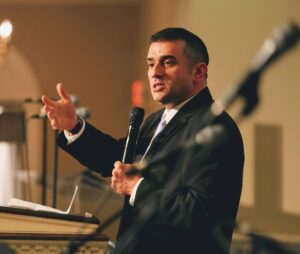
Mapping our Love
Jun 22, 2022 By Brent Chaim Spodek | Commentary | Shelah Lekha
Moses had no idea what he was getting into.
It wasn’t just when he was talking to shrubbery and confronting tyrants at the beginning of his journey that he was in the dark about what his future held. Even deep into his leadership, even after he had weathered rebellion and despair, even after he had personal encounters with the Divine, he had no idea what was coming next.
Read More
How Should One Shine One’s Light?
Jun 17, 2022 By Luciana Pajecki Lederman | Commentary | Beha'alotekha
In the past few years, technology and social media specialists, neuroscientists, psychologists, and philosophers have been discussing the ubiquity of distraction in our modern lives. As Joshua Rothman puts it, “like typing, Googling, and driving, distraction is now a universal competency. We’re all experts” (The New Yorker, June 16, 2015). These specialists have been warning us about the personal perils of distraction to our learning, professional performance, financial stability, creativity, mental health, social skills and civic engagement, and even to our physical lives. And as should be expected, some suggest strategies to “reclaim attention” in this age of distraction.
Read More