Striving for Shlemut: An Emerging Approach to Jewish Education

Dr. Bill Robinson

My friend and teacher Dr. Jonathan Woocher (z”l) left us with a challenge:

Twentieth-century Jewish education was designed to answer the question, “How can we ensure that individuals remain ‘good’ Jews, even as they become good (and successful) Americans?” Jewish education must respond to a subtly, but significantly, different question: “How can we help Jews draw on and use their Jewishness to live more meaningfulfulfillingand responsible lives?

For the last three decades, education has focused on the goal of ensuring that Jews, Jewish institutions, and Jewish practices survive in the open marketplace of America. As American Jews, it is time we move beyond surviving to thriving. The question before us today is: what does Jewish education for “thriving”¾leading meaningful, fulfilling, and responsible lives¾look like?

To craft a preliminary answer to Jon’s question, the Fellowship in Educating for Applied Jewish Wisdom, made possible by the support of Lippman Kanfer Foundation for Living Torah and the William Davidson Foundation, was born. It brought together a group of scholars and innovative Jewish educators who were already doing what Jon asked of us. Through reflecting on their educational practices, they crafted a set of six guiding principles toward educating for thriving, or as they preferred to call it, educating for shlemut (wholeness).

Others have taken on Jon’s challenge and we have shared their thinking in multiple issues of Gleanings. One of the more popular approaches looks to Dr. Martin Seligman’s positive psychology to offer a vision of the life toward which we would educate, what the Greeks would have called the “good life,” or a “life of goodness.” Seligman sums up his view of the “good life” in his PERMA model in which the individual develops: Positive emotions (feeling good), Engagement (finding flow), Relationships (authentic connections), Meaning (purposeful existence), and Achievement (a sense of accomplishment).

While offering a perfectly nice vision to American sensibilities, I would suggest that PERMA has its limitations. Notably, it cares about the well-being of the individual without explicitly caring about the society and world in which that individual lives. In his framework, one should have a sense of purpose but need not speak to bringing forth justice or healing the world. Similarly, one needs to connect with others, but in this model, the other is treated as a means rather than as a whole person.

In contrast, Martin Buber did not just call for better relationships, he asked of us to treat the other as a valued end in herself, as a “thou” not an “it,” regardless of the use she may have to us. Martin Luther King Jr. proclaimed, “I have a dream that my four children will one day live in a nation where they will not be judged by the color of their skin but by the content of their character.” Abraham Joshua Heschel challenged us to be sensitized to the sublime wonder of the world around us and to hear the divine call that issues forth from it. When he walked with King in Selma, Alabama, it was a way of responding to that divine call. Heschel did not just feel “flow,” he “felt [his] feet were praying.” These are rudiments of the thriving life that will inspire the young and the old alike, visions taken together along with a care of the soul that could form the basis of a life of shlemut, which should drive Jewish education.

So, as Jewish educators grounded in social constructivist and experiential education and attuned to the complexities of social emotional learning, we would then ask: What are the dispositions, what the Greeks called “virtues” and Jews call “middot,” that people need to lead this envisioned life of thriving? What virtues do they need to cultivate in themselves in order to better love their neighbors as themselves, pursue justice, and co-create a better world, as well as care for their own well-being? For our larger purpose here, how can Jewish education do this?

The teaching of Jewish text in havruta can be a path toward deepening these middot in our students. Yet, this is not a one-way process of filling students’ heads with knowledge about these virtues. Text study involves a dialogical engagement with the text and other learners, in which the process, not just the content, is the locus of learning. As Elie Holzer and Orit Kent have shown, through havruta, the student learns to practice the virtues of “sensitivity, listening, wholeheartedness, open-mindedness, vulnerability, responsibility, and ethical commitment.” People also encounter one another face to face, nurturing relations of I-Thou, where the sacred becomes present. Once developed, these virtues then enable us to attune not just to the text and co-learners but the world around us. Attunement to that world is the first step toward responding to the call of the world and making it a better place.

Moreover, text study is not the only Jewish resource for cultivating the virtues. Through the practice of Shabbat, we can learn mindfulness. Through a commitment to the saying of blessings, we attune ourselves to the world around us and cultivate a sense of gratitude. Through developing a daily practice of tzedakah, we can become more responsive to the needs of those around us.

This is not new to Judaism. Rather, this new paradigm in Jewish education reaches back to older understandings of Judaism through contemporary lenses. Thus, Maimonides understood the value of the Jewish practice tzedakah as educational in the sense of building one’s character. For him the benefit of giving was not primarily toward the one who received but toward the giver, within whom a regular practice was needed to cultivate the virtue of generosity.

Unlike Maimonides, today we live in a world where we can take ownership of the Jewish practice of mitzvot and craft them to be more responsive to our individual capacities and the virtues we are seeking to develop in ourselves through our practice of them. Thus, the ways in which we choose to practice Shabbat with our families and in our communities are open to us. What’s most important is that we recraft Jewish practices in ways that renew their value and sustain our ongoing commitment to them and to each other as co-practitioners and co-learners. For many, this process begins in the various settings of Jewish education, formal and informal alike.

Underlying this new approach to Jewish education is the empowerment and responsibility of the self to become the author of one’s own Jewish-American life. We tend to think that identity precedes practice. Quite the contrary, we develop our identities by reflecting upon and narrating the life we are learning to lead. If Jews do not find themselves doing Jewish often with other Jews, there are no Jewish stories that can be the building blocks of their Jewish identity. By giving learners the freedom and guidance to play with Jewish practices in the pursuit of virtues relevant to their life today and by helping them in the course of their education to reflect upon experiences through the telling of their story, they will arrive at robust Jewish identities that are integrated with and of value to being virtuous Americans.

The above description of this new paradigm follows a six-point framework of “educating for shlemut” that emerged out of our aforementioned Fellowship in Educating for Applied Jewish Wisdom: cultivating dispositions, being in relation, co-creating the world, presencing the divine, practicing Jewish, and authoring the self.

The fellows and faculty of the fellowship to whom I am indebted include Erica Aren, Ilana Gleicher-Bloom, Sue Bojdak, Yonatan Brafman, Gretchen Marks Brandt, Rebecca Epstein-Levy, Lizzi Heydemann, Beth Huppin, Jeff Kress, Rebecca Lieberman, Debbie Miller, Alisha Pedowitz, Jane Shapiro, Michael Shire, and Adam Weisberg. The specific articulation offered above is my own; while the framework provides a set of guiding principles for all Jewish educators engaged in this new paradigm, it does so without constricting the creativity of individual educators.

I have written at greater length about this framework in a nine-part series on eJewish Philanthropy, and those pieces can be found here. I also suggest a seventh defining characteristic of this new educational paradigm is covenantal peoplehood. Covenantal peoplehood situates the educational enterprise within the continually unfolding story of the Jewish People and its ongoing covenantal project to bring forth redemption. A primary purpose of Jewish education is thus to inspire learners to participate creatively and committedly in this multigenerational project. To borrow from Clayton Christensen, we each have many “jobs to be done,” but the job of redeeming the world is eternally core to the Jewish mission and increasingly vital to our common future on Earth. I thus end with these questions to you, the reader:

As educators and as parents, do we want our children just to know what to do according to the prescribed traditions? Or do we want them to be creative participants in the Jewish project of co-creating a just and caring world and, in so doing, renewing our traditions? Do we want their compliance or commitment? Do we want their conformity or creativity, as the future of this world lies increasingly in the balance and our traditions do not yet have all the answers?

For me, the answer is clear; the challenge is making the journey together across a partially glimpsed landscape into an uncertain future.

Dr. Bill Robinson served as the Dean of the William Davidson Graduate School of Jewish Education of JTS.

Volume 6, Issue 2

Striving for Shlemut—Realizing Our New Paradigm for Jewish Education

Mark S. Young

In spring of last year, we published our Gleanings issue with articles advancing the emerging goal that Jewish education in the 21st century should help us thrive as human beings. Around the same time, we launched our Fellowship in the Educating for Applied Jewish Wisdom, gathering an exceptional cohort of experienced and creative Jewish educators and faculty to develop a new paradigm for Jewish education that would help us educate to this goal and subsequently develop innovative pedagogies and frameworks to bring this vision to life.

In January of this year, the Leadership Commons held our Striving for Shlemut (wholeness) conference. We brought 100 of our fellow Jewish educators together to learn from the participants in our fellowship who presented their new paradigm, a six-pointed, interconnected jewel that challenges us to consider the various elements of a Jewish education that ought to be present and active in order for our learners to reach shlemut.

This issue of Gleanings highlights the work and perspectives from those involved in our fellowship. Inside, you will find a description of the how and why of this approach from our dean, Dr. Bill Robinson, and our colleagues at Lippman Kanfer Foundation for Living Torah, our leading funder for this work, along with reflections from several members of our fellowship cohort on their fellowship experiences, the jewel, and how we can put this work into action.

As always, we seek your contributions to advance this conversation; it is, indeed, up to all of us who care deeply about strengthening our Jewish future to come together; share, challenge, and advance ideas; and be aligned in the desire to guide all we seek to impact through Jewish education toward their own individual and communal shlemut.

Shalom and to our collective success.

Mark S. Young served as the Managing Director, Leadership Commons at the William Davidson Graduate School of Jewish Education of The Jewish Theological Seminary.

Window into Israel: A Firsthand Look at JTS
Programming and Study in Israel

DECEMBER 16–19, 2019

How does JTS train future rabbis to lead on Israel today? How will they learn, as spiritual leaders, to nurture and strengthen their future communities’ ties to Israel? Join Rabbi Daniel Nevins, Pearl Resnick Dean of the Rabbinical School, Rabbi Matthew Berkowitz, Director of Israel Programs, and JTS second-year rabbinical students for an insider’s view of JTS in Israel.

Tour Highlights

  • Learn with students and acclaimed scholars at the Schocken Institute
  • Participate in a musical circle with vocal artists
  • Tour the Schocken Institute’s book collection, one of finest Judaic libraries in the world
  • Take part in a private viewing of the Israel Museum’s contemporary Israeli art collection
  • Attend a shiur at Machon Schechter with JTS and Schechter Rabbinical School students
  • Learn with luminaries and artists from Jerusalem; 2018 trip featured Yossi Klein Halevi and Netanel Goldberg
  • Experience the development of a spiritual renaissance in Jerusalem together with JTS students

To be a rabbi, one must be fluent in the language of our people and deepen one’s roots in Israel. This tour gives our lay leaders a window into the Israel experience that makes our rabbis better spiritual leaders and better interlocuters, who will strengthen the bridge between the North American diaspora and Israel. —Rabbi Matt Berkowitz, Director of Israel Programs

Trip Details

Hotel: Waldorf Astoria, Gershon Agron St., 26-28; Jerusalem

Cost (land only): $3,000 single occupancy $4,500 double occupancy

WHAT’S INCLUDED

  • Meals: Full breakfasts at the hotel; restaurant meals on the itinerary, as indicated
  • Transportation: Private shuttle during tour
  • Tours: Site admissions fees

Questions?

For further information and itinerary details, contact Joan Goodman, director of Lay Leadership: jogoodman@jtsa.edu; (212) 678-8861

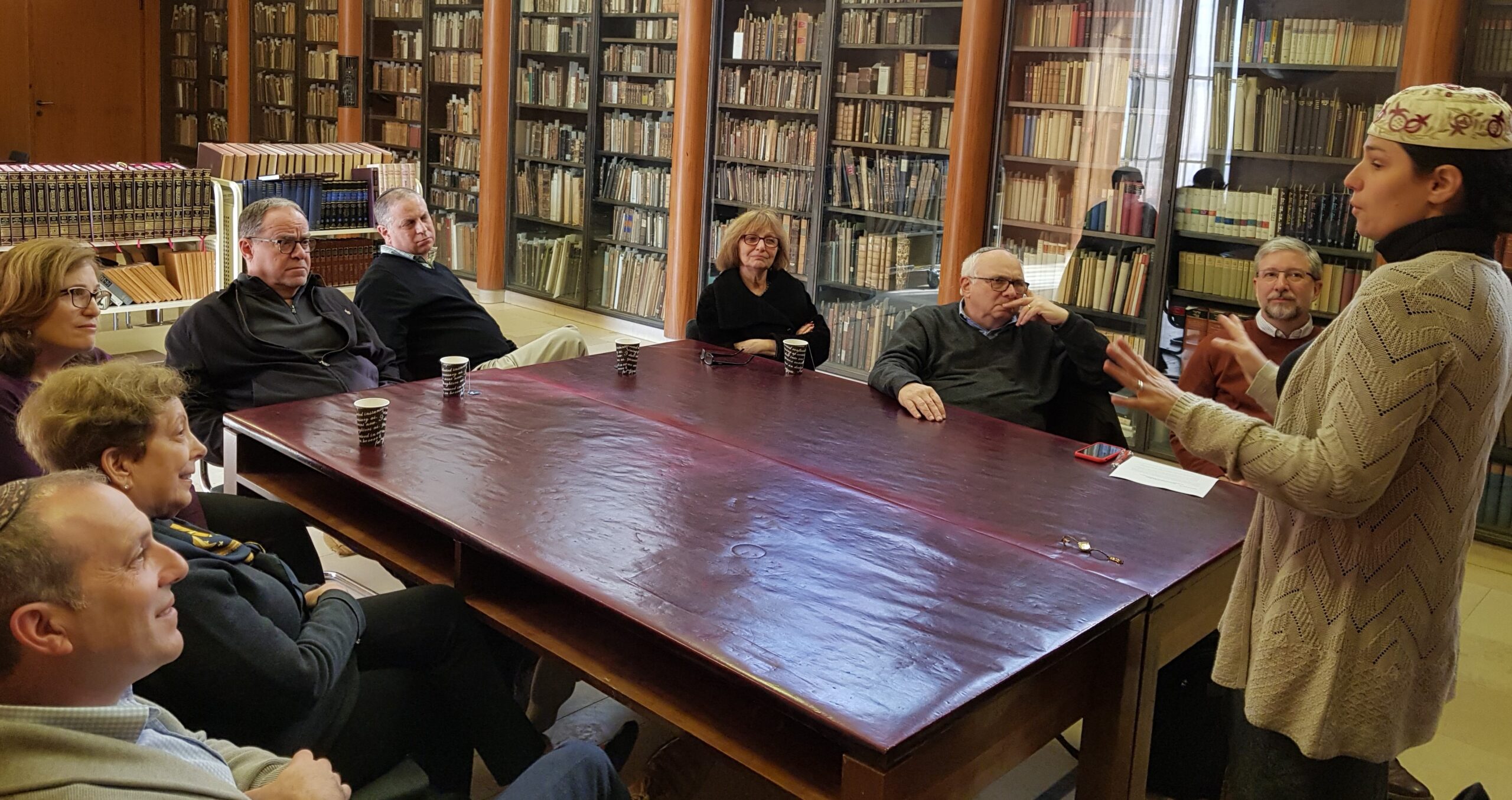
Leaders at the forefront of a pluralistic Jewish renaissance in Israel are role models for students. Here our participants learn from Rabbi Chaya Rowen Baker from Kehilat Ramot Zion.

JTS Alumni Donors 2018

Each year, JTS alumni around the world make generous contributions to support the next generation’s students. We extend our heartfelt gratitude for these gifts. Thank you, and we hope you’ll consider supporting JTS again as you plan your future giving.

List College

Shanna Ackerman Hocking
Rachel Ain
Vadim Avshalumov
Adam Baldachin
Audrey Beerman
Sarah Belz
Hezi Ben Sasson
Sarah Berman
Dahlia Bernstein
Erin Beser
Shachar Binyamin
Naomi Bloom-Wurtman
Eliav Bock
Deborah Bromberg Seltzer
Benjamin Brown
Jacob Caplain
Suzanne Chipkin
Daniel Cohen
Maxwell Cohen
Michael Cohen
Simeon Cohen
Robbie Cohen-Millstein
Menachem Creditor
Yonina Creditor
Cory Doliner
Daniel Dorsch
Joshua Dorsch
Morgan Dorsch
Benjamin Ehrlich
Nicole Farchi-Segal
Ariel Fein
Jeremy Fine
Jessica Fisher
Aaron Friedman
Jason Fruithandler
Rachel Fuld Cohen
Ilana Garber
Ricky Gratz
Ross Haimowitz

Abigail Halpern
Eytan Hammerman
Rebecca Hammerman
Yael Hammerman
Meredith Harris
Jake Hershman
Jodi Hirsch-Rein
Jaime Horowitz
Alison Joseph
Joshua Joseph
David Kalender
Cara Kantrowitz
Tracy Kaplowitz
Eliana Katz Seltzer
Eytan Kenter
Samuel Kerbel
Daniel Kestin
Orly Klein
Hillel Konigsburg
Meryl Kramer-Brown
Dana Kresel
William Krieger
Michelle Kwitkin
Elie Lehmann
Chavie Lescher
Bara Levitt
David Levy
Noah Liben
Theodore Lichtenfeld
Joshua Lieberman
Lisa Mamaysky
Anya Manning
Paul Margulies
Joshua Mohrer
Yoni Nadiv
Iris Paltin
Ari Paul
Leah Penkava
Michal Raucher

Richard Reaven
Mira Resnick
Pauline Rose
Ariella Rosen
Michelle Rosen Sapir
Leora Rosenblum Holzer
Robin Rubenstein
Jeremy Ruberg
Stephanie Ruskay
Ariel Russo
Matthew Russo
Ari Saks
Rachel Saks
Ilana Sandberg
Evan Schaffer
David Schnitzer
Jessica Schwab
Yoni Schwab
Andrea Schwartz
Rami Schwartzer
Jocelyn Seidenfeld
Ellie Sheinwald
Erez Sherman
Abby Shuster
Tyler Silver
Rebecca Singer
Kenny Sperber
Tova Sperber
Marissa Sterling
Alissa Talamo
Danielle Truglio
Rebecca Tuchman
Benjamin Waldman
Daniel Walker
Shira Wallach
Michael Wolk
Elie Wurtman
Missy Zedeck

The Rabbinical School

Ari Abelman
Rachel Ain
Daniel Alder
Joel Alter
Julia Andelman
Noah Arnow
David Arzt
Raphael Arzt
Stanley Asekoff
Toba August
Adam Baldachin
Sharon Barr Skolnik
Emily Barton
Marvin Bash
Lia Bass
Joshua Ben-Gideon
Rebecca Ben-Gideon
Fred Benjamin
Kenneth Berger
Leonard Berkowitz
Mitch Berkowitz
Alvin Berkun
Timothy Bernard
Dahlia Bernstein
Cecelia Beyer
Mark Bisman
Leonardo Bitran
David Blumenfeld
Jacob Blumenthal
Samuel Blustin
Eliav Bock
Alexander Braver
Akiva Brilliant
Joseph Brodie
Sharon Brous
Michael Brown
Aaron Brusso
Howard Buechler
Gadi Capela
Nina Cardin
Marge Cella
Benjamin Chaidell
Gary Charlestein
Marim Charry
Joel Chernikoff
Geoffrey Claussen
Alan Cohen
Burton Cohen
Martin Cohen
Michael Cohen
Mitch Cohen
Simeon Cohen
Moshe Corson
Elliot Cosgrove
Donald Crain
Menachem Creditor
Yonina Creditor
Melissa Crespy
Michelle Dardashti
Alexander Davis
Mark Diamond
Henry Dicker
Bruce Dickstein
Stephanie Dickstein
Charles Dobrusin
Elliot Dorff
Daniel Dorsch
Joshua Dorsch
Gilah Dror
Aderet Drucker
Moshe Edelman
Bernard Eisenman
David Eligberg
Joshua Elkin
David Englander
Estate of Rabbi Saul Leeman
Gideon Estes
Murray Ezring
Edwin Farber
Michael Fel
Edward Feld
Aviva Fellman
Azriel Fellner
Jeremy Fine
Jeremy Fineberg
Jessica Fisher
Lyle Fishman
Herbert Freed
Alex Freedman
Gordon Freeman
David Freidenreich
Jeni Friedman
Jason Fruithandler
Baruch Frydman-Kohl
Ilana Garber
Stephen Garfinkel
Bernard Gerson
Philip Gibbs
Henry Glazer
Michael Gold
Ben Goldberg
Nechama Goldberg
Megan GoldMarche
Nason Goldstein
Arnold Goodman
Felipe Goodman
Marvin Goodman
Sarah Graff
Michael Greenbaum
Katie Greenberg
Ariel Greenberg Platt
Gary Greene
Reuven Greenvald
Mayer Gruber
Nicole Guzik
Harold Hayyim Halpern
Eytan Hammerman

Richard Hammerman
Yael Hammerman
Robert Harris
Abraham Havivi
Eliezer Havivi
Lindsey Healey-Pollack
Corey Helfand
Joshua Heller
Lauren Henderson
Lester Hering
Ben Herman
Amiel Hersh
Howard Hoffman
Avraham Holtz
William Horn
Joseph Hurwitz
Jonathan Infeld
Rachel Isaacs
Ronald Isaacs
Ari Isenberg-Grzeda
Alan Iser
David Kalender
Sylvan Kamens
Elana Kanter
Shamai Kanter
Louis Kaplan
Tracy Kaplowitz
Michael Katz
Lilly Kaufman
Alvan Kaunfer
Allan Kensky
Eytan Kenter
Paul Kerbel
Stanley Kessler
Sheldon Kirsch
David-Seth Kirshner
Shelley Kniaz
Lori Koffman
Daniella Kolodny
Ashira Konigsburg
Hillel Konigsburg
Randall Konigsburg
Jay Kornsgold
Charles Kraus
Harold Kravitz
Jonathan Kremer
Sarah Krinsky
Aaron Krupnick
Neil Kurshan
Vernon Kurtz
Harold Kushner
Jay Lapidus
Robert Layman
William Lebeau
Melanie Levav
Judd Levingston
Carol Levithan
David Levy
Sheldon Lewis
Adina Lewittes
Dan Liben
Micah Liben
Miriam Lichtenfeld
Theodore Lichtenfeld
Miriam Liebman
Steven Lindemann
Jonathan Lubliner
Alan Lucas
Ari Lucas
Aaron Mackler
Mitchel Malkus
Mark Mallach
Howard Mandell
Noam Marans
Robert Marcus
Richard Margolis
Frederic Margulies
Barry Marks
Myrna Matsa
Jonathan Medows
Aryeh Meir
Joel Meyers
Michael Meyerstein
Clifford Miller
Jason Miller
Raphael Miller
Victor Mirelman
Susan Mitrani-Knapp
Jack Moline
Loren Monosov
Steven Morgen
Lionel Moses
Yoni Nadiv
Rhonda Nebel
David Nelson
Daniel Nevins
Debra Newman Kamin
Max Nissen
Daniel Novick
George Nudell
Aaron Nussbaum
Raphael Ostrovsky
Sara Paasche-Orlow
Elliot Pachter
Lee Paskind
Micah Peltz
Carl Perkins
Richard Plavin
Philip Pohl
Irit Printz
Joseph Prouser
Joshua Rabin
Michael Ragozin
Rafi Rank
Evan Ravski
Joyce Raynor
Esther Reed

Steven Rein
Efrem Reis
Avram Reisner
David Resnick
Mira Rivera
Adam Roffman
Yaacov Rone
Carnie Rose
Paula Rose
Ariella Rosen
Shira Rosenblum
Gil Rosenthal
Leonard Rosenthal
Amy Roth
Joel Roth
Moshe Rothblum
Rachel Rubenstein
Richard Rubenstein
Steven Rubenstein
Jeremy Ruberg
Robert Rubin
Arthur Rulnick
Stephanie Ruskay
Ariel Russo
Marc Sack
J.B. Sacks
Mickey Safra
Ari Saks
David Saltzman
Alex Salzberg
Moshe Samber
Alvin Sandberg
Neil Sandler
John Schechter
Craig Scheff
Jennifer Schlosberg
Paul Schneider
Jonathan Schnitzer
Ismar Schorsch
Joel Schwab
Michael Schwab
Charles Schwartz
Marcus Schwartz
Moshe Schwartz
Steven Schwartz
Rami Schwartzer
David Seed
Lester Segal
Ethan Seidel
Bruce Seltzer
Joel Seltzer
Larry Serbert
Joel Shaiman
Norton Shargel
Leonard Sharzer
Erez Sherman
Howard Shub
Marion Shulevitz
Ariana Siegel
Steven Silberman
Zachary Silver
Alan Silverstein
Harry Silverstein
Joe Simckes
Mia Simring
Michael Singer
Zachary Sitkin
Gerry Skolnik
Hillel Skolnik
Jonathan Slater
Robert Slosberg
David Soloff
Henry Sosland
Elliott Spar
Brent Spodek
Mychal Springer
Murray Stadtmauer
David Starr
Pete Stein
David Steinhardt
Ari Sunshine
Paul Teicher
H. Teitelbaum
Albert Thaler
Jon-Jay Tilsen
Mervin Tomsky
Lawrence Troster
Annie Tucker
Jan Uhrbach
Danielle Upbin
Stanley Urbas
Burton Visotzky
Shira Wallach
Michael Wasserman
Jonathan Waxman
Debi Wechsler
David Weiner
Aaron Weininger
Philip Weintraub
Samuel Weintraub
Etan Weiss
David Weizman
Marilyn Werman
Bryan Wexler
Aryeh Wineman
Edmund Winter
Ethan Witkovsky
Jeffrey Wohlberg
Michael Wolk
Eric Yanoff
Herbert Yoskowitz
Adam Zagoria-Moffet
Joel Zaiman
Gerald Zelizer
Rachel Zerin
Sidney Zimelman

The William Davidson School

Rachel Ain
Joel Alter
Ofra Backenroth
Dahlia Bernstein
Eliav Bock
Scott Bolton
Benjamin Chaidell
Michael Cohen
Simeon Cohen
Emily Cook
Menachem Creditor
Yonina Creditor
Michelle Dardashti
Alexander Davis
Cynthia Dolgin
Amy Dorsch
Daniel Dorsch
Joshua Dorsch
David Englander
Jeremy Fine
Alex Freedman
Aaron Friedman
Jason Fruithandler
Jessica Fruithandler
Ilana Garber
Izzy Gordan
Katie Greenberg

Gary Greene
Joseph Griminger
Yael Hammerman
Anna Hartman
Noah Hartman
Wendy Heller
Ben Herman
Amiel Hersh
Tracy Kaplowitz
Eliana Katz Seltzer
Eytan Kenter
Jane Kessler
Sharon Knafo
Hillel Konigsburg
Michelle Konigsburg
Sarah Levine
Judd Levingston
Micah Liben
Mitchel Malkus
Debra Massey
Deborah Miller
Jason Miller
Yoni Nadiv
Max Nissen
Daniel Novick
Marla Olsberg
Micah Peltz

Joshua Rabin
Evan Ravski
Efrem Reis
Amy Ripps
Jen Rolnick
Shira Rosenblum
Rachel Rubenstein
Jeremy Ruberg
Stephanie Ruskay
Ariel Russo
Sharon Safra
Ari Saks
Barbara Saunders-Adams
Jennifer Schlosberg
Ivy Schreiber
Michael Schwab
Charles Schwartz
Moshe Schwartz
Terri Soifer
Aaron Starr
Annie Tucker
Rachel Wachtel
Judith Weiner
Etan Weiss
Joel Weissglass
Bryan Wexler
Eric Yanoff

The Gershon Kekst Graduate School

Ari Abelman
Ellen Abramson
Lauren Albert
Adam Baldachin
Emily Barton
Vanessa Bennett
Kenneth Berger
Mitch Berkowitz
Timothy Bernard
Ruth Bloomfield Margolin
Scott Bolton
Alexander Braver
Joseph Bravo
Deborah Bromberg Seltzer
Naomi Brunnlehrman
Aaron Brusso
Ellen Cahn
Nina Cardin
Geoffrey Claussen
Martin Cohen
Debbie Cosgrove
Judy Craig
Linda Daitz
Eliezer Diamond
Esther Dick
Stephanie Dickstein
Alisa Doctoroff
Cynthia Dolgin
Joshua Dorsch
Brett Drucker
Debra Edelman
Michael Fel
Beth Finger
Alex Freedman
Joan Freeman
Jeni Friedman
Baruch Frydman-Kohl
Debbie Geller
Philip Gibbs
Henry Glazer
Ben Goldberg
Megan GoldMarche
Galya Greenberg

Ariel Greenberg Platt
Hana Gruenberg
Nellie Harris
Robert Harris
Judith Hauptman
Lindsey Healey-Pollack
Corey Helfand
Lauren Henderson
Alan Iser
Benjamin Kamine
Karen Kaplan
Lawrence Katz
Eliana Katz Seltzer
Jan Kaufman
Allan Kensky
Melissa Kerbel
Dori Kirshner
Shelley Kniaz
Lori Koffman
Ashira Konigsburg
Jen Kraft
Jonathan Kremer
Sarah Krinsky
Helene Krupnick
Alisa Kurshan
Bryna Kurtz
Melanie Levav
Judd Levingston
David Levy
Miriam Liebman
Adele Lobel
Jonathan Lopatin
Ari Lucas
Mitchel Malkus
Guy Massie
Francine Mendelowitz
Rachel Mikva-Rosenberg
Deborah Miller
Yoni Nadiv
Nina Nesher
Debra Pearlstein
Carl Perkins

Leon Perlman
Irit Printz
Ora Prouser
Esther Reed
Steven Rein
Avram Reisner
Adam Roffman
Paula Rose
Ariella Rosen
Jen Rosenberg
Zahava Rosenfeld
Gil Rosenthal
Amy Roth
Mickey Safra
Susan Sandler
Ilene Scholnick Ausubel
Andrea Schwartz
Aviva Schwartz
Marcus Schwartz
Shuly Schwartz
Rami Schwartzer
Lori Seed
Joel Shaiman
Judith Shapero
Baila Shargel
Robyn Shoulson
Howard Shub
Marion Shulevitz
Stefanie Siegmund
Zachary Silver
Alan Silverstein
Zachary Sitkin
Diana Sklar
Henry Sosland
Brent Spodek
Pete Stein
Jon-Jay Tilsen
Burton Visotzky
Bracha Werber
Ethan Witkovsky
Adam Zagoria-Moffet
Rachel Zerin

H. L. Miller Cantorial School

Matthew Austerklein
Rebecca Carl
Kathryn Claussen
Jen Cohen
Farid Dardashti
Elisheva Dienstfrey
Arthur Giglio
Izzy Gordan

Jesse Holzer
Lilly Kaufman
Mark Kula
Sarah Levine
David Lipp
Riki Lippitz
Alberto Mizrahi
Bat-Ami Moses

Misha Pisman
Elliot Portner
Sidney Rabinowitz
Jen Rolnick
Linda Shivers
David Tilman
Eliot Vogel

Center for Pastoral Education

Efrem Reis
Molly O’Neil Frank
Simeon Cohen
Alexander Braver
Sally Shore-Wittenberg
Ari Abelman
Aaron Weininger
Lori Koffman
Philip Gibbs
Ariel Greenberg Platt
John Bethell
Jessica Fisher
Mira Rivera
Samuel Blustin
Mark Borovitz
John Shellito

Alex Salzberg
Dahlia Bernstein
Rami Schwartzer
Ariel Russo
Sally Kaplan
Katie Greenberg
Adam Baldachin
Matthew Austerklein
Melanie Levav
Dean Weber
Lindsey Healey-Pollack
Richard Gorman
Ariana Siegel
Ethan Witkovsky
Neal Loevinger

Joshua Rabin
Corey Helfand
Zachary Sitkin
Jennifer Schlosberg
Izzy Gordan
Megan GoldMarche
Jeremy Fineberg
Jen Rolnick
Philip Weintraub
Hillel Konigsburg
Ian Silverman
Lauren Henderson
Scott Bolton
Amy Roth
Amy Bolton

Teachers Institute and Seminary College

Nancy Abramson
Raphael Arzt
Toby Berger Holtz
Carol Berkowitz
Fredda Bisman
Elizabeth Bloch-Smith
Joseph Brodie
Steven Brown
Nina Cardin
Paula Charry
Joel Chernikoff
Jeanette Chiel
Alan Cohen
Esther Dick
Stephanie Dickstein
Deborah Dobrusin
Marlynn Dorff
Risa Doris
Harriet Doronne
Nathan Drenger
David Eligberg
Edwin Farber
Judith Fellner
Donna Fishman
Herbert Freed
Bella Goldstine
Rosalyn Gooen Milians
Gary Greene
Jules Gutin

Richard Hammerman
Robert Harris
Judith Hauptman
Eliezer Havivi
Lester Hering
Howard Hoffman
Carol Ingall
Ronald Isaacs
Harold Kasimow
Herbert Kelman
Paul Kerbel
Elise Kintzer
Samuel Klagsbrun
Shoshana Joy Knapp
Murray Kohn
Jay Kornsgold
Risa Krohn
Aaron Krupnick
Helene Krupnick
Mark Kula
Alisa Kurshan
Harold Kushner
Jonathan Levin
Susanna Levin
Robert Manstein
Richard Margolis
Miriam Mayer
Sandy Meyers
Michael Meyerstein

Jeannette Miller
Raphael Miller
Judith Neufeld
Celia Platek
Philip Pohl
Joseph Prouser
Ora Prouser
Ellen Rank
Rafi Rank
Chaim Reich
Avram Reisner
Selma Roffman
Marvin Rosen
Sandra Rosen
Menorah Rotenberg
Arthur Rulnick
Moshe Samber
Hadassah Schultz
Jonathan Schwartz
Rhea Schwartzberg
David Seed
Baila Shargel
Dina Shtull
David Sidorsky
Chana Simckes
Robert Slosberg
Esther Stern-Bloom
Karen Vogel
Len Wasserman

Reimagining Expertise: Curiosity, Shared Purpose, and Who We Invite into the Room

DR. SHIRA D. EPSTEIN, EDD, and DR. ANDREA JACOBS, PHD

We have all experienced the typical gathering of Jewish educational leaders and funders many times over: Launching the day with a keynote speaker, notepad and pen provided, followed by creation, in small groups, of bullet points on large Post-its smacked askew to the walls. Sneaking out during a breakout session to chat with an old friend, as it is the only opportunity for connection. We furtively return emails during a frontal presentation, as we cannot relate to the advice the panelist is sharing; it feels too distant from our own experiences. A wrap-up with a moderated panel at the end of the day where new ideas are offered. The conversations are often rich and textured. Yet, once we leave, the dialogue is complete and our notes are relegated to the bottom of a pile in our offices. We are so used to this model that it is often looked to as the gold standard. What happens when we design a convening, or gathering, through the lens of “relational leadership” and a stance of “emergent strategy” rather than expert solutions?

When the Leadership Commons launched its Gender Equity and Leadership in Jewish Education Initiative this past year, we wanted to imagine a different way of designing convenings that could be replicated both within our programming and offered as a model within Jewish educational leadership. We set the intention of bringing people together to both consider alternative models of leadership that might be implemented and to hear from institutions that support adaptive, systemic change. Through our work with Didi Goldenhar, co-author of Leveling the Playing Field, and Dr. Elana Stein Hain, scholar in residence and director of faculty at the Shalom Hartman Institute of North America, we reflected upon our assumptions of why we bring people together, starting with re-visioning: “Who is an expert?” “What is expertise?” Didi and Elana supported us in starting from a place of curiosity, designing a series of convenings where we would begin with asking questions, rather than launching from a modeling of solutions.

We recognized early on that our project was not simply about equalizing the numbers of men and women in leadership. Informed by feminist principles, we would need to question the models of sharing our expertise that had become the norm, as well as make transparent the choices that we made in pushing against these norms. Our choices in crafting the convenings were informed by Emergent Strategy by Adrienne Marie Brown, who espouses a “relational model” of leadership: “We would organize with the perspective that there is wisdom and experience and amazing story in the communities we love, and instead of starting up new ideas/organizations all the time, we would want to listen, support, collaborate, merge, and grow through fusion, not competition” (Brown, p. 10). We approached this year and our mandate to develop convenings from the perspective of what it looks like to gather and share expertise in a different way. Thus, we informed our design by who was invited into conversation, as well as how we can support those in the room to interact and guide them to be present.

We asked ourselves: What do our convenings look like when we start from a place of cultivating curiosity about change, rather than the assumption that we are gathered together to learn solutions from a small group of experts? What if we adopted the stance that we all bring expertise to the conversation and our job is to find those people who can push our thinking deeper? With this approach, strategies for change emerge from the group in the context of relationships—asking questions, sharing learning, and adopting an experimental mindset. All participants, through dialogue and experimentation, are able to identify interventions and strategies that are most relevant to their context. Those in attendance feel a deeper sense of ownership to the emerging ideas. Thus, they will be motivated to continue to explore and implement, with a greater chance of larger-scale success taking root.

We also drew upon this “relational model” in recognizing that there were others in our networks who had created similar programs with the goals of generating new ideas and questions. We reached out to them and asked them to share how they engaged in their own processes. What questions did they ask? What worked? What didn’t?

We started the day by asking participants to engage in thinking together. The convenings this spring in NYC and Chicago took participants through a process of examining:

  • Via Women and Power: What are our assumptions about what constitutes Jewish leadership? What models do we favor and employ?
  • Via a panel of offering alternative models of text teaching, imagining leadership, and using a gender lens in schooling: How can we ask the “What if?” questions and arrive at this from a place of curiosity?
  • Via small break-out sessions: How can we question ourselves around what we could try out and employ? What could we accomplish if we had more support to try, fail, and learn? What risks to create change might we take?

This approach to convenings melds with “design thinking,” considering how a day is structured in order to enable generative conversation, where the challenges we face are not solved through any one solution, but rather by asking new and different questions, trying different strategies, learning, and adapting. The preparation for these conversations launched from the moment we reached out to potential presenters. We invited those who have been engaged in trying out new ideas and models of leadership to share; we let them know that the emphasis was on what they learned in their efforts rather than presenting a polished result.

To guide our panelists, we asked them to present based upon the following questions:

  • What was the challenge that sparked an exploration to try something new in your setting? What was the catalyst for change?
  • What have you tried?
  • What could you try?
  • What have you learned and how does that lead to your next step?

The convenings are a model of how one fosters an inquisitive stance and engages within these day-long gatherings as a learning community. The goal is to apply lessons from success and failure to generate new ideas relevant to our own contexts and to recognize the shared challenge of creating change. We are each part of larger emergent wholes that can work together and support each other in making respective successes a reality under a unifying, shared purpose. We aim to shift from a solution-driven model to focus on the day itself as an opportunity for movement building and networks of support that are infused with shared curiosity, a sense of purpose, and a real opportunity to instigate large-scale change.


Dr. Shira D. Epstein, EdD, is assistant professor of Jewish Education in The William Davidson School, serving as area coordinator in Jewish Education, as well as coordinator of the concentration in Pedagogy and Teaching. Shira has authored curricula for JWI and MyFace, focused on healthy relationship building and choosing kindness. She served as founding director of the Evaded Issues in Jewish Education project and co-created Educational Jewish Momentsa methodology for addressing gender issues in schools. She is currently writing a book on using drama as pedagogy for engaging learners in “power talk.”

Dr. Andrea Jacobs, PhD, is the project director of the Gender Equity and Leadership in Jewish Education Initiative for the Leadership Commons at The William Davidson School. Andrea is also cofounder and partner at Rally Point for Collaborative Change, a consulting practice that focuses on working across differences to facilitate transformative change. As an educator, researcher, and organizational consultant, she focuses on developing resources and training programs to address gender equity, LGBTQ inclusion, and racial justice for a wide range of educational and communal organizations.  

Lech L’cha: Role-Modeling Self-Care and a Community of Trust as an Approach to Scaling Success

BETH GARFINKLE HANCOCK and MARK S. YOUNG

“The LORD said to Abram, ‘Go forth from your native land and from your father’s house to the land that I will show you. I will make of you a great nation, and I will bless you; I will make your name great, and you shall be a blessing.’”

—Genesis 12:1–2

At the Leadership Commons, we design each of our leadership institutes to adapt to particular target audiences. Yet, whether we are training aspiring heads of day schools or newly minted directors of Jewish early childhood education centers, all of our institutes share several core principles. Perhaps the most critical of these is the building of community and the cultivation of self-care through intensive cohort retreat experiences.

Each institute participant, often referred to as a fellow, completes our programs with a cohort of peers. We whisk away cohorts from their “native lands” (i.e. their organizations) to new places physically, intellectually, and spiritually, filling their mental reservoirs with new people, ideas, and skills. Each enters as an Abram, engaging in a journey to become an Abraham, feeling renewed and energized to excel in their work and to be a blessing to others upon their return.

We take great care at our intensives to develop a community of trust and promote high-level self-care, creating the foundation that we feel success rests upon. We foster the scaling of success by nurturing the role modeling that takes place among fellows. We will discuss role modeling in detail a bit later. Let us first examine the importance of this foundation.

Build A Community of Trust

At our retreats, fellows are encouraged to explore ideas freely and openly. Fellows enter our programs with accomplishments and specific successes and we provide forums to share and invite peers to explore how they can adapt each other’s successes in their own shop. In addition, fellows receive timely, judgment-free feedback that nurtures a culture of healthy experimentation and failing forward.  This all builds communal trust.

In addition, the first retreat in all of our institutes, which typically span 1-2 years and multiple retreats, not only focus on building a strong community of peers, they also set the stage for how one practices self-care to become a sustainable high performer.

The two of us partner with excellent collaborators at the JCC Association to direct one of our newest institutes, the JCC Leadership Training Institute (JCCLTI), preparing talented and accomplished mid-level JCC professionals who work throughout the continent to assume the high-responsibility and often stress-inducing executive roles at JCCs. JCC executives are trusted to ensure their center meets its broad mission, nurtures innovation, maintains financial health, and provides an overall high-quality experience for users and staff. It’s a tall order. Thus, our starting point is to invest in practices to nurture their physical, psychological, and spiritual health.

Invest in Self-Care

At our first program retreat, we partnered with TIGNUM (“beam” in Latin), the firm that selected JCCLTI as their non-profit partner program for 2018. TIGNUM’s philosophy is that while every organization, and indeed every person, may have a slightly different structure, we all need a strong foundation of support, or beam, that will allow us to function at a sustainable high-performance–level of work.

TIGNUM focuses on four areas: mindset, movement, nutrition, and recovery, outlined in Jogi Rippel’s and Scott Peltin’s book, Sink, Float, or Swim. Chiefly, we practice and promote during our retreats a positive mindset. A positive mindset is a healthy way of thinking that gives us the best chance to produce successful results. It is also a thinking process that is in direct alignment with realizing success. We also learn together a ritual of movements to perform throughout the day, as well as healthy nutrition, and schedule time for recovery. In particular, we stress movement. We teach easy self-massage techniques to do at one’s desk, going on a midday walk, or taking the stairs instead of the elevator. We cannot begin to scale up ideas unless we have the stability, energy, and focus for the hard work it takes. Therefore, increasing our metabolism, raising our heart rate, and improving strength helps us get there. We also model the essentials of the other TIGNUM areas at our retreats, including providing healthy food and drink and building recovery time into our schedule (more on recovery below). In doing so, we are modeling that leaders of Jewish organizations can be high-energy, intentional, enthusiastic people primed for effective leadership. We then encourage and provide tools for fellows to continue and embrace these practices after they return home.

Strengthen Ourselves Together: Role Modeling

This translation of the V’ahavta prayer commands us: “You shall love the Lord your God with all your mind with all your strength and all your being . . . teach them faithfully.”

At our retreats, fellows learn from our facilitators, yet the most important learning is when they share their own ideas and challenges with each other. By sharing with their like-minded peers to whom they relate and are beginning to trust, they inspire one another. For example, our cohort craved ideas on how to improve the effectiveness of their time, part of working in a positive mindset. We learned strategies to set our daily tasks, lead meetings with intentionality, and eliminate time wasters and traps. As the cohort modeled these ideas and shared their own with each other, they gave each other energy toward a healthy and productive use of time. Their sharing and role-modeling to each other feeds the notion that we can all achieve our goals with a positive mindset. We then encourage fellows to model the mindset concepts to staff and lay leadership at their JCC, spreading the ideas so they go viral.

With role modeling, fellows also give each other a permission to create change. As Maimonides states in his Eight Levels of Tzedakah, “The greatest level, above which there is no greater, is to support a fellow Jew by endowing them with a gift or loan, or entering into a partnership with them, or finding employment for them, in order to strengthen their hand so that they will not need to be dependent upon others.”

It can be challenging for organizations to implement new initiatives or scale up success; as it is easy to remain stuck in their habits. Yet, in JCCLTI, we thrive on pursuing change. We change our behaviors, whether it is in how we run meetings, how we engage in healthy communication strategies with others, or how we collaborate, to meet our performance goals with fellows cheering each other on. We give each other the permission to discover what we can do differently and better. Creating change in one’s personal practices too, being more intentional about what we eat, how much we sleep, and our movement during a workday, impacts our professional work in many areas. The “gift or loan,” in this case, is the development of partnership, creating relationships at the retreats with each other and our respective organizations that encourage and celebrate change.

Finally, role modeling in a community of trust creates accountability. Fellows hold each other accountable, for example, to take time to recover. We cannot sustain high performance if we do not power down regularly. We discussed at our retreat how to reexamine our Jewish professional schedules and behaviors. We recognize and validate the challenges in prioritizing all that we must accomplish in a workweek. Many JCCLTI fellows are also “on” during Shabbat and Jewish holidays. Though Shabbat and many of these holidays are built-in Jewish time for recovery, between entertaining and preparing for all of the holiday events in our calendar, it still feels like work. Thus, we role model recovery at our retreats, scheduling individual time to do what each fellow needs to recover and re-energize. Recovery is also important for learning, so we prioritize time for reflection. We schedule time to further develop relationships and share insights and best practices to break down the material presented, which helps our learning stick.

By role-modeling high level self-care and a community of trust that gives peers permission to change and creates accountability, our fellows are better positioned, encouraged, and skilled to adapt and scale up those programs or initiatives they may learn from their JCC peers or build up what is already working in their own shop. Our fellows can then role-model these new behaviors and ideas to their staff and users back in their “native lands,” (i.e. their JCC). Each fellow can model giving permission to change and hold colleagues accountable for the changes they aspire to make. Role-modeling self-care and a community of trust can extend sustainable high-performance behaviors further, which can nurture success in Jewish communities throughout the continent.

Role-modeling behaviors and ideas fellows learn on their journeys away, as well as the relationships they form, can help spread the energy and thoughts necessary to help the journey of the Jewish people, and people of all faiths who engage in our communities, to new successes and heights. This is a blessing to us all.


Beth Garfinkle Hancock (DS ’03) is the program manager of the JCC Leadership Training Institute, a partnership between the Leadership Commons at The William Davidson School and JCC Association.

Mark S. Young is the managing director of the Leadership Commons at The William Davidson School, and part of the faculty planning team of the JCC Leadership Training Institute.

The Mandel Teacher Educator Institute (MTEI): People Are Our Product

Dr. Gail Z. Dorph

The Mandel Teacher Educator Institute (MTEI) has fostered a unique approach to scaling up quality teaching and learning in Jewish education for over two decades by populating the field with a new kind of educational leader. MTEI has impacted both the principles and practices of the field through the learning and leadership of its 250-plus graduates who are in more than 60 communities in the United States, Israel, and Canada. We have learned from our graduates that these principles and practices not only enable them to do their current jobs differently, they also serve them in future roles they play as their careers develop. (See our website, mtei-learning.org, for further enumeration of these principles).

To place MTEI in historical perspective, in 1991, the North American Commission for Jewish Education published A Time to Act, the findings of a two-year study that made two suggestions related directly to the problem of improving Jewish education at scale. They were: 1) Focus on building financial and political will to champion Jewish education as a priority, and 2) Create a cadre of educational leaders able to transform the system at its core.

MTEI was the first educational leadership capacity project that was designed based on these recommendations. The MTEI leadership team designed the program to grow the kind of educational leaders who could leverage the system. When MTEI was launched in 1995, improving the quality of teaching was at the heart of national educational reform efforts. Researchers suggested that in order to make deep changes in the current educational system, the focus had to be on improving the quality of teaching. This meant helping teachers learn new ways of thinking and acting. Previously, instructional leadership had been defined in terms of defining the school mission, managing the instructional program, and promoting a positive school learning climate. Now the concept of instructional leadership was expanded to include a broader view of leadership focusing on establishing and promoting a school culture in which teaching and learning could flourish. (Holtz, B. W.  Dorph, G. Z. and Goldring, E. (2002). Educational Leaders as Teacher Educators: the Teacher Educator Institute—A Case from Jewish Education. Peabody Journal of Education. 72 [2] 147–166.)

At that time most teaching and learning in Jewish education focused on facts and skills and there was little emphasis on the “big ideas” of Judaism. Further, Jewish educational leaders lacked serious professional training and knew little about how to support teacher learning in the service of meaningful learning. There was no ongoing substantive professional development for Jewish educational leaders, especially related to instructional improvement, in particular. (Goldring, E. B., Gamoran, A., & Robinson, B. (1996). Educational leaders in Jewish schools. Private School Monitor 18:1, 6–13.)

The MTEI leadership team designed an intensive two-year program for educational leaders across denominations and settings that consists of six four-day seminars with assignments between gatherings. The MTEI curriculum intertwines best practices in teacher education and professional development with Jewish texts and big ideas. Our target recruit was, and still is, individuals already serving in educational leadership roles, for example, a head of school or key leader in a school setting; a head of an agency or educational consultant who works in a national or communal organization; or an educator who is developing a new initiative or institution.

The program rests on several beliefs about learning: people learn best when knowledge is presented in authentic contexts; long-lasting learning requires social interaction and collaboration; and learners need scaffolded opportunities to see and practice what they have learned. All of MTEI’s activities, including the seminar-based and home-based activities, are designed to situate learning within the real work of educational leaders and to build in opportunities for practice, feedback, critique, and partnership.

The program is designed to help participants develop ongoing, substantive, professional learning experiences for their teachers, and build a collaborative learning environment for them and their students. Our unique strategy for successfully scaling up instructional change results from preparing leaders who educate their teachers who, in turn, impact their students.

MTEI graduates work with diverse learners in a variety of settings in the Jewish world, always encouraging the same kind of active and meaningful learning modeled and practiced in our MTEI program. In this way, they gradually transform the very cultures of their institutions. That is both our theory of learning and the method by which the project works to achieve its scaling goals.

So, what is the MTEI’s theory of change as we work to change the field of Jewish education at scale? Our very first principle can be attributed to the vision of our philanthropist Morton Mandel, who from the very beginning said: “Invest in good people.” We have followed his guidance, recruiting strong leaders and providing them with a robust program based on best practices of learning and professional development. We have also created a vibrant network of graduates who share a vision of collaborative colleagueship and who benefit from a listserv, video-conference learning opportunities, an Edmodo online platform that allows for sharing resources and opportunities for unlimited storage and asynchronous learning, and periodic graduate seminars. All these allow graduates to connect both with one other and with MTEI faculty on an ongoing basis.

Evidence suggests that this theory of change is having our intended impact on the field of Jewish education across settings and environments.

Here are only three examples of how MTEI graduates are transforming the Jewish education landscape:

Graduate A designed one of the first afterschool programs for children between the ages of four and twelve that emphasizes, in particular, three of the MTEI principles: the centrality of Jewish content, the fact that how we talk with each other matters, and the importance of collaborative inquiry.

Graduate B created a Jewish educational consulting practice using the dialogic nature of havruta learning as the backbone of an initiative. The MTEI principle of the centrality of Jewish content in creating an intentional community was key to the design and enactment of this program, which helped educators integrate technology into their own practice.

Graduate C developed a community-wide mentoring program for principals and lead teachers based on the collaborative approach to educative mentoring espoused by the program.

As MTEI now educates its eighth national cohort and begins recruitment for the next cohort to begin in November 2019, this sustained 20-year program continues to develop educational leaders who are catalysts for change in the field of Jewish education.


Dr. Gail Z. Dorph is the founding director of the Mandel Teacher Educator Institute. Her research interests are teacher development and the relationship between Judaic content and pedagogy. Prior to her work with the Mandel Foundation, she directed the Fingerhut School of Education at AJU (formerly the University of Judaism).

Networks: Spreading Ideas Peer to Peer

DEBORAH FISHMAN

Being a classroom teacher can be an isolating experience. You may not know where to turn for new ideas and wish there was a way you could benefit from the experimentation and expertise of others in classrooms like yours across the country. Fortunately, in the past few years, Jewish day school educators have been able to find networks designed to incubate and spread ideas and practices. As a network-weaver working at the AVI CHAI Foundation, I have an interest in understanding and documenting these networks, which could range from organized programs, such as the JDS Collaborative, for which I serve as program officer at AVI CHAI, to a much less formal Twitter chat. Let’s look at what these networks are, which ones are more likely to scale through successfully spreading ideas, and why.

Ariella Falack, a teacher of Torah and halakhah at Magen David Yeshivah Celia Esses High School, was an early adopter of game- and project-based learning at her school. She was able to explore this interest through the JDS Collaborative, a program of Prizmah: the Center for Jewish Day Schools led by Educannon Consulting. JDS Collaborative puts together educators from multiple schools to implement a project in their own school’s context, with continual opportunities to collaborate, learn from implementation at other schools, engage in workshopping challenges, and share and document ideas and solutions in a continuous feedback loop. Each project is designed to further some aspect of schools’ Jewish missions. In this case, the focus was on applying game-based learning to the Judaics classroom. As her personal way of implementing the project in her school, Falack experimented with creating an escape room–style experience. She designed this game and executed it in her school, and then posted her game on the Basecamp site used by the collaborative and on JEDLab on Facebook, looking for feedback and suggestions from fellow educators. Falack also presented what she was doing and learning to participants at the 2017 Prizmah Conference, along with Alanna Kotler, project manager for the collaborative.

“In that room, the excitement for this was unbelievable. When it was actually done using Judaic material, the teachers saw the possibilities for their own classrooms,” said Kotler.

As a result of this presentation, five of the teachers got their schools on board to participate in a new collaborative project specifically built around the escape room methodology (“breakout”). The project included a five-part webinar series led by Falack that broke the methodology down into pieces. Then each participant designed his/her own escape room game for use in his or her own classroom.

“It wasn’t easy. It took some educators 20 hours to develop a breakout, but the cohort kept them accountable. They had Ariella to support them, and sharing the challenge of it was a motivator. The network and their fellow teachers kept them going. Now they have a relationship with Ariella and can continue the enthusiasm,” Kotler said. 

Ideas spread when networks of peer educators come together to share ideas. This methodology is powerful and most effective when three components are present: trust, a coordinating network-weaver, and documenting and sharing. 

First and most importantly, successful networks are built on trust. Teachers trust other teachers in what Kotler calls an “unspoken understanding: they’re more likely to take a risk themselves based on what other teachers doing.” This comes in part from the common language between them, including the challenges and expectations in place. A network can provide the safe space to which teachers can return to address challenges or to celebrate successes. 

Andrea Hernandez, associate director of Teaching and Learning at Prizmah, agreed that ideas spread more effectively among educators as opposed to in a top-down way. “There’s a huge difference between things that are marketed to me and things I hear from my fellow practitioners. I tend to be more interested in things that come my way from a fellow practitioner. There’s a difference in the intentions behind sharing: selling a product or sharing honest reflections. Educators are more likely to give a more tempered description with pros and cons.”

While Twitter chats and other informal networks built on trust can spread ideas, they are more impactful when managed by a network-weaver. For instance, Kotler is able to devote her time to project management of the collaborative, increasing accountability through setting deadlines and next steps to make sure the projects remain on track. Another example is the Prizmah affinity groups known as Reshetot, which are run by Prizmah network-weaver Debra Shaffer Seeman. She keeps in close touch with many people and gets to know their passions, strengths, and challenges. She is thus able to develop a birds-eye perspective on the field. Her understanding of the common patterns, hot topics, and emerging ideas allows her to connect the appropriate people to have the conversations that will move their work and, through many such conversations, the entire field forward.

A final aspect of effective networks is sharing and documenting. “Our responsibility is to share. When you’re doing something new and different, take the time to document and share with your network,” said Hernandez. While this sounds easy, it can be hard to find the time and discipline for it—but doing it can be so impactful for others in the field. For instance, Hernandez is working with Jewish day schools that are piloting the Altschool and Summit Learning personalized learning platforms to contribute to the Personalized Learning Platforms blog, with funding from AVI CHAI. These platforms are online tools that help students set and track goals, learn content at their own pace, and complete deeper learning projects.

“They’re learning a tremendous amount from what they’re doing. By documenting and sharing it with other educators who are toying with or curious about the idea, they can learn in a way that would make them feel more primed to pay attention and make decisions based on fellow educators’ work. I tried for a long time to learn more about Summit Learning that wasn’t airbrushed by the company. I never understood what it was or if it was as good as they say. Now that I’m hearing from educators, I’m much more inclined to do it.” Hernandez said.

Personalized learning, Maker Spaces, STEAM, and STEM—these are all ideas that are gaining traction and interest in Jewish day school networks, as is using those pedagogies and spaces as a way to shift school culture from learning being linear (you seek to learn something, you learn it, and then it’s completed) to valuing experimentation.

Kotler said, “An idea might be shared into a network of teachers, but what’s interesting is to watch it change as people grow the idea together. That’s a powerful thing. With social media, ideas spread quickly whether they’re good or bad. Within the collaborative, there’s a shared understanding and a trust that will allow good ideas to spread effectively.”

Networks like the collaborative are spreading ideas, even as they improve and build on those ideas through an iterative process. At the end of the day, these networks are about the relationships and trust between educators—with the end result being that they will feel less alone, great ideas can be shared, and success can be adapted and occur on a greater and greater scale.


Deborah Fishman is director of communications at the AVI CHAI Foundation.

MORE ARTICLES FROM “GLEANINGS”

READ NOW