CHIdush: Sparking Change in Synagogue Schools Through Collaboration
LINDA GERARD and RABBI SCOTT T. AARON, PHD

“The answer is not ‘Build it and they will come’; it’s closer to ‘If they build it, they will come.’”

—CHIdush participant

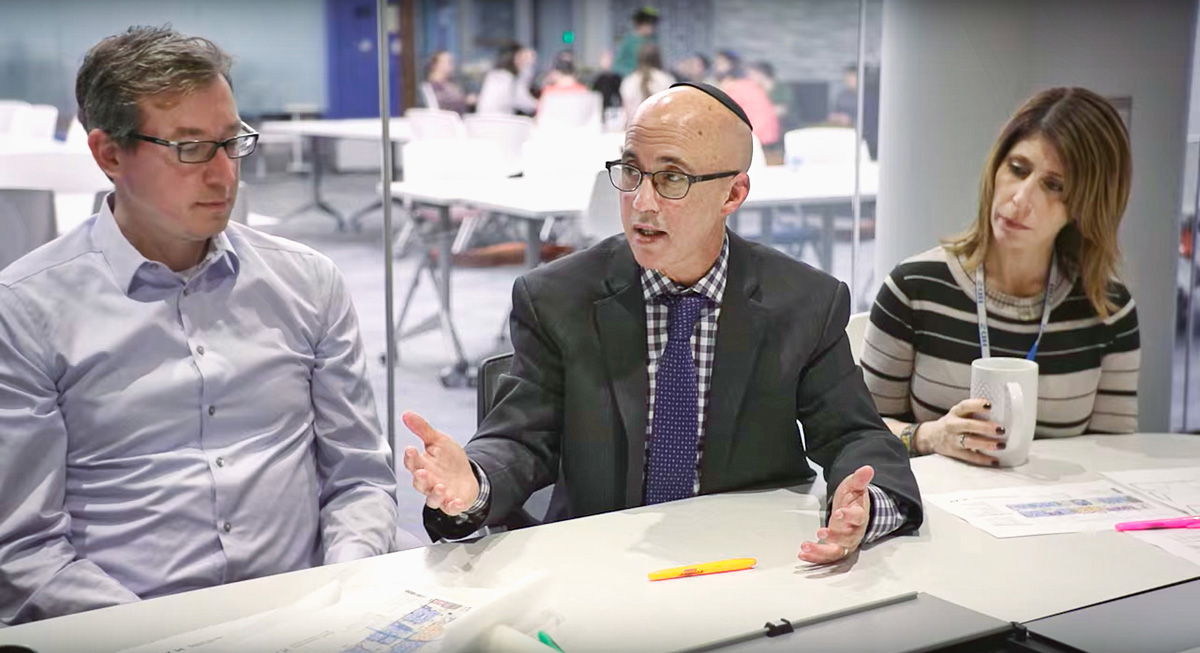
How has our world changed from the 1950s until today, and how have our synagogue schools changed with it? At a retreat in Chicago, synagogue educators, clergy, and lay leaders armed with Post-it notes mapped out the shifts across decades in family structure, technology, education, and more—from Ozzy and Harriet of the 1950s to today’s Modern Family. The big “aha” from the era-mapping exercise? Despite dramatic shifts in our social, political, and cultural landscapes, our traditional synagogue education models haven’t always changed with them. The opportunity? To reimagine Jewish education in synagogues to meet today’s learners where they are and to expand our focus from surviving to thriving.

This mandate was at the heart of an 18-month change effort called CHIdush, undertaken by a forward-thinking network of synagogue teams in Chicago through a partnership between UpStart and the Jewish United Fund (JUF) of Metropolitan Chicago (made possible by the generous funding support of the Crown Family and The Jack and Goldie Wolfe Miller Fund). “The program allowed us to see that the world our kids are experiencing in their lives and in school doesn’t always square with what’s going on with synagogue learning,” noted Joy Wasserman, CHIdush project manager for JUF. CHIdush brought together seven diverse synagogue school teams to identify challenges and opportunities in their communities and to design meaningful solutions to them—drawing from bright spots locally and nationally. This piece will share stories of impact from the inaugural CHIdush cohort and highlight lessons learned for scaling success across a field of Jewish life.

An Approach for Scaling Impact

The name “CHIdush” puts a Chicago spin on the Hebrew and Yiddish word for a new idea or insight. CHIdush established the conditions for these ideas to flourish by leveraging the foundational principles of Design Thinking and Adaptive Leadership through a methodology called Adaptive Design. Pioneered by UpStart cofounder and associate Maya Bernstein and Marty Linsky and laid out in their seminal Stanford Social Innovation Review article, Adaptive Design helps people generate new ideas in a way that integrates community needs, embraces creative experimentation, and produces rapid results—while equipping them to manage the change process. 

At its heart, this process is deeply collaborative. In the context of Jewish education, Stanford education professor Ari Y. Kelman and Maya Bernstein, authors of “Working Across and Working Between,” suggest the best innovations thrive because they leverage the contributions of important stakeholders and create opportunities for them to work together toward a solution.

Through CHIdush, we integrated three layers of collaboration in order to scale success:

  1. Collaborate with your learners:
    Congregation Solel posed the design challenge: “How might we engage seventh graders in Jewish learning and community post–b’nai mitzvah?” According to Solel Cantor Jay O’Brien, students were “invited to be collaborators in building a seventh-grade, project-based, learning program,” shaping everything from the topics explored to the location and food to their interaction with the clergy. After each session, the CHIdush team met with the teens during gatherings called “Lifnot” (your turn) to receive real-time feedback and rapidly evolve their program design. Through CHIdush’s workshops, tools, and coaching, Cantor O’Brien’s team was able to build empathy with their learners, tap into their hopes and yearnings, and partner with them to imagine a better future. Cantor O’Brien credits recent increases in seventh-grade post–b’nai mitzvah retention to genuinely inviting learners to collaborate in building authentic Jewish experiences.

  2. Collaborate with your community:
    Anshe Emet Synagogue expanded their initial focus from redesigning a class for preschool families to a broader vision: “How might we create new pathways to Jewish life and community for young families?” This question led them to possibilities beyond the walls of the classroom, requiring the partnership and buy-in of an expanded group. Their success lay in their ability to embrace this approach wholeheartedly, using adaptive tools to collaborate with a diverse team of leaders, along with a robust advisory group made up of young families. “Working with partners and lay leaders and being intentional about getting their feedback was a game-changer for us,” said Maxine Segal Handelman, director of Family Life & Learning at Anshe Emet. (You can read more about Anshe Emet’s radical collaboration and rapid experimentation in developing their Little Builders program HERE.) This new way of working yielded not only new approaches to education, but also transformative changes to culture. As Rabbi Rachel Weiss of the Jewish Reconstructionist Congregation (JRC) of Evanston reflected, “Our entire congregation is asking, ‘How might we?’” This simple reframe has been a rallying cry for them to view challenges as opportunities, from redesigning their ritual practices to reimagining Jewish education.

  3. Collaborate with your field:
    CHIdush’s model centered around shared opportunities for learning and cross-pollination in order to accelerate success not just in one synagogue, but across a field. “Knowing there were others doing this work alongside us has inspired us,” said Dr. Roberta Goodman, education director of North Shore Congregation Israel (NSCI), where they are reimagining their fifth and sixth grade model to empower learners with more choice. “By doing this as part of a community process, we not only received resources and recognition, but also the permission to try new things and a framework to support us along the way.” Many participants were eager to drive change in their communities, but found that the CHIdush framework—team-based coaching, learning experiences with their peers, and community visibility—gave them the tools and hekhsher (stamp of approval) they needed to accelerate the success of their efforts. In addition to inspiration from peers, participants had opportunities to learn from “bright spots” across the field. For example, the CHIdush teams embarked on a “virtual visit” via video chat with Rachel Happel of Temple Beth Sholom of Needham, Massachusetts, who introduced teams to their innovative model and led them through a day in the life of her learners. These bright spots helped open up the network’s thinking to new possibilities, creating a bigger window to imagine what might be, extract principles of success, and express them in ways that met the needs of their own communities. The seventh-grade project-based learning model that Congregation Solel piloted was inspired in part by a “bright spot” from another community (Temple Beth Elohim’s “Omanut” program).

    CHIdush itself was the result of a critical collaboration—between JUF and the participating congregations. While Federation involvement in synagogue education varies across the country, JUF realized its direct investment and energy could play a critical role in spurring innovation in the congregational education space. JUF recruited the cohort, gathered the needed resources, partnered with Upstart to work with the congregations, and committed to supporting the CHIdush congregations beyond the initial project. This type of collaboration gave the congregations access to resources that would not have been possible on their own and increased the probability that these efforts would achieve long-term sustainability.

Becoming the Bright Spots
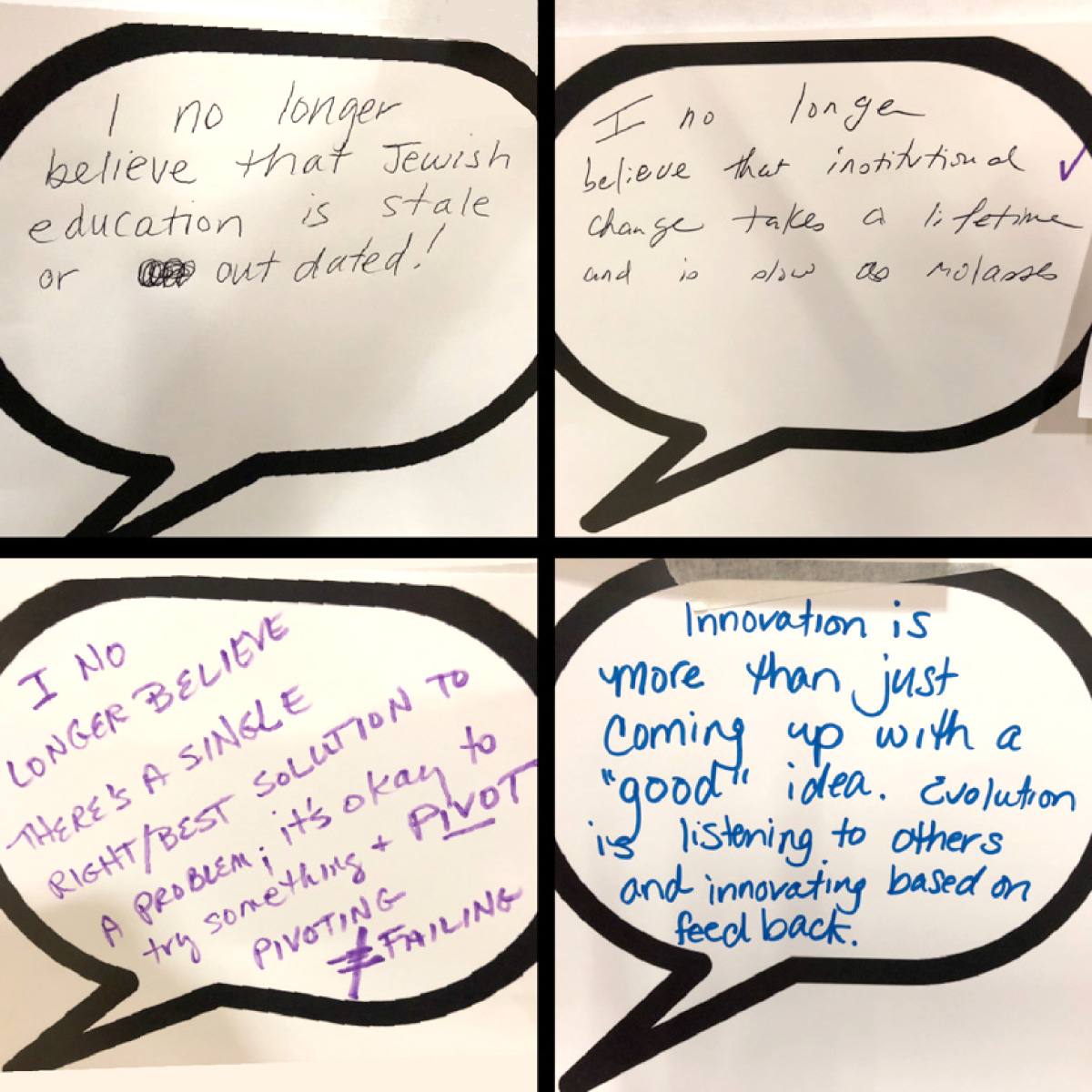
At the program’s closing siyyum (communal celebration), the synagogue teams again took to the wall, this time posting reflections on their transformative journeys. “I now believe we have a rubric for change—one based on creating partnerships among parents, learners, and educators,” wrote one participant. Perhaps this was the most important chidush to come out of the program—the realization that change can’t happen in a vacuum. It is collaboration across stakeholders that will ensure innovation efforts will truly take root.

Ultimately, CHIdush inspired a new cohort of synagogue leaders armed with the tools to create ongoing change. “We had the privilege of participating in a living educational laboratory, where the principles of design thinking are directly applied to the challenges of Jewish education based in synagogues,” noted Rabbi D’Ror Chankin-Gould of Anshe Emet Synagogue. “The only way the Jewish people can thrive is to take sincere risks and design a stronger future based on the wisdom we gain along the way.”


Linda Gerard, MBA, is the chief program and innovation officer at UpStart, which fuels and connects the ideas, leaders, and organizations that reimagine how—and why—people engage with Jewish life.

Rabbi Scott Aaron, PhD, is the executive director of the Community Foundation for Jewish Education of the Jewish United Fund / Jewish Federation of Metropolitan Chicago. JUF is the one Chicago organization that impacts every aspect of local and global Jewish life, providing human services for Jews and others in need, creating Jewish experiences and strengthening Jewish community connections.
Scaling Curricular Initiatives: Five Approaches

NACHAMA SKOLNIK MOSKOWITZ

In 1987, Cleveland’s Bureau of Jewish Education began supporting an intensive curriculum development partnership between its Curriculum Department and individual local schools and educational programs. In its earliest years, this work was known as Project Curriculum Renewal (PCR). It involved a formal three-year process that moved through the stages of research, curriculum design, and development (year one); implementation, coaching supports, evaluation, and revision (year two and then again year three); and finally sharing the document with other educational programs. In 1993, the project was included in the initiatives adopted by the BJE’s successor, the Jewish Education Center of Cleveland (JECC).

This intensive process of curricular improvement was site-specific and classroom-based. It did not focus on an entire congregation or institution, nor was its goal to scale up. Rather, PCR built the capacity of a program for curricular change and ensured that the needs of a particular school or educational program were met.

Thirty years later, the formality of PCR has disappeared. And, while site-based curriculum development has been at the fore of JECC’s Curriculum Department’s work, its staff has learned that it is possible to enlarge and scale curricular efforts without special grants and funding. The department does this by raising up, teaching, sowing, sharing, and galvanizing.

  • Raising up: Generally, Cleveland’s most successful community-wide initiatives have bubbled up from the field, with JECC staff grabbing onto ideas and raising them up, offering supports that lead to forward momentum. One of the most successful examples emerged late in the day at a congregational education directors’ retreat when a core group expressed interest in collaborating on a community-wide curriculum for sixth graders. The JECC’s Curriculum Department and Retreat Institute raised up the idea and supported the education directors in developing “Count Me In,” a three-to-four week unit that culminated in a community-wide event for students with a parallel event for parents. The classroom-based unit had at its center the midrashic text, “Everyone has three names: the name their parents give them, the name others call them, and the name they earn for themselves.” Amazingly, all 12 Cleveland congregations with education programs chose to be “in” and now, seven years later, it is still an integral part of everyone’s sixth-grade program.
  • Teaching: At the turn of the millennium, the Curriculum Department began developing curriculum using the process known as Understanding by Design (UbD). Its staff gained great expertise in UbD and supporting others to utilize its framework. With a desire and willingness to spread the power of UbD, for eight summers the JECC hosted an intensive three-and-a-half-day, college-credit-optional Understanding by Design seminar. An average of 15 to 20 local and national educators attended annually, thus, approximately 150 in total over time. Each returned with the skills to apply UbD to their own curricular needs.

    Teaching as a way to bring to scale a curricular initiative may also be currently seen in the JECC’s work with Hebrew Through Movement (HTM). This learning approach— brought to life by Dr. Lifsa Schachter, while a professor at Cleveland’s Siegal College—introduces Hebrew language in a playful, kinesthetic way. Before Lifsa retired, she developed a robust curriculum guide that supported the approach. The curriculum department created a 10-hour, asynchronous, online seminar that complemented Cleveland’s approach to professional development. By hiring two master teachers as learning facilitators, the online seminar became self-sustaining, making it easy to offer it to teachers beyond Cleveland. Over the last five years, 1,100 educators representing over 350 different educational programs have registered for the seminar. This created a quick tipping point for the nation-wide adoption of HTM’s energizing approach to Hebrew language for more than ten thousand learners.

  • Sowing: The developers of Understanding by Design stated at a seminar that their intention was not to tightly control the adoption of UbD. While offering supports (books, workbooks, articles, blogs, seminars, a website, etc.), their approach was in stark contrast to other educational change projects that required its adopters to complete specific training, receive targeted coaching, and “swear allegiance” to the original structure. This lack of concern for how other educators adopted or adapted a curricular approach greatly impacted the JECC’s Curriculum Department; it became apparent that curriculum could be offered to interested educators without tying up staff in the follow-up. As a result, the JECC’s curriculum is available for free download from the JECC Marketplace and Hebrew Through Movement offers training, curriculum, and a Facebook group, but places no implementation expectations on those adopting it. The result, for better or worse, means that carefully developed, piloted, and researched educational initiatives take on different looks in other educational programs. 
  • Sharing: For many years, the JECC’s “Immediate Response Curricula” were the most well-known, respected, and depended-upon sharing efforts of the agency. Responding to national or international crises, JECC staff dropped current work obligations and collaborated to publish an Immediate Response Curriculum in time for teachers to access by midafternoon. Each multipage document included background on the current situation and supports for addressing the crisis, including Jewish texts, learning activities, and response suggestions. Over the course of 15 years, the JECC’s response curriculum accumulated tens of thousands of downloads and shares (no mean feat in an age prior to the proliferation of social media). In 2014, as a result of shifting staffing patterns at the JECC, this project was put to bed, though not until a more generic Responding to Crisis website was developed with 24/7 access. Other examples of the JECC’s outward sharing of its materials include a number of websites (some for teachers and others for students), as well as free and immediate downloads of curriculum via the JECC Marketplace.
  • Galvanizing: In the last year, the JECC’s Curriculum Department began circling back to some of its earlier efforts to transform Hebrew learning in part-time/congregational settings—what might be the impact of conference presentations, consultative phone calls with colleagues, and supportive curricular materials on the hoped-for changes? It was discovered that almost a dozen Jewish educators had moved their Hebrew education programs dramatically forward. To galvanize their efforts and give energy to the change process, the JECC invited a handful of education directors to Cleveland. Their sharing of experiences and openness to discussing challenges led to #OnwardHebrew, a growing national conversation that is leading to a sea change in Hebrew teaching and learning.

The JECC Curriculum Department’s experiences illustrate that while local Jewish education agencies have community-specific missions, there is great potential to share work on a broader scale with modest financial support and without Herculean efforts by staff.  The JECC has been able to grow its local initiatives by raising up ideas, teaching in areas of expertise, sowing ideas, sharing resources, and galvanizing Jewish educators, leading to dramatic steps forward on behalf of our students, teachers, and their educational programs.


Nachama Skolnik Moskowitz is the senior director and director of curriculum resources for the Jewish Education Center of Cleveland.

Why It’s So Hard to Scale Success (And What to Do About it)

Dr. Rob Weinberg

“I’ll have what she’s having.” In the 1989 film When Harry Met Sally, this is what the woman at the next table tells her waiter after Sally simulates physical ecstasy in the middle of Katz’s Deli. The classic, hilarious scene demonstrates the logic behind the elusive desire to “scale success.” If only, the logic goes, we could replicate what those who are successful do, we would be successful too. But that doesn’t always happen. Why not?

I’ve spent much of my career wrestling with this question. Let me share what I’ve learned about why it’s so difficult to scale success in Jewish education, what strategies are most promising, and where we might go from here.

Scaling success is what the organizational research literature calls “diffusion of innovation.” It shows up under a variety of popular guises every decade or so. In the ’70s and ’80s it was about “critical incidents”; in the ’90s, about benchmarking best practices; and in the current decade, we’re all abuzz about “bright spots.” But let’s look at what it takes to identify these bright spots and to diffuse or scale them, examining how those conditions match with the realities of Jewish education.

First, we need to know what success is. For as long as I’ve been involved in Jewish education the debate has raged about what constitutes success. Is it assimilation prevention, Jewish literacy and ritual competence, Jewish identity formation, informed Jewish choice, lifelong engagement in Jewish learning, or adopting Judaism as a pathway to thriving in one’s own life and striving for creative responses to a changing world? Educators face a dizzying and unattainable plethora of expectations from parents, board members, clergy, donors, and the learners themselves. Often what accompanies innovations in congregational education is a new and welcome conversation about what the desired outcomes ought to be. Yet without clear and shared outcomes, how can we identify which practices are successful?

Second, once we agree on outcomes, we need to measure those outcomes to determine which practices were successful. Dr. Jack Wertheimer was neither the first nor the last to recognize the incredible dearth of research evidence on outcomes in Jewish education, particularly in the congregational context where most of my work has focused. If we can neither define nor measure success, how can we purport to scale it?

Third, we need to agree on what it is that we seek to “scale.” The foremost scholar of diffusion of innovations, Everett M. Rogers, defines an innovation as “an idea, practice, or object that is perceived as new by an individual or other unit of adoption.” But Jewish education is complex and multifaceted. Jewish educational innovations are more like what Rogers calls “technology clusters,” in other words, bundles of innovations packaged together in which it is difficult to “determine where one innovation stops and another begins.” Take Mayim—the innovative congregational education model at Temple Beth Shalom of Needham, Massachusetts—as an innovation we might wish to scale. What aspect of it is the innovation? Is it their tailored application of project-based learning? Or is it mifgash, their adaptation of Morning Meeting from Responsive Classroom? Or their experimentation with Hebrew Through Movement, learner choice, or flexible scheduling? Or is it the welcoming, relational environment they create by having a volunteer receptionist stationed near the door to welcome each child by name or a half-dozen other identifiable aspects of Mayim? Different congregations may perceive various aspects of a multifaceted innovative model as new for different reasons.

In addition, Jewish educational systems are often embedded in broader (e.g., congregational) systems that are, themselves, embedded in communities. Thus, innovation in congregational education requires not only behavioral change but also complicated systemic and social change, which run up against long-held practices, investments, and attitudes. Scaling success requires not only introducing the innovation itself but also a surrounding process of psychological and social transition to supplant existing skills, habits, and behaviors. All of this must take into account the context of socially mediated and constructed cultural norms, beliefs, and assumptions.

Although many who advocate scaling seem to regard it as a technical challenge, it is clearly an adaptive one. Dr. Michelle Lynn Sachs has written about the social legitimacy of the paradigm of schooling as an impediment to change—colloquially I often talk about this by saying, “People only know what they know.” The yardsticks against which they measure a new educational approach or model are old yardsticks designed not only to fit old educational “technologies” but to measure old outcomes.

These conditions and more suggest that the spread of “successful” innovation is likely to be slower than any of us would like and to fail more often than we’d like. So what are the promising strategies and where can we go next? Some shareable lessons I have learned about scaling innovation:

Teach Them to Fish: Experience teaches that it is more important and productive to build innovative capability than replicate specific educational innovations. In a constantly changing world and ever-evolving field, diffusing a particular innovation may offer little more than a recipe for repeated obsolescence. Educational models and practices no longer have the century-long shelf life of the supplementary school model introduced by the Benderly Boys. Rather, educational leaders need to build their innovation muscles to innovate repeatedly both to come closer to enacting their educational visions and to be continually responsive to the changing needs of learners and families. Success is a moving target.

Adapt, not Adopt: Second, successful scaling is a matter of adaptation rather than adoption. In my work with colleagues at the Experiment in Congregational Education, we developed an Adaptation Continuum that extended from Adaptation, or Modification, at one end of the continuum to Mix and Match in the center to Inspired Redesign at the other end.

To explain, consider your options when purchasing a new home. You might purchase an existing home and redecorate a bit (Adaptation). You might purchase a home and remodel the kitchen to be more like one you’d seen in another home and the bathroom in the style of yet a third home (Mix and Match). Or you might decide to build your own home from scratch, drawing design ideas from multiple places and inspiration from specific architectural styles and principles (Inspired Redesign).

Intentionally not included on the two ends of the continuum are direct replication (copying) and complete ignorance of existing practice. The former rarely succeeds due to the differences among organizations (effective diffusion requires a certain amount of reinvention). The latter is simply wasteful. It requires complete reinvention without benefit of others’ experience and learning.

It’s the Principle of the Thing: Stanford University Business School professor Dr. Jeffrey Pfeffer once wrote: “Don’t copy what great companies do, copy how they think.” Rather than seeking to implement universal best practices, we should seek to learn from and apply best principles. Rather than copying educational programs, we should seek to implement 21st-century educational-design principles and broad categories of practices (such as project-based learning), but tailor them in a way that suits each educational setting and its respective unique qualities.

How’s the Fit?: Before introducing an educational innovation, first seek to understand the social system and the communal and organizational norms—the indigenous belief system and how compatible the innovation is with it. Deliberate and successful innovation can’t be like a one-way message; it has to be more like mutual convergence around meaning. Consider the social relationships that impact adaptation of an innovation. Who is eager to please whom? What networks are relevant? Who are the social models, connectors, and opinion leaders whose involvement and endorsement might lead others to lend their support? Who are the change agents and are they perceived as similar to or aligned with those who must accept or support the innovation? Finally, are those supporting the innovation coming from an innovation-orientation or a “client” orientation?

If we have learned anything from the application of Human Centered Design to innovation in Jewish education, it is the importance of focusing on the needs, wants, pains, and gains of the users (learners and their families), as well as the secondary audiences of decision makers and influencers. Successful scaling of innovations depends on knowing the ground into which you will plant the seed and choosing seeds you know are compatible with the conditions in the field.

Shout it from the Rooftops: Jewish educational innovations are largely hidden in plain sight. Educators exert above and beyond effort to keep their educational programs running and introduce innovation at the same time. They lack time, energy, funding, and channels through which to publicize and tell their stories. Further, our values in the field promote modesty. Those who go out of their way to blog and publicize are worried about being seen as boastful grandstanders. We need new and robust channels to share innovations—both innovations in Jewish educational practice and, more importantly, innovative principles and the contextual characteristics behind them. Some efforts exist to share online but more and more robust channels are needed. Flat, two-dimensional descriptions don’t cut it. We have to find ways to bring innovators into dialogue with one another. In one such example, Rachel Happel of Temple Beth Shalom took participants in Chicago’s CHIdush project on a “virtual visit” to the Mayim program, making it come alive and interacting to share vision, motivations, principles, and experiences and answer their questions.

Crawl Before You Walk; Walk Before You Run: Finally, policy makers, foundation professionals, federation leaders, and others need to keep in mind the complexity of that mission. We need to be prepared to scaffold the process of innovation and adaptation with training to build innovative capacity. We need to share so-called bright spots not for purposes of replication but for inspiration and confidence building.

We also need to engage the wider community in the conversation about the real purposes of Jewish education in the 21st century and to build buy-in to new yardsticks for success. We need to fund serious professional learning for educators to stay current with 21st-century educational principles and practices and then scaffold their process of adapting those principles to Jewish education.

Lastly, we need to be patient and supportive if and when early efforts at innovation fail. We need to regard these as part of the learning process, not an invitation to pull the plug. Scaling success in Jewish education is a marathon, not a sprint.

If we learn our lessons and do it well, scaling success is less about “I’ll have what she’s having” and more about “I need to know what she knows and what she knows and what he knows.” Only by looking at successes and learning how they were achieved will we really learn how to accelerate innovation that builds (and continually rebuilds) compelling Jewish education.


Dr. Rob Weinberg serves as a coach, consultant, and facilitator helping individuals, teams, organizations, and networks to find clarity, chart direction, and navigate change. Current clients include Shinui: The Network for Innovation in Part-Time Jewish Education, Kenissa: Communities of Meaning Network, the Union for Reform Judaism, and the Jewish United Fund of Metropolitan Chicago. Previously Rob served for 16 years as national director of HUC-JIR’s Experiment in Congregational Education. He holds a PhD in Organization Behavior from Northwestern University’s Kellogg School of Management.


The Best Laid Plans: Samson Benderly and Supplementary Jewish Education

Dr. Jonathan Krasner

Today, congregational schools are dismissed by many as functionally and even irredeemably flawed educational institutions. It may then seem odd to think of the 20th-century growth of supplementary Jewish education as an example of scaling-up success. Yet this is exactly how the rise and rapid spread of the modern afternoon Hebrew school was viewed by many mainstream mid–20th century Jewish educators and communal leaders. The career of Samson Benderly, arguably the premier American Jewish educator of the early 20th century, is inextricably connected to the development and expansion of the modern supplementary school.

In 1910, Benderly was hired to become the founding director of the first North American bureau of Jewish education in New York City. It was a time when few modern Jewish afternoon schools existed and most children who received a Jewish education attended one-room, privately operated schools called cheders, or they worked with private tutors or attended Sunday school. A 1909 survey of New York’s Jewish educational institutions, conducted by Mordecai Kaplan and Bernard Cronson, found each of these alternatives sorely lacking. Those families that opted for a more intensive education enrolled their sons—there were few intensive options for girls—in a handful of traditional yeshivas, which, rightly or wrongly, acquired the reputation of being “ghetto schools.”

Benderly gained notoriety in Baltimore at the Hebrew Education Society, running a progressive Hebrew school where students were taught Hebrew using the natural method, a foreign language–acquisition technique designed to mimic primary language acquisition. The emphasis in the youngest grades was on conversation rather than reading or writing. Eschewing translation, Benderly created an immersive Hebrew classroom, relying on pictures, manipulatives, pantomime, and the natural surroundings. Benderly wasn’t the first pedagogue to apply the natural method to Hebrew instruction, but he popularized the technique, colloquially known as “Ivrit b’Ivrit” in North America.

Benderly’s commitment to Ivrit b’Ivrit helped to cement his conviction that the afternoon supplementary school offered the best alternative for American Jewish education. The natural method of language acquisition required more hours per week than the Sunday school could offer, while the intensive Jewish education of the yeshiva was unappealing to most immigrants and their children. They viewed the public schools as an indispensable vehicle for economic advancement and social integration. Thus, the afternoon supplementary school, meeting three to five days (i.e., six to ten hours) per week, offered an attractive compromise.

Benderly had his requirements. He insisted that these schools operate along modern pedagogical and administrative lines, with credentialed teachers in suitable, up-to-date facilities. A doctor by training, Benderly was also keenly concerned about students’ health and advocated for sanitary conditions, playgrounds for exercise and recreation, and a more abridged session than that which prevailed in more traditional afternoon schools and yeshivas, which often met into the evenings.

At the most basic level, Benderly’s efforts to promote the afternoon Hebrew school were a resounding success. Over the next half-century, these supplementary schools “scaled up.” His disciples, known as the Benderly boys, presided over many of the largest central Jewish education agencies in the country and thus were able to implement similar models. The percentage of Jewish children attending afternoon schools grew until in the 1950s, enrollment surpassed even that of the Sunday schools. Hebrew became a cornerstone of the afternoon school curriculum—so much so, that the schools became popularly known as “Hebrew schools.” This startling turn of events prompted the late JTS professor of Jewish Literature Alan Mintz to marvel at how “a small band of committed Hebraists kidnapped the Talmud Torah movement and retained control over it for several decades.”

Delve more deeply, however, and we notice where and why scaling up did not translate into large-scale success, with the limitations of this phenomenal growth becoming patently clear. It is not simply that few baby boomer graduates of the afternoon school recall their experiences fondly or that sociologists estimate that the impact of these schools on positive Jewish identity formation was modest at best. The reality is, first, that most of these schools did not remotely approximate Benderly’s progressive Hebrew Education Society school in their approach to teaching and learning. Second, the rapid growth of the afternoon school after World War II coincided with the reduction in the number of hours per week of instruction. The Talmud Torah, a four- or five-day-a-week school under communal auspices, gave way to the two- or three-day-a-week congregational school. Scaling up diluted or, in some cases, completely changed the original product.

It would be comforting but inaccurate to think that these shortcomings were a result of a lack of forethought or planning. In fact, when Benderly was hired in New York he laid out an elaborate plan for scaling up, which included the establishment of demonstration schools, the professionalization of the teaching force, the publication of curricula and resources, and the formation of a research department. As we know today, many of these plans did not come to fruition or resulted in only short-term reforms. Though it is impossible in the space provided to catalog the manifold reasons why these plans either failed to materialize or did not adequately provide the necessary guardrails to ensure quality control, we can point to a few overriding factors. First, the Jewish education system was (and continues to be) highly decentralized, which limits its susceptibility to top-down reform efforts. Second, a supplementary education system primarily relies on a mostly part-time teaching force, which significantly hinders efforts at professionalization. Third, there has been a lack of alignment between the desired outcomes of teachers and parents. This makes it impossible for educators like Benderly to cultivate a unified base of support for their reform efforts. Fourth, there was (and is) no consensus around a sustainable funding structure for Jewish education and a lack of appetite for the proposition that Jewish education was a communal responsibility, rather than simply a private matter. Finally, even the most meticulous planning could not anticipate historical contingencies and demographic changes. In the long run, events like the Great Depression and World War II, followed by trends like suburbanization and the growth of the Conservative Movement, played an outsized role in determining the shape, emphases, and intensity of supplementary Jewish education.

So what does this mean for us and those who want to scale up success in Jewish education today? As it happens, we are experiencing a new generation of reformers attempting to remake supplementary Jewish education. Some are succeeding in identifying compelling models of “schools that work,” creating a far more sophisticated systems-based change model than that of Benderly’s generation, organizing well-regarded and amply funded transformation projects, and working to scale up with partnering schools and congregations. The outcomes thus far though have been uneven and reforms often fleeting. It is perhaps ironic that the system of supplementary Jewish education that emerged in the first half of the 20th century, while seriously flawed, has been highly resistant to change.

If there is a lesson to be learned from Benderly and his disciples’ efforts to forge a dominant pattern of Jewish education, it is not that reform initiatives are in and of themselves futile. Rather, these efforts must be approached with equal measures of conviction, humility, political savvy, and vigilance.


Dr. Jonathan Krasner is the Jack, Joseph and Morton Mandel associate professor of Jewish Education Research at Brandeis University. He is also the author of The Benderly Boys and American Jewish Education, a history of Samson Benderly and his disciples working to transform Jewish education in North America in the early 20th century.

Scaling Success in Jewish Education

Mark Young

What does it take to nurture small successes into larger successes in Jewish education? Often we take a program or initiative that works well in one setting (say one particular synagogue school or JCC) or city and attempt to replicate it elsewhere, yet it fails to flourish.

Yet there are, in fact, numerous stories of scaling success in Jewish education, with strategies that illuminate how this can be done. This issue of Gleanings aims to shed a light on these stories and strategies, with the hope that you are inspired to apply within your particular site or area of Jewish education.

 
We start with Dr. Jonathan Krasner, who grounds our issue with a history on the challenges of scaling success in Jewish education, taking us back 100 years to Samson Benderly and the development of the modern religious school, noting its own successful scaling in the post–World War II period. We then learn about current challenges to and the possibilities of scaling success in the synagogue space today from Dr. Rob Weinberg, which is followed by a piece from Nachama Moskowitz outlining a series of steps for us to fellow so we can scale success in curriculum development and design.

Scaling success is also about how we best spread good ideas in a manner that is supportive, nurturing, and generative, and that makes the best use of networking principles. Linda Gerard of UpStart and Rabbi Scott Aaron share their story of applying a multi-level approach to collaboration to spark change and scale success in synagogue schools throughout Chicago. Deborah Fishman shares a similar networking strategy from her work network-weaving  teachers in Jewish day schools. Dr. Gail Dorph discusses the successful scaling-up models within the teacher training at the Mandel Teacher Educator Institute, and Beth Garfinkle Hancock and I share our story of building high-sustainable performers and a community of trust during our retreat-based cohort leadership training for JCC professionals, all of which helps successfully spread innovative ideas and best practices.

Finally, we seek to best understand how to bring all the voices and wisdom in our field to the foreground as we create and sustain movements that can realize the positive change we may already see popping up in various corners of our field, known as “bright spots.” Drs. Shira Epstein and Andrea Jacobs share their experiences of building such a movement, leading our work to advance gender equity and shared models of leadership in Jewish education.

Scaling success may often feel like Sisyphus climbing up the mountain and always falling short, but we’d rather view it through the lens of Pirkei Avot 5:17, “A debate for the sake of heaven will endure; but a debate not for the sake of heaven will not endure.” Ideas and projects that achieve success on a small scale are often worthy of spreading and scaling. The question is: what is the best course of action in order to ensure that these successes endure and grow?
 
B’hatzlacha (To your success!),

Mark S. Young
Managing Director, Leadership Commons

Rabbinical Student Reflects On CPE Internship

BY LEORA PERKINS
Fourth-year rabbinical student, JTS

One day, I went to visit a hospice patient of mine. This patient, a Hispanic woman in her early sixties, had a lot of frustration about her dependence on others. Unable to even turn over in bed by herself, she had to wait for an aid for the most basic of functions— to change her, to adjust her position, to bring her food or water. Today she felt even more isolated than usual because her daughter had taken away her new smartphone. She had never become comfortable enough with the touch screen to be able to use it, but not having it at all made her feel more dependent on others even for conversation.

During previous visits, this patient had openly cried with me, and it was a crying that often seemed to bring relief. She shared her frustrations with her daughter, her desire to go home, and her fear of dying. Today, she once again brought up her death, but today felt different. She was getting worse, she told me. She knew she was going to die, and she wasn’t ready. I asked her what she meant by that. I listened to her tell me what she wished she had had time to accomplish in life, and what she wanted to tell her children. I suggested to her that maybe she didn’t need to feel guilty about wanting to live longer, that there is no “should” when it comes to how to die. Before I left, we prayed together, a heartfelt prayer that she might find inner peace. She was noticeably calmer by the end of our conversation and told me she hoped she would see me again the following week.

This conversation was on a Friday. I returned from my weekend to find out that she had died the next day. The news took me by surprise, and I was sad and moved. I had gotten to know her over the previous two months and really cared for her. Beyond that, I had seen so many long and drawn-out deaths that I was shocked at the suddenness of it, that one day we were talking and the next she was gone.

Despite my grief, there was something redemptive for me about this experience. This patient was one of the first I had met in my placement. I learned from her what it looks like to really give someone space to feel her own emotions, and the immense relief that that expression alone can bring. Although she died too soon, and with unaccomplished dreams, she showed me that the work I was doing mattered, and that in some small way, that work has the possibility to ease at least some amount of spiritual and emotional pain.

$3 Million Gift for Community Engagement

Thanks to a generous gift from Betsy Gidwitz of Chicago, a longtime Jewish lay leader, JTS can now strengthen its ability to bring Jewish learning to the broader community. Dr. Gidwitz’s gift will endow the Center for Community Engagement at JTS, which will be overseen by Rabbi Julia Andelman, director of Community Engagement. Among Dr. Gidwitz’s many roles in Jewish leadership, she has been a member of the Board of Governors of the Jewish Agency since 2000. A former faculty member at MIT and specialist on post-Soviet affairs, she chairs the agency’s Russian-Speaking Jewry Committee. Dr. Gidwitz has held several leading positions with the Jewish Federation/Jewish United Fund of Metropolitan Chicago, including serving for many years as an officer of the federation board. We are deeply grateful for Dr. Gidwitz’s gift, which reflects her belief in Jewish learning and her support for our mission to bring JTS scholarship to the Jewish world. 

Yom Ha’atzma’ut—On Campus and Online

On the morning of Yom Ha’atzma’ut, we welcomed the creators of the satirical Israeli TV series, “Hayehudim Ba’im” / “The Jews Are Coming.” Natalie Marcus and Asaf Beiser talked about the show and screened some of its sketches, which cover the Jewish people from the Bible to the present. Over lunch, Chancellor Eisen and Dr. Hillel Ben Sasson, visiting assistant professor of Israel Studies, held a fascinating discussion and debate about the relationship between Israeli and Diaspora Jews. The pair took the conversation online, as well, with the webinar, “Is It Time to Rethink the Israel-Diaspora Relationship?” in which they explored how Israel and Diaspora Jewry influence each other and how we can develop a new vision for working together. The previous day, for Yom HaZikaron, we welcomed Ambassador Dani Dayan, the Consul General of Israel in New York.

Watch the webinar