Fall 2025 Faculty News
Once again, our faculty impress and inspire us – not only through their teaching of JTS students, but also through their groundbreaking research, public engagement, and the publication of remarkable scholarly works. We are deeply proud of the profound impact they continue to make in their respective fields.
Dr. Yitz Landes, Assistant Professor of Rabbinic Literatures and Cultures, published a review essay in The Jewish Review of Books entitled “Monuments and Mosaics: The Ancient Synagogues of the Galilee.” He was also recently appointed co-chair of the Rabbinic Literature and Culture program unit of The Society of Biblical Literature, will deliver a paper on “On the Bavli and Its Sources: Intermedial Aspects of the Transmission of Rabbinic Literature in Late Antiquity,” and preside over a panel on “Expertise in Late Antiquity.”
Dr. Shira Billet, Assistant Professor of Jewish Thought and Ethics, participated in an academic conference at the University of Vienna entitled “Crisis, Critique, and Self-Criticism” where she delivered a lecture entitled “No Truthfulness Without Humility: Jewish Philosophical Approaches to Self-Knowledge, Self-Examination, and Self-Criticism as Building Blocks of Knowledge.” The conference was hosted by the Department of Islamic Theological Studies in partnership with the Forum on Jewish and Islamic Thought and Theology. In December, she will present a paper at the Association for Jewish Studies Annual Meeting in Washington D.C. entitled, “‘Whatever we are… as Jews we are by virtue of… Cohen’: Steven Schwarzschild and the Reception of Hermann Cohen in North America.”
She also recently published From Volozhin to London: Elijah Zvi Soloveitchik’s Jewish-Christian Holy Spirit” in the Journal of Textual Reasoning 16:2.
In September, Drs. Landes and Billet, as well as Chancellor Schwartz, Chancellor Emeritus Eisen, and Chancellor Emeritus Schorsch, delivered presentations at Hebrew Union College’s “A Conference In Memory of David Ellenson: Assessing His Impact, Advancing His Legacy.” The conference brought together leading scholars to honor Rabbi David Ellenson, z”l—an intellectual giant, beloved teacher, and visionary leader of HUC.
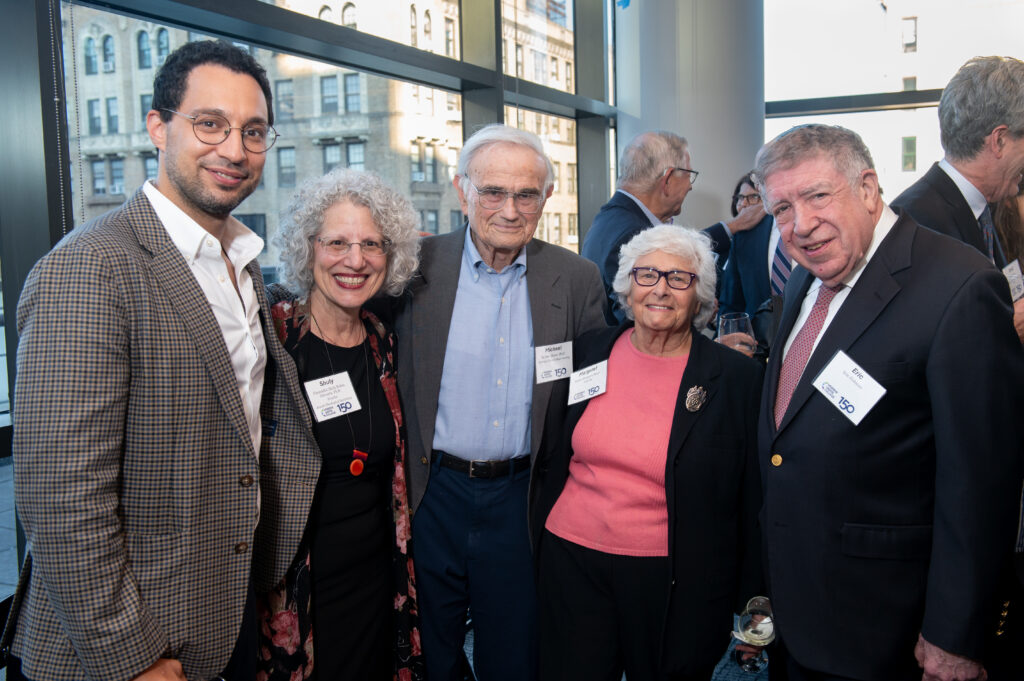
Dr. Sandy Fox, Robert S. Rifkind Chair in American Jewish History, contributed to the NYC DOE’s new curriculum, Hidden Voices: Jewish Americans in United States History, featured in JTA. She is also publishing an essay in The Oxford Handbook of American Jewish History, which will be released soon.
In addition to appearing in the Jewish Theology Is a Dialogue, Not a Conclusion documentary short film, Dr. Benjamin D. Sommer, Professor of Bible and Ancient Semitic Languages, is spending the year at the National Humanities Center as the William Bouwsma Fellow. This fall, he has been actively engaged in a number of speaking engagements, including a talk at the Duke University Divinity School on the topic, “Complaint or Petition? The Function of Crisis Psalms in Biblical Scholarship and the Phenomenological Study of Religion,” participation in a lecture series on sacred writings in world religions at the University of Vienna’s Faculty of Protestant Theology, an upcoming series of talks at Marquette University, and a lecture at the Catholic University of Paris (Institut Catholique de Paris – ICP) in December.
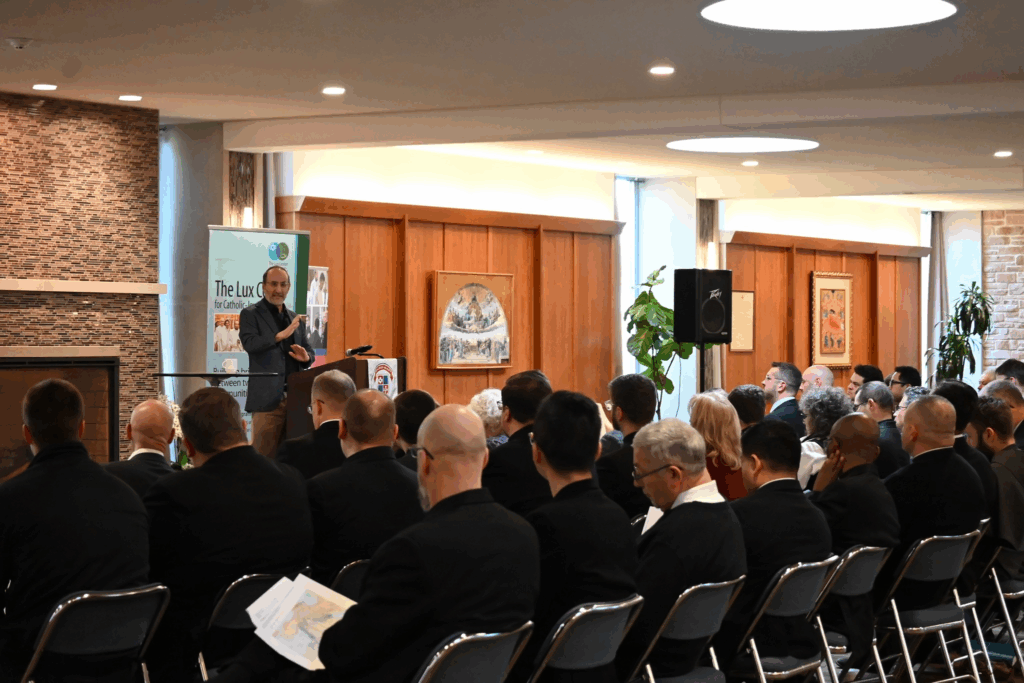
Dr. Sommer also recently spoke at the Lux Center for Catholic-Jewish Studies, where he guided seminarians, faculty, staff, and guests through the Biblical, historical, and archaeological evidence that traces the deep and direct connection between the ancient Israelites and the Jewish people.
Dr. Robbie Harris, Professor of Bible and Ancient Semitic Languages, appeared on Central Synagogue’s Podcast, “The Jewish Bookshelf: Tanakh with Rabbi Robert Harris, PhD.,” This discussion with Professor Harris and Rabbinic Intern Rebecca Thau examines sacred texts and specific books that fill our rich and storied “Jewish bookshelf.”
Faculty members also continue to host important book talks. Dr. Marjorie Lehman, Professor of Talmud and Rabbinics, organized “Jewish Traditions in the Age of Catholic Humanism: The Making of the Antwerp Polyglot Bible (1568-1572): A Conversation with Professor Theodor Dunkelgrun.” During the lecture, Dunkelgrun (University of Antwerp) discussed his recent monograph, The Multiplicity of Scripture: The Making of the Antwerp Polyglot Bible.
Dr. Eitan Fishbane, Professor of Jewish Thought, will speak at and moderate an upcoming symposium to be hosted at JTS, entitled, “On Emotion and Existentialism in Hasidic Mysticism,” which will discuss two new books by Dr. Leore Sachs-Shmueli and Dr. Eli Rubin. He is also an active part of an ensemble group of Zohar scholars writing commentaries on a range of Zohar texts on the weekly parashah and holidays for My Jewish Learning’s project, “A Year of Zohar.” This year, Dr. Fishbane has been serving as a Posen Digital Curriculum Fellow and he continues to work as a book review editor for Marginalia Review of Books.
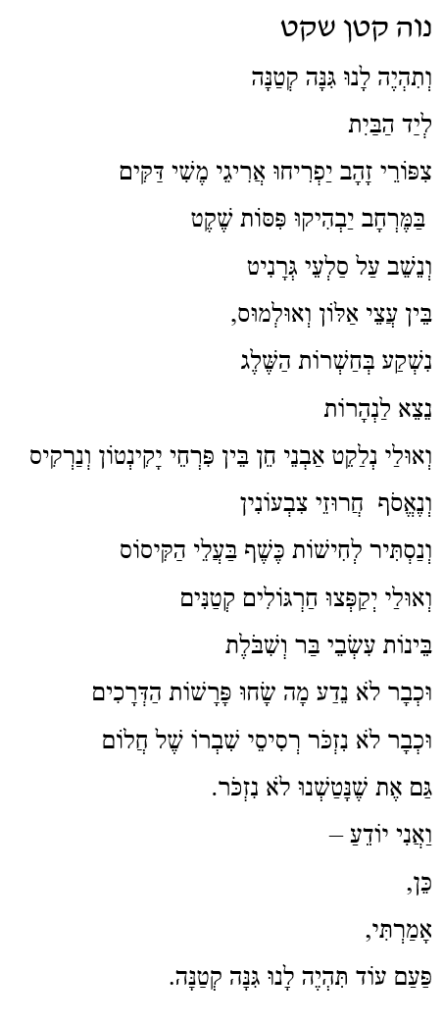
Dr. Boaz Tarsi, Professor of Jewish Music and Liturgy, received the Shira Bamakom Prize for Poetry in Israel’s annual competition run by the Helicon Publishing House. Each year, the competition highlights a different theme, and this year’s focus was “hope.”
Dr. Tarsi comments on the translation below: “Generally speaking, the poem is practically untranslatable. The reader should take into account that it cannot convey the specific poetics of the text, its tone, or its language registers, but can only attempt to provide the closest equivalent.”
Read his moving poem:
A Quiet Beautiful Abode
And we shall have a little garden
Near our house
Golden birds will wave delicate patches of silk in the air
Pieces of quiet will shimmer in the distance
And we shall sit on granite rocks
Among oak trees and elms
We shall revel in the snow
We shall depart for the rivers,
And perhaps we shall gather gems of beauty
Among hyacinths and daffodils
And collect colorful rhinestones
And hide magic whispers in ivy leaves,
And maybe tiny grasshoppers will hop
Among grass and barley stacks
And we shall not know what the crossroads recounted
And no longer remember the shards of a broken dream
Nor remember what we left behind.
And I know –
Yes,
I said so,
Someday we shall have a little garden.