Grapes of Canaan
Sometime in the mid-2000s, the Israeli Ministry of Tourism decided to give its logo a facelift. In place of the two biblical spies returning from Canaan, the new logo shows a bunch of grapes between two dancing figures. Their simplified, wavy form evokes a visual genealogy redolent of Matisse’s paintings Dance (1909) and Music (1910). Instead of an ancient biblical land, the logo promises a light and colourful atmosphere of music, dance, and wine.
The popular bulletin Shabbaton welcomed the change, arguing that the iconic illustration distorts the verse “וישאהו במוט בשנים”, as most commentators understood it. Indeed, following Sotah 34b, Rashi believed the cluster was carried by no less than eight people. Furthermore, the grapes symbolise a sin, which the iconic image blurs.
The spies’ illustration epitomizes the power of images but also their hermeneutic limitations. Of the complex story that Parashat Shelah Lekha relates concisely, the grapes are a central motif in the visual tradition that illustrates it. For a biblical story to become an image, the artist must focus not only on the sayable but also the seeable. Hence, throughout history, images have often been presented alongside words. For example, the ancient mosaic from the Huqoq Synagogue depicts the two spies, along with the inscription במוט בשניים”.[1]“
During the Renaissance, words were increasingly excluded from pictures; thus, the bible’s illustrators had to find other ways to signify their themes. Since Biblical paintings have no definite visual tradition to draw on, artists often chose a prop to make their pictures identifiable. When Giovanni Lanfranco painted Moses and the Messengers from Canaan (1621-1624), he depicted the former with his staff and horns, not to recall a miracle or divine radiation, but to indicate who is shown. It is perhaps for these practical reasons that the grapes became the visual emblem of the spies’ narrative.
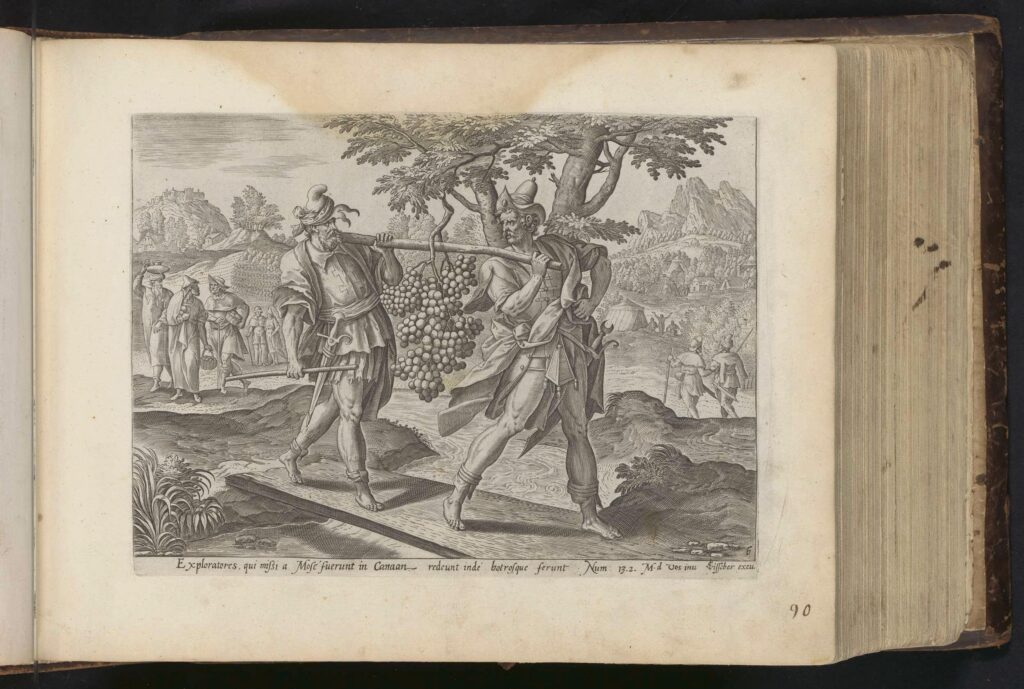
Maerten de Vos’ illustration is set in a pastoral, hilly landscape (c. 1584). In addition to the two spies who crossed the Eshcol stream on a makeshift wooden bridge, he portrayed several figures that indicate, as the spies reported, that Canaan was populated. In the background, one can see one of the fortified cities that terrorized the Israelites. But the only feature in the picture that links it indelibly to the spies’ story is the grapes the duo carries.
Even in the 19th century, when depictions of the story became more “realistic,” the grapes retained a
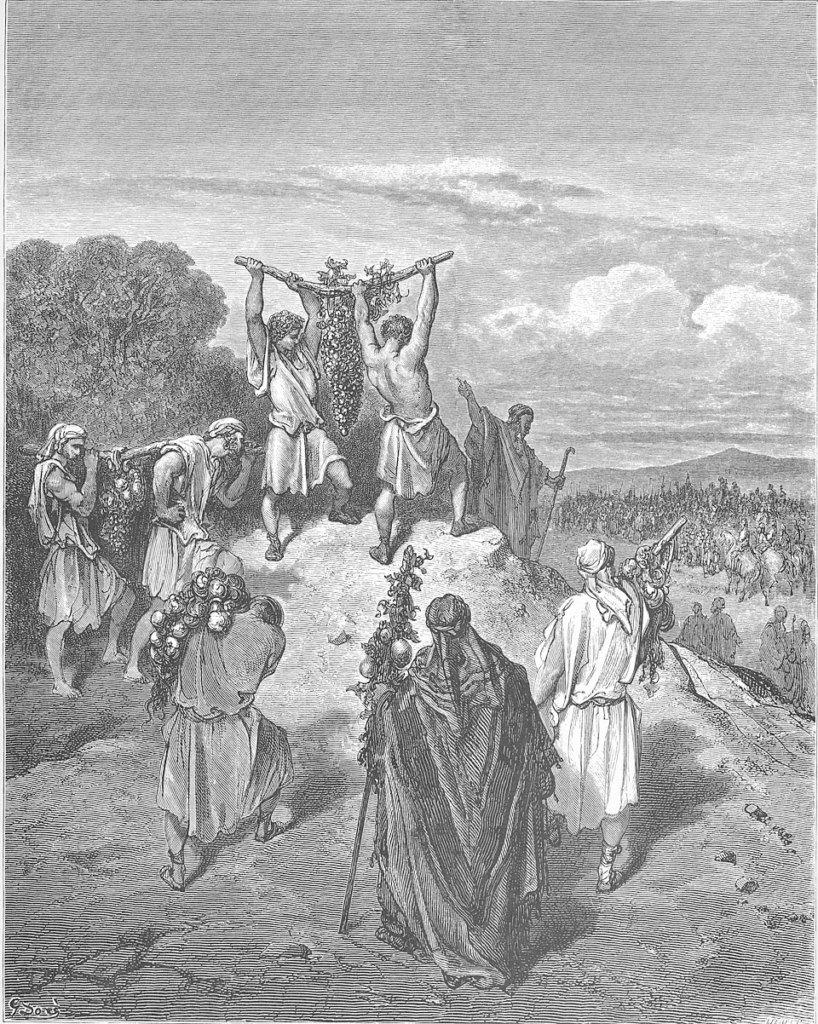
primary role. In Gustav Doré’s 1866 print, the scene appears in a desert landscape with “Oriental” costuming. However, here, even more than before, the grapes dominate the composition. Displayed on a small hill before the Israelites, they affirm the spies’ report. The illustration, however, departs from Numbers 13:27, where the fruits testify that Canaan flows with milk and honey. The rebellion occurs when the spies claim that the Canaanites are invincible. Thus, one may wonder whether Doré’s print brings to the fore an important trope or a relatively marginal theme.
The Talmud, as discussed above, enlarges the grapes to unnatural proportions, making their symbolism ambiguous. The cluster may speak to Canaan’s abundance but also the otherness of a newly encountered land. In his commentary on Sotah, Rashi resolves this ambiguity: “its people are as strange as its fruits, tall and strong.” The images I discuss here, by contrast, preserve the grapes’ open-endedness.
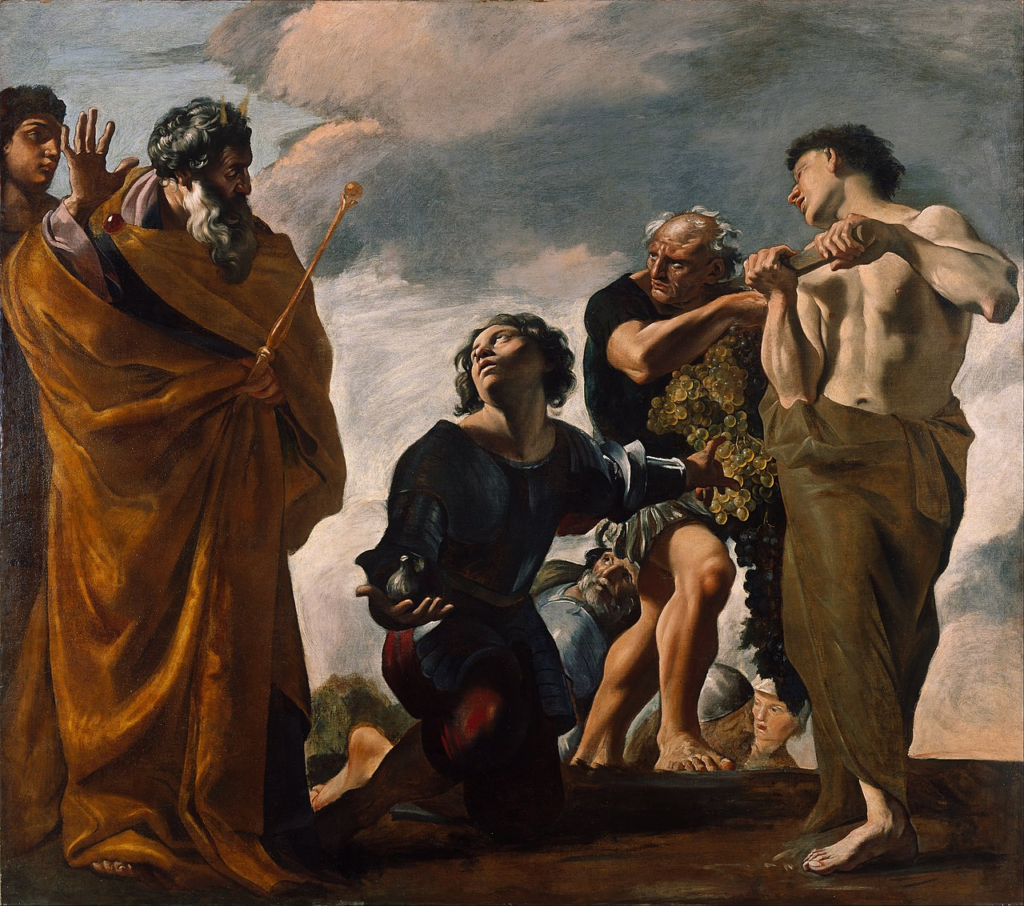
In Lanfranco‘s painting, the spies appear less rebellious than perplexed. Painted from a low angle, the scene emphasises hierarchy: Moses raises his hand while a spy bows before him. Holding a dark fig, the spy points towards the enormous cluster. His questioning look suggests bewilderment in the presence of the eccentric bunch of lush green grapes and dark, murky fruits.
The grapes can thus be seen as a pharmakon, i.e., a signifier whose hermeneutic indeterminacy can only be settled by interpretive violence. While reading Plato’s Phaedrus, Jacques Derrida argues that the translation of pharmakon as poison or remedy “obliterates the virtual, dynamic references to the other uses of the same word in Greek.” Similarly, in Jewish classical texts, the grapes have several meanings. Psalms praise the wine that makes the human heart happy, but Proverbs warns that it bites like a snake. In Numbers 13, too, the grapes represent duality: fertility, but also, since such a large cluster does not grow in the wild, it speaks of the presence of other people.
As a pharmakon, the grapes do not destabilize the text’s meaning, nor merely bring forward hermeneutic pluralism, but embody its peculiar demand of faith. If the mission to Canaan was supposed to dispel uncertainty (Deuteronomy 1:22), the grapes retrieve the undecidability of standing before the divine. They call for a free decision, which must “go through the ordeal of the undecidable.” In this vein, Derrida cites Kierkegaard, for whom “the instant of decision is madness.” The encounter with the incalculable warrants the intoxication of trust in God.
By the time the grapes were adopted in Palestine, they no longer harboured ambiguity. Instead, they symbolized agricultural fertility and, paradoxically, rootedness. The image was first used by Teperberg Winery, later Karmel Mizrachi, and finally the Israeli Ministry of Tourism.[3] This led to several copyright court cases, manifesting not only commercial but also political tensions. While the Teperberg Winery was part of the Old Yishuv, Karmel Mizrachi was an initiative of the First Aliya.
In this vein, one may read the decorative ceramic panel by Zeev Raban,[4] which shows the spies in Arab clothing, carrying an “Oriental” sword and a big rifle.[5] The figures recall the Second Aliya members of HaShomer who guarded the Jewish settlements. The artwork denotes the rootedness of those who defend the land. When the grapes became the Ministry of Tourism’s logo, they were an established national symbol.
The story’s lost ambiguity was recently revived by the Israeli musician Shlomi Shaban, whose song Canaan portrays Moses and the spies as a squad of soldiers walking aimlessly in the desert. Although the grapes play a marginal role in this dramatization, they reverse the function of religious symbols in contemporary Israel. Joshua, who is referred to in the song as “yud,”[6] says, “My soul is thirsty not for revelations but wine.” Similarly, the song ends with insights that resonate with Rabbi Nachman of Breslov,[7] and postpones the return to Zion into an eternal future: “But there is no Canaan, Canaan is in the heart/ if we enter or not, it is the same… I am only a wandering Jew/ I was born to depart/ from ancient time and until the next year in Jerusalem.”
The publication and distribution of the JTS Parashah Commentary are made possible by a generous grant from Rita Dee (z”l) and Harold Hassenfeld (z”l).
[1] The mosaic, which was probably created in the 5th EC, was discovered by archaeologist Jodi Magness and her team from the University of North California.
[3] Zeev Teperberg used the spies’ logo already in 1852 when he opened an agency for wine and drinks in the old city of Jerusalem, and later, of the winery his son Abraham Teperberg established in 1870. The winery is now known as Efrat Winery.
[4] The panel is now located in the old Beit Hava’ad of Beit Hakerem in Jerusalem.
[5] Raban follows a common practice of depicting the spies with swords (e.g., Maerten de Vos’ illustration and Poussin’s Autumn), but the edition of the rifle is unique.
[6] Throughout the song, Moses, Joshua and Caleb are suggestively called “mem,” “yud,” and “kaf” as intelligence personnel and special forces.
[7] Rabbi Nachman famously said, “Everywhere I go, I go to the Land of Israel.”