Connecting Pesah with Sukkot
Oct 10, 2003 By Ismar Schorsch | Commentary | Pesah | Sukkot
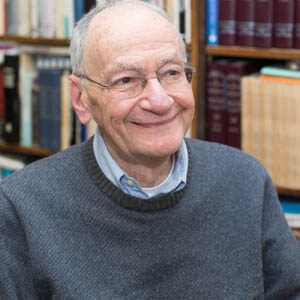
The parallelism between Sukkot and Pesach is striking. The Torah scripts them to start on the fifteenth day of the month when the moon is full and to last for seven days. Originally agricultural festivals, their historical overlay links them both to the redemption from Egypt. In each case, the name of the festival derives from the ritual which is its most prominent feature. In tandem, the two anchor the changing of the seasons in the fall and the spring (the two times of year when the seasons actually change in the Middle East) in the biblical calendar. They are the axis on which that calendar turns.
Read More
Taking Refuge in Sacred Texts
Oct 19, 2003 By Ismar Schorsch | Commentary | Simhat Torah
Most books that we read we never open again. A classic draws us to revisit it on occasion. Not so the Torah. As we finish reading it yearly in our synagogues, we immediately begin it afresh, without interruption.
Read More
Crafting a Moral Compass
Oct 6, 2003 By Ismar Schorsch | Commentary | Yom Kippur
If the liturgy of Yom Kippur is a symphony in five movements, then the leitmotif that unites them is the public confession. From Minhah prior to Kol Nedrei till the Ne’ilah service at the end of Yom Kippur, every Amidah (silent devotion) has at least one confessional prayer. Indeed, five of the six (excluding Ne’ilah) have two: the short version beginning with Ashamnu (we have acted with malice), which lists twenty-four generic types of reprehensible behavior and the long version of Al Het Shehatanu (for the sin that we have committed.), which doubles the number to forty-four generic types. Yom Kippur is utterly distinctive in the annual cycle of Jewish holy days for many reasons; not the least of which is that it is the only time that Jews confess publicly. Far more private is the traditional deathbed prayer of confession whose poignancy is underlined by the fact that it is cast in the first person singular, rather than in the plural like Yom Kippur.
Read More
A Universal New Year
Sep 27, 2003 By Ismar Schorsch | Commentary | Rosh Hashanah
Living in a universe at least thirteen billion years old, we view with mild disclaim an ancient rabbinic dispute over the exact month in which God created it. Not long after the destruction of the Temple by the Romans, two of Rabban Yochanan ben Zakkai’s renowned disciples expressed opposing views. Rabbi Eliezer ben Hyrcanus insisted that God had created the world in the month of Tishrei, while Rabbi Yekoshua ben Hananyah contended that the event occurred in Nisan. Both rejected the Geek view that the cosmos might be eternal and uncreated. For the Torah and rabbinic Judaism, the ultimate reassurance of God’s existence is the miracle of creation, the mother of all miracles (BT Rosh Hashanah 106-11a).
Read More
The Journey of Life
Oct 4, 2008 By Marc Wolf | Commentary | Shabbat Shuvah | Vayeilekh
There is so much fundamentally wrong with the world today. As Chancellor Eisen wrote in his High Holiday message this year, “On bad days, the problems seem utterly beyond managing. On good days, they call for a degree of judgment, sacrifice, and national unity seldom seen in our country or our world.” My fear is that we have actually become too accustomed to calamity; too proficient at responding to disaster.
Read More
Sanctifying Our Days
Aug 22, 2009 By Matthew Berkowitz | Commentary | Shofetim | Rosh Hashanah
What constitutes a life well-lived, a life of blessing, a life lived to its fullest? With this week marking Rosh Hodesh, the beginning of a new month, we pray for God to renew our lives in the coming month: “Grant us a long life, a peaceful life with goodness and blessing, sustenance and physical vitality, a life informed by purity and piety . . . a life of abundance and honor, a life embracing piety and love of Torah, a life in which our heart’s desires for goodness will be fulfilled” (Birkat HaHodesh). This Rosh Hodesh offers us a particularly auspicious moment to dwell upon this question of a life well-lived, for this week marks the beginning of Elul—a month in which we are encouraged to take a heshbon ha-nefesh, an accounting of our souls. At its essence, this idea demands that we look inward and become critical of ourselves and the year that has passed. This week’s parashah, Shof’tim, gives us one definition of a life of blessing that we can use in evaluating where we have come from and where we are going.
Read More
Our Hope and Despair
Jul 18, 2009 By Mychal Springer | Commentary | Masei | Mattot | Tishah Be'av
We are now in the period known as the Three Weeks: the weeks between the fast of the seventeenth of Tammuz, which marks the day the outer walls of Jerusalem were breached by the Babylonians, and the ninth of Av, when the Babylonians destroyed the Temple. These weeks are the low point of the year. In a dramatic reversal of the ordinary mourning process, which begins in its starkest intensity and lifts over time as the mourners are comforted, these weeks of mourning increase in intensity as they move, inevitably, to the destruction of God’s house and the banishment of the people into exile. The prophetic readings drive home that we have brought this horrible tragedy on ourselves. This week’s haftarah, from chapter 2 of Jeremiah, is the second of three haftarot of affliction. Jeremiah chastises the people for having strayed from God and God’s Torah.
Read More
The Meaning of Pesah
Apr 8, 2006 By Matthew Berkowitz | Commentary | Pesah
Next week marks the beginning of Passover; with this annual celebration, Jews gather to celebrate the birth of the Israelite nation.
Read More