
Sarah Rockford – Senior Sermon (RS ’26)
Oct 16, 2025 By JTS Senior Sermon | Commentary | Senior Sermon | Bereishit
Bereshit All Class of 2026 Senior Sermons
Read More
Making Meaning From Chaos
Oct 17, 2025 By Mychal Springer | Commentary | Bereishit
The opening words of B’reishit are exhilarating. “In the beginning God created the heaven and the earth.” Each day, as God creates the world and everything in it, we are told that it is good. On the sixth day, when God creates people, we are told that it is very good. From the chaos comes order, goodness, and endless possibilities. But the parashah ends with the world on the verge of destruction: “The Lord saw how great was man’s wickedness on earth, and how every plan devised by his mind was nothing but evil all the time. And the Lord regretted that He had made man on earth, and His heart was saddened”
Read More
Rebecca Galin – Senior Sermon (RS ’25)
Oct 22, 2024 By JTS Senior Sermon | Commentary | Senior Sermon | Bereishit
Rebecca Galin’s Senior Sermon on Bereishit
Read More
God’s Partners in Torah
Oct 25, 2024 By Robert Harris | Commentary | Bereishit
The ancient rabbinic Sages taught that the people of Israel must consider themselves, שותפיו של הקדוש ברוך הוא במעשה בראשית “God’s partner in the work of creation” (BT, Shabbat 119b and elsewhere). Often overlooked is that reading the Torah’s opening (בראשית ברא אלהים…, which I am deliberatively leaving untranslated for now) demands a similar type of partnership. The reason for this is that the opening of the Torah contains impenetrably difficult syntax. Let us consider the very first verse: בְּרֵאשִׁית בָּרָא אֱלֹהִים אֵת הַשָּׁמַיִם וְאֵת הָאָרֶץ. If we were to translate this verse literally, and absolutely retaining the order of the words, we would understand it along these lines: “In the beginning of, he-created God (did), heavens and earth . . . ” This is a far cry from the affecting cadence of the majestic King James Bible’s translation, “In the beginning, God created the heavens and the earth.” The question is, given the difficult syntax, what does this verse “actually” mean?
Read More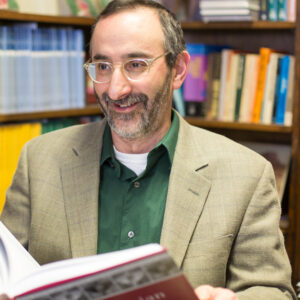
An Anthology of Beginnings
Oct 13, 2023 By Benjamin D. Sommer | Commentary | Bereishit
The Torah seems to begin twice, in a way not paralleled by any other creation narrative from the ancient Near East. It uses the conventions of ancient literature in a new way. By beginning twice, the Torah announces what sort of a work it intends to be: it is less a book than an anthology, a compendium of numerous viewpoints and competing teachings.
Read More
The World of Creation in Each of Us
Oct 21, 2022 By Israel Gordan | Commentary | Bereishit
One of the most well-known, and controversial, passages in the Torah comes after God creates man and woman: “God blessed them and said to them, ‘Be fertile and increase, fill the earth and master it; and rule the fish of the sea the birds of the sky, and all living things that creep on earth’” (Gen. 1:28).
Read More
Is the World a Mirror?
Oct 1, 2021 By Dianne Cohler-Esses | Commentary | Bereishit
The God of the Torah is driven by loneliness, by a desire to be in relationship with humanity and to God’s chosen people, Israel. As Abraham Joshua Heschel says (quoted by Michael Lerner in his book Jewish Renewal), “God’s dream is not to be alone, but to have humankind as a partner in the drama of continuous creation” (vi). Out of a great loneliness God emerges from royal solitude to create a world and within it humanity as a partner for God.
Read More
Beginning, Rebuilding
Oct 16, 2020 By Daniel Nevins | Commentary | Bereishit
Like millions of American children in the 1970s, I tuned in weekly to ABC’s Wide World of Sports. The opening sequence showed skiers gracefully racing down a mountain, and then spectacularly wiping out while the narrator promised viewers “the thrill of victory and the agony of defeat.” Something tragic and true was contained in this message. The possibility of calamity makes moments of triumph precious and worth pursuing.
Read More