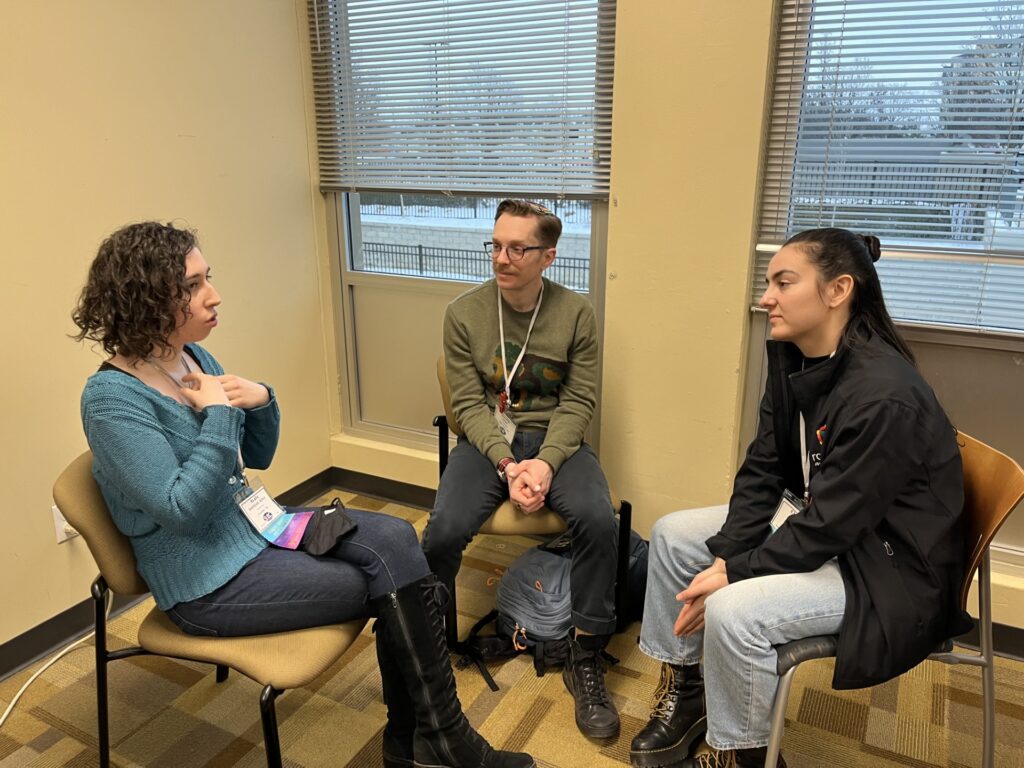
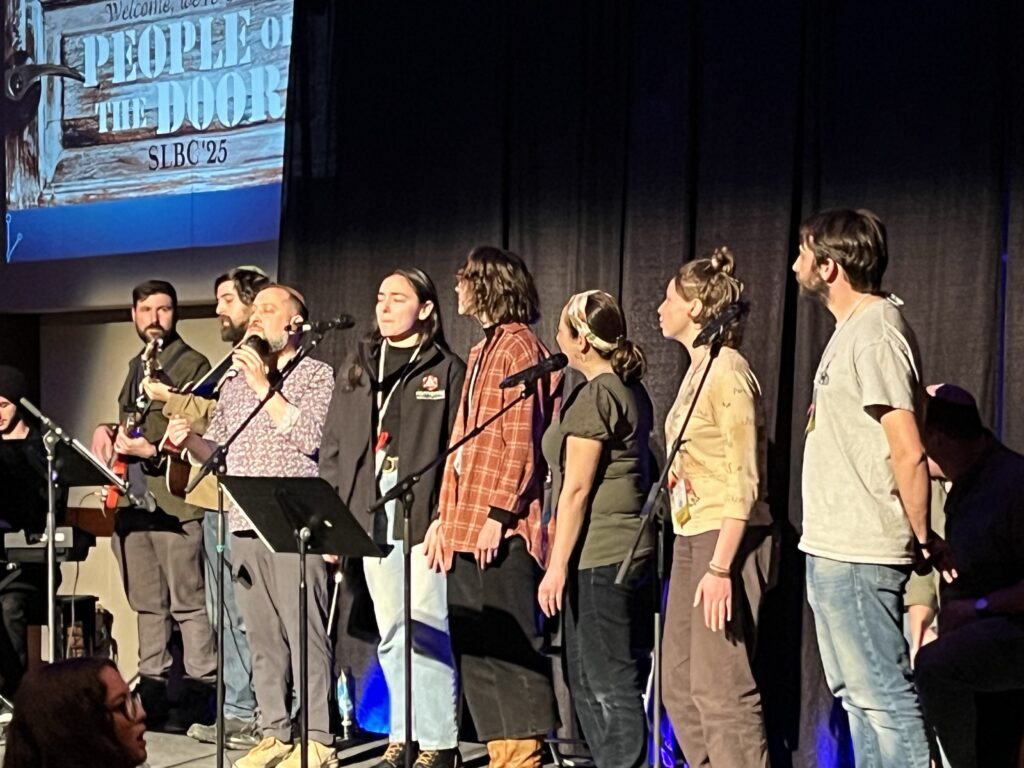
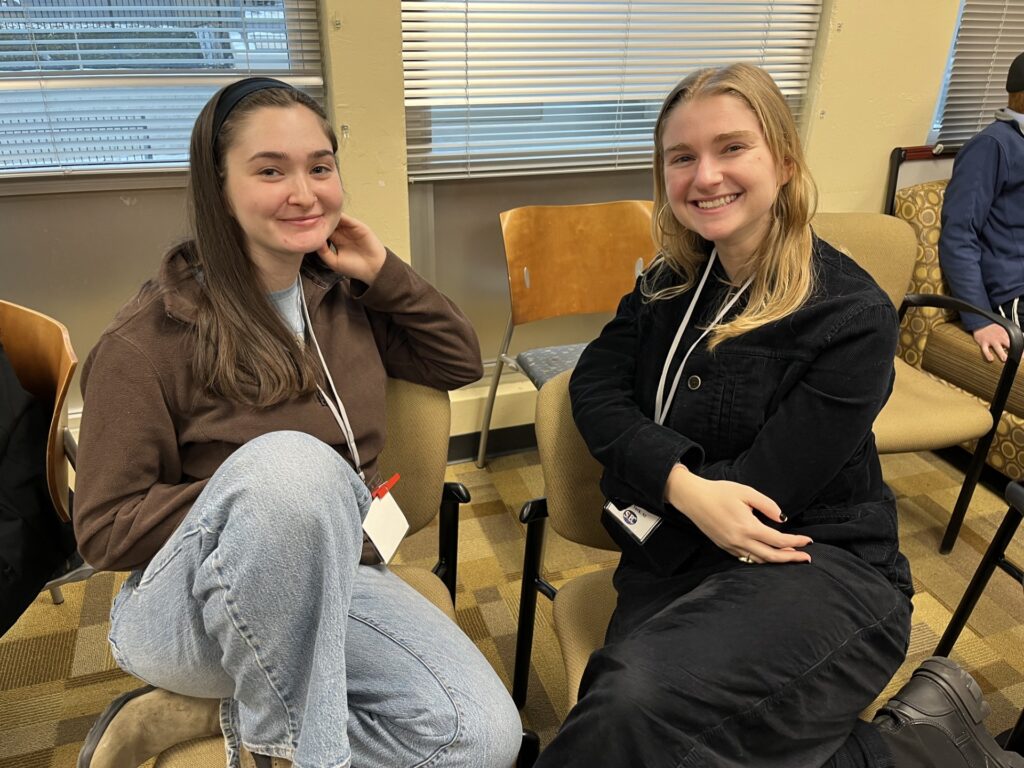
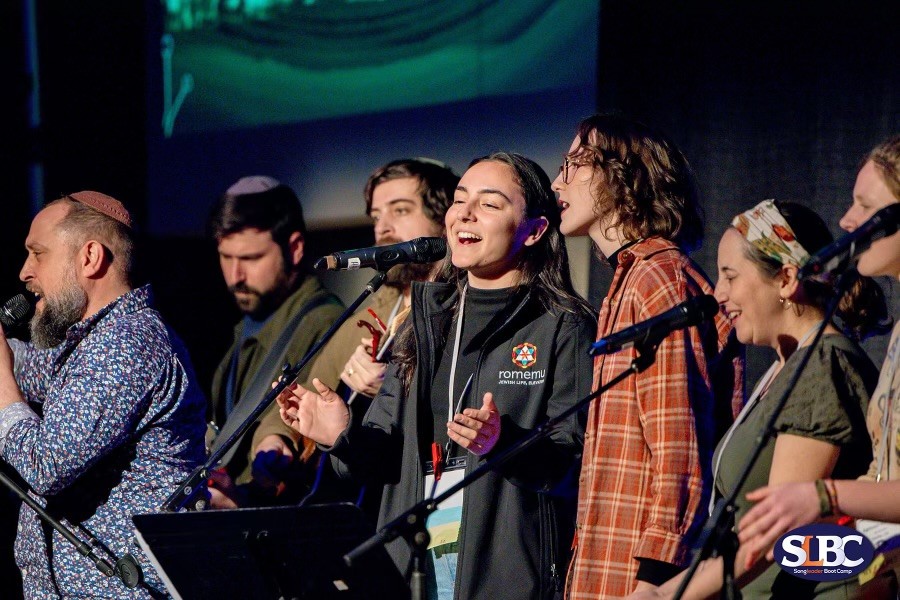
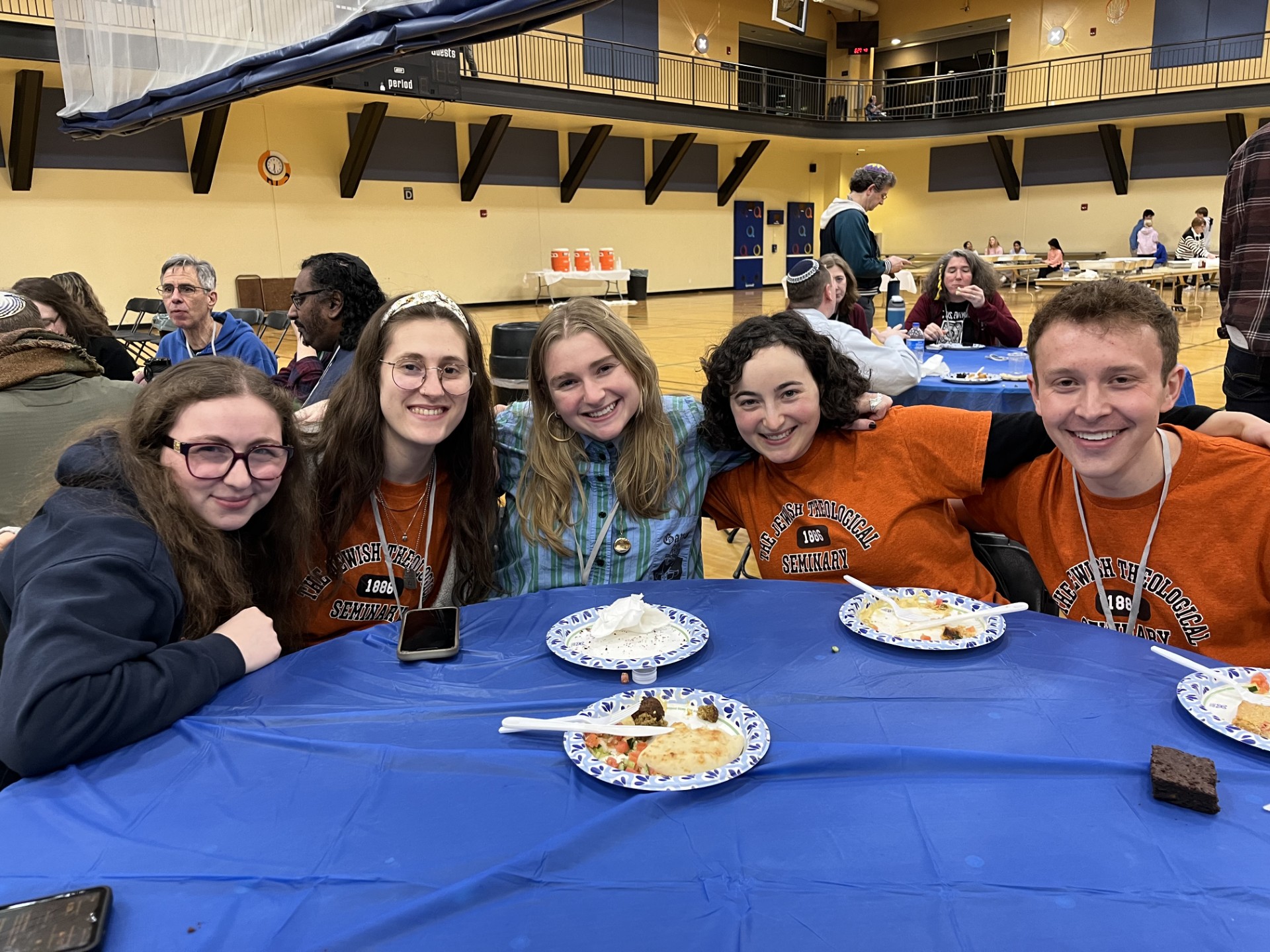
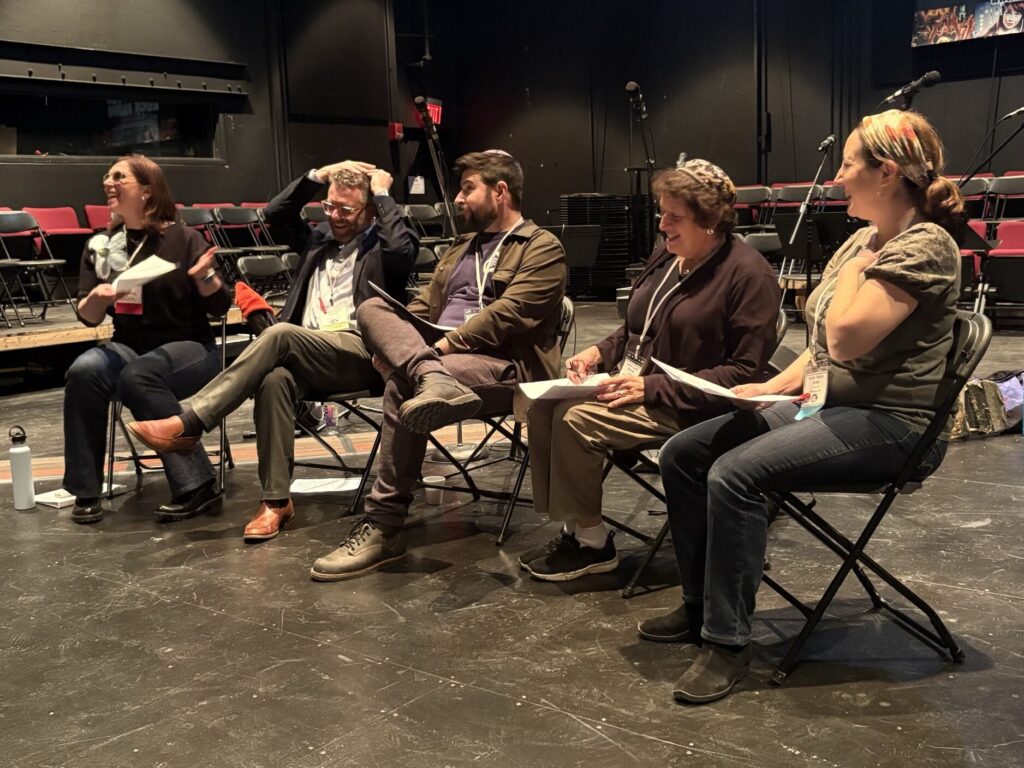
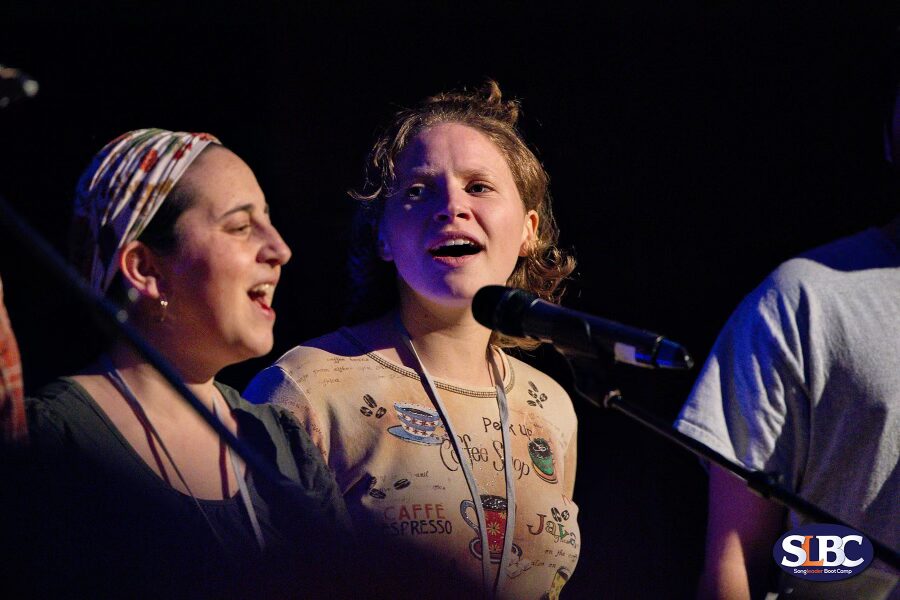
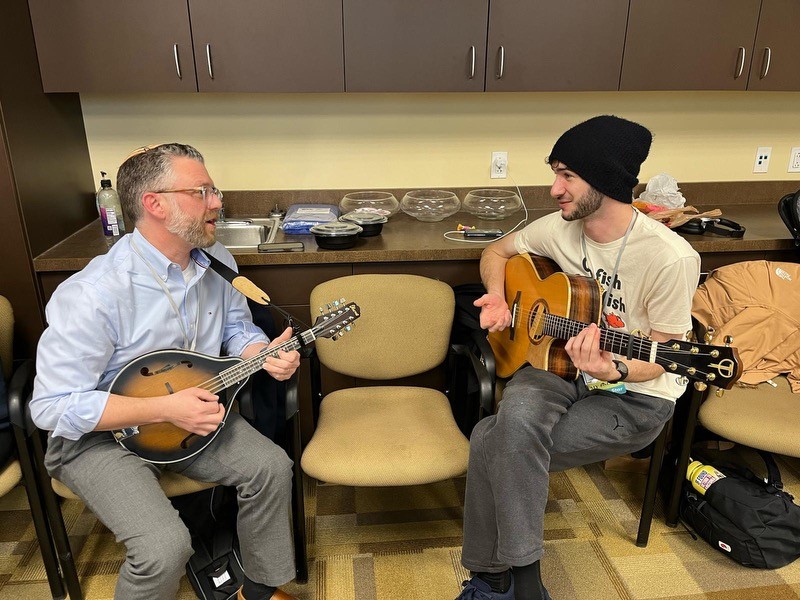
On February 16–18, a delegation of 18 a delegation of 18 JTS undergraduate and graduate students and staff traveled to this year’s energizing Songleader Boot Camp in St. Louis, where they connected with a multitude of JTS alumni and shared their voices in Torah and song. Led by nationally renowned Jewish thought leaders, educators, and music artists, the annual conference provides powerful Jewish leadership training to both new and veteran songleaders.
As one of the conference’s sponsors, JTS was honored to be involved in so many aspects of the weekend. On February 17, JTS hosted a tisch, where 12 of our students, including List College, Rabbinical, and Cantorial students, presented offerings, giving divrei Torah and leading and sharing niggunim. This included many of their own original pieces.
Many members of the JTS community also performed and led sessions throughout the conference. Rabbi Joel Seltzer, Vice Chancellor for Institutional Advancement, and Rabbi Annie Lewis, Director of Recruitment and Admissions for Religious and Educational Leadership and Assistant Dean of First Year Rabbinical Students, appeared together on a panel called “Clergy Career Opportunities.” Throughout the three-day gathering, JTS alums and students found many opportunities to gather together to sing and be in community, bonding over their shared passion for Jewish music.
Rabbi Joel Seltzer shared how special it was to be at the conference. “I had an incredible time at Songleader Boot Camp, relishing every moment of the experience. From playing my guitar with fellow alums to connecting with prospective students and singing alongside current JTS undergraduate and graduate students, it was an overwhelmingly joyful and energizing experience that left me feeling inspired and connected.”
We’re already looking forward to attending next year’s conference!
Torah Fund Stands With Israel: January 2025
These are the links to websites referred to in the presentation by Tal Itzhakov, Spokesperson, Embassy of Israel in Spain:
Monday, December 23, 2024: Chancellor Eisen has appeared on several podcasts and in the media over the past few weeks, discussing both his book, Seeking the Hiding God: A Personal Theological Essay, as well as other timely topics.
On December 21, Dr. Eisen discussed the significance of Hanukkah and what it means for the first day to fall on Christmas in a special holiday episode of the podcast JustLove with Monsignor Kevin Sullivan, the executive director of Catholic Charities of the Archdiocese of New York.
On December 11, Dr. Eisen appeared on Rabbi Jeffrey Salkin’s Martini Judaism podcast, where he discussed Jewish relationships with God and how God is hiding in the world and not readily accessible to us.
JTS Receives Generous Gift To Establish the Robert S. Rifkind Professorship of Jewish History
Robert S. Rifkind, longtime trustee and supporter of JTS, endows gift to support a new tenured member of the JTS faculty
December 11, 2024 (New York, New York) – The Jewish Theological Seminary (JTS) is pleased to announce a gift of $2.5 million from JTS trustee Robert S. Rifkind of New York. This significant contribution will establish the Rifkind Professorship of Jewish History, strengthening JTS’s academic programs and commitment to excellence in the field of American Jewish history.
Throughout its history, JTS has been home to some of the leading Jewish Studies scholars, playing a key role in educating the future leaders who will shape tomorrow’s North American Jewish community. This endowed professorship will be held by a newly appointed tenured or tenure-track JTS faculty member specializing in American Jewish history. JTS will seek a scholar with a passion for teaching a broad array of courses in Modern Judaism and American Jewish history to JTS’s diverse student body.
Chancellor Shuly Rubin Schwartz, a groundbreaking scholar of American Jewish history herself, acknowledged the impact of Rifkind’s gift. “I am deeply moved by Bob’s enduring support and know what a difference it will make,” said Chancellor Schwartz. “The Rifkind Professorship will ensure that JTS students from across our academic programs will graduate with an appreciation for the complexity and richness of the American Jewish experience, enabling them to locate their own lives within its rich tapestry and to approach contemporary challenges with perspective and clarity.”
In establishing the new professorship, Mr. Rifkind observed: “The large, energetic and prosperous Jewish population of America will inevitably continue to have a profound influence on the future of Judaism and Jewish civilization in the years ahead. To bear that responsibility it needs to understand itself, its strengths and shortcomings, its challenges and opportunities. It is the indispensable role of JTS to help explore, shape, and articulate that understanding.”
Rabbi Joel Seltzer, Vice Chancellor of Institutional Advancement, expressed gratitude for Rifkind’s longstanding relationship with the institution. “Bob’s generous contribution will significantly enhance our academic programs and further our commitment to excellence in the field of American Jewish history. We are so thankful.” said Rabbi Seltzer.
The search for the inaugural holder of the Robert S. Rifkind Professorship of Jewish History is currently underway. JTS looks forward to welcoming a distinguished scholar who will contribute to the institution’s rich academic legacy.
Faculty Happenings
December 4, 2024
Over thelast few months, our faculty have been showcasing their scholarship during conferences and symposium throughout the country, as well as on campus at JTS.
In late November, the Society of Biblical Literature and the American Academy of Religion conference was held in San Diego, CA. JTS professors and graduate students participated in several panels at the annual meeting.
During a session responding to the publication of The Oxford Handbook of Hosea, Professor Amy Kalmanofsky presented on “Hosea 1–3 and the Marriage Metaphor.” Professor Yael Landman chaired a session on Biblical Law and contributed to a discussion on “Exodus 32 and Issues of Pedagogy.” Professor Yitz Landes participated in a session on “The Use of Rabbinic Literature for the Study of Early Christianity” and chaired another on “Jesus in the Jewish First Millennium,” which featured a paper by JTS doctoral candidate Loraine Enlow. Additionally, Dr. David Moster and doctoral candidate Benjamin Kamine presented papers at the conference.
During the Biblical Law session, chaired by Dr. Yitz Landes.
On November 18, international scholars, students, and laypeople, gathered at JTS for a symposium entitled, “JTS and the Jerusalem Talmud,” a daylong conference organized by JTS Professor Jonathan Milgram, Aviad Hacohen, and Menachem Katz.
The conference highlighted the intellectual legacies of Professors Louis Ginzberg and Saul Lieberman, both JTS professors and luminaries of the nascent study of the Jerusalem Talmud in the twentieth century, as well as the current state of Jerusalem Talmud study and the announcement of a new digital edition of the Jerusalem Talmud. A highlight of the program was a presentation by the President of Israel, his Excellency Isaac Herzog, who spoke of the importance of the Israel/diaspora collaboration around matters of intellectual and cultural relevance and his family’s relationship with Professor Lieberman. Chancellor Schwartz closed the day with personal memories of her relationship with Mrs. Adele Ginzberg, wife of Professor Ginzberg, and the long history of exceptional scholarship of rabbinic literature at JTS.
This event was co-sponsored by JTS and The Academic Center for Law and Science and The Talmud Yerushalmi Hadigitali (both in Israel).
Earlier in November, JTS hosted a joint seminar between the Bible Department and the Rabbinic Literatures and Cultures Department, organized by Professors Robbie Harris and Yitz Landes. The event, “The Bible in Baghdad: A Medieval Karaite Interprets Genesis,” invited Professor Miriam Goldstein of the Department of Arabic Language and Literature at the Hebrew University of Jerusalem to JTS to speak to attendees both in-person and via zoom. After the talk, Miriam provided an overview of the manuscripts of Toledot Yeshu, with input from Professor Gidi Bohak of Tel-Aviv University (who happened to be in the Library at the time.)
Professor Goldstein showing the manuscripts of Toledot Yeshu, along with Professor Gidi Bohak of Tel-Aviv University, who was working on other manuscripts of Toledot Yeshu.
Dr. Shira Billet, Assistant Professor of Jewish Thought and Ethics, spoke at Washington University in St. Louis, MO this fall on the topic “Teaching Jewish Philosophy and Politics in the Aftermath of October 7 and the Campus Protests” and also appeared on a panel called “Justice, Justice Shall You Pursue” at The Institute for Israel and Jewish Studies.
From the Associate Dean
By Ofra Backenroth
I welcome you to the fall 2024 issue of Gleanings, a publication of The William Davidson Graduate School of Jewish Education. The issue, focusing on “Learning on the Move” comes out while times are still difficult. We are dealing with losses and sorrows and facing many challenges here in our country and in Israel. Notwithstanding, learning from professionals in the field, we need to provide our learners the education they deserve, and we need to practice it the best way we can, with joy, movement, and creativity.
For this issue, we approached educators whose thoughtful and innovative initiatives inspire, educate, and support learners at all stages–early childhood, elementary school, teens, and adults—and in diverse settings such as camp, schools, and universities. We seek to highlight their knowledge and understanding of how they provide their learners (and themselves) with opportunities to learn by moving and using their bodies. Highlighting dance and movement, we are profiling four educators, three of whom are Davidson alumni. We invite you to read more about Amy Kalmanofsky, professor of Bible and dean of both Albert A. List College of Jewish Studies and the Gershon Kekst Graduate School; Rabbi Ami Hersh, who received a Davidson MA a year after ordination; Eva Bogomolny Kaufman, whose MA concentrated in special education; and Sammie Brenner, a graduate of the Hitlamdut Fellowship.
My own educational career began when I was seventeen and was entrusted by my dance teacher with a group of sweet young children whom I taught literacy through movement. My last teaching dance experience occurred just before I joined the ranks of JTS and the Davidson School, teaching interpretation of Bible through dance at the Revivim educational program for advanced students at the Hebrew University in Jerusalem.
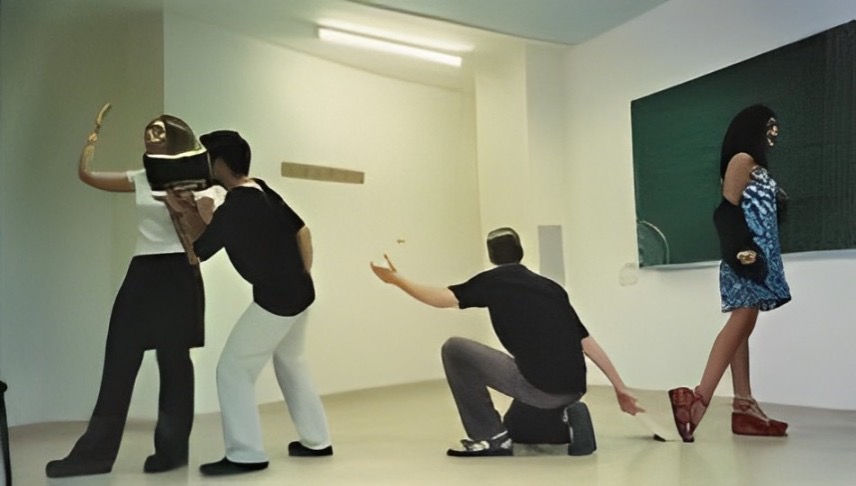
The picture below is an example of a dance phrase created by students expressing their interpretation of Genesis 4:9-10 culminating with “What have you done? Hark, your brother’s blood cries out to me from the ground.” Stance, movement, use of space are all elements that contribute to the interpretation.
Movement is a powerful way to teach, learn, and innovate and engages skills such as discipline, skill, and stamina. In this kind of holistic educational mode, we think about the body, content, and aesthetic expression. Whether the subject is Bible or reading, math or Hebrew, involving the body and recognizing that moving helps embody the learning and make it everlasting helps us and our learners to create a deep, meaningful, and engaging learning environment.
Especially in this difficult time, amid the trauma of war and personal losses, educators face challenging time. We need all the support and compassion we can get. Taking care of our bodies and souls can help to relieve some of the stress we all feel, consequently helping our learners. We hope you will find this issue interesting and helpful in your own practice.
We send our thoughts to the people who lost their dear ones and to the families of all who have suffered. As we write this in November, we still pray for the hostages’ return to safety and to the land of Israel and safety to all who dwell there.
On a personal note, I wish you, your families, and friends strength as we all hope for calmer and more peaceful days.
Ofra Arieli Backenroth Associate Dean, William Davidson Graduate School of Jewish Education
Teaching, Bible, and Tap Dance
“Like learning a language and learning an instrument” is how Dr. Amy Kalmanofsky describes the challenge of taking tap dance lessons. Through her own learning, she has gained an understanding of how movement can deepen her experience as a teacher and scholar.
Dr. Amy Kalmanofsky, Blanche and Romie Shapiro Professor of Bible and dean of both Albert A. List College of Jewish Studies and the Gershon Kekst Graduate School, has always been someone on the move. Since age 16 she has run six days a week, first thing in the morning, and she sees that daily run as a key contributor to her mental health. “My brain is just wired to appreciate movement,” she said.
Kalmanofsky has always shared a love of the arts, especially musical theatre, so it was not completely out of the blue about three years ago when she decided to explore moving her body in a whole new way: through tap-dancing.
Signing up for a class at the prominent Upper West Side dance studio Steps on Broadway, she jumped in not knowing what to expect (she even initially registered accidentally for a beginning class that was too advanced) but felt compelled to learn. “I’ve always enjoyed teaching, especially in a live classroom,” she said, “but I really love to learn.”
“Learning tap is the hardest thing I have ever done,” Kalmanofsky said. “Part of what is beautiful about tap is that it is non-verbal—it is speaking with sounds but without words.” Kalmanofsky’s academic career has been built on analyzing the language of the Bible, spoken and otherwise, which makes the wordless language of dance particularly attractive to her.
Kalmanofsky’s connection to movement and the body pervades her research. She is author of “Body Language: A Postmodern Interpretation of the Body in the Biblical Prophets” in The Oxford Handbook of the Prophets as well as “Bare Naked: A Gender Analysis of the Naked Body in Jeremiah 13” in Jeremiah Invented.
While movement in the Bible is often a narrative component and not a spiritual or esoteric aspect of text, Kalmanofsky appreciates the role of the body and movement in her own religious life.
“I’m not a meditator, but the rhythms of tap and the concentration needed to sustain them is meditative. In many ways, tap feels like a spiritual practice,” she said. “You have a deep connection to the other people dancing with you, a sense of community.” For Kalmanofsky, dance is what she called her “language of spirit.”
In communal prayer, her favorite liturgical moment is on Yom Kippur when the whole congregation bows to the floor during the aleinu prayer. “We need more physicality in our davening,” she said, understanding these movements as a means of “connecting to an abstract ideal filtered through an imperfect body.”
Becoming a student of tap dance has ignited Kalmanofsky’s curiosity in unexpected ways. Having lived in New York City for decades, she now finds herself going to jazz at Lincoln Center and reading about choreographers and dance theory. She appreciates the art of movement as a practitioner, not only an observer.
Kalmanofsky has also learned more about teaching. In her tap classes, she has observed how intuitively dance teachers adjust their teaching to the needs of their students. “For some students, tap is all about learning to count the rhythm; for others it is the mechanics of the step itself. I am in awe of what the teachers are actually doing for their students,” she said, emphasizing the “doing.”
“Tap is both learning a language and learning an instrument. It’s about skill and about expression,” said Kalmanofsky, and she has come to recognize the differences in these two modes of instruction. “On one hand dance teachers are teaching a skill, like teachers of a foreign language. And they are also teaching an appreciation for and expression of an artform.” Being able to do both at the same time takes considerable talent and considerable commitment to their students. “Dance teachers are amazing and unique educators.”
In higher education, especially with the pressures of tenure and subjective student evaluations, some professors have been made to feel that they need to perform. “We’ve lost our way a bit,” said Kalmanofsky.
Dance teachers at Steps—many of whom are or have been professional performers–are not performing in the classroom, they are student-focused, adapting their approach individually to the students in their classrooms, said Kalmanofsky. One thing that distinguishes Steps from other studios is that students do not perform at recitals. “It is all about what happens in class, learning to move your body in a deliberate way, with the process and product inextricably linked.” This is a mode of teaching that Kalmanofsky would like more educators to practice.
Kalmanofsky recalled one specific instructor who understood how to push and support students where they felt literally off-balance and physically vulnerable. “It can be deeply unsettling to not be able to control one’s body, to feel behind the rest of the class,” she said. Starting as a novice and working hard to learn tap, Kalmanofsky has gained great empathy for those who struggle to learn something like a foreign language or text.
“All learning, but especially learning that situates you outside your comfort zone, is an act of vulnerability,” she said. “Physically during tap, you are listening and moving and creating sound in ways that require enormous concentration, and that does not all happen right away at the same time,” she said.
At JTS, Kalmanofsky tries to channel her beloved dance teacher into her own teaching. Knowing when to push and when to support, creating a physical space for learners to allow themselves to be vulnerable are lessons she both practices and works to impart to the students in her classroom, many of whom will become Jewish educators.
While we might not catch Kalmanofsky tapping in Times Square, up on Broadway at 122nd Street, she is bringing rhythm and movement into her work, step by step.
“Boker Tov, Machaneh Ramah: Let’s Dance!”
Each morning hundreds of campers arrive at Ramah Day Camp in Nyack to the soundtrack of popular Israeli music. Rabbi Ami Hersh reveals the secrets behind “migrash dancing” and why getting everyone moving is a key ingredient.
At this time of year, the field—migrash—at Ramah Day Camp in Nyack, NY, looks seasonally appropriate. Leaves have fallen and been raked away, and all that remains is bare, tired-looking grass. During the summer, the landscape is remarkably changed, with beautiful full trees, but the grass itself remains similarly downtrodden for an entirely different reason: hundreds of small feet trample on it every morning in the ritual known as “migrash dancing.”
Rabbi Ami Hersh, camp director since 2021 and associate director since 2012, recalls the time a local Nyack resident, having heard the loud energetic music each morning, asked him if it was a workout camp. “He thought we were all about exercise,” said Hersh, who explained that the camp was dedicated to Jewish education.
Hersh received rabbinic ordination from JTS as well as two MA degrees, including one in Jewish education from The William Davidson School of Jewish Education in 2013. Beginning in 2000, Hersh joined Ramah Nyack as a counselor and held subsequent leadership positions there before being appointed director. He also previously taught fourth grade at the Solomon Schechter School of Greater Hartford. Hersh knew that camping was the perfect fit for his passion for Jewish informal education and role as a rabbi.
“Whatever I do at camp, I am doing it as a rabbi and educator,” said Hersh. “It is not just a business, we are helping campers, staff, and families take steps along their Jewish journeys.”
“Our well-worn migrash is one of the holiest places in camp,” said Hersh. “It is filled with kedushah.” Camp starts every morning with music and accompanying semi-synchronized movements. According to Hersh, dance is “a universal language that breaks down barriers and creates community.” What some call “migrash magic” is actually the result of careful planning over many months. The seemingly spontaneous appearance of hundreds of Israeli flags during any given song, for example, is usually orchestrated quite deliberately.
The tradition of migrash dancing at Ramah Nyack started close to 30 years ago during a heatwave, said Hersh. “It was really hot, and there was no air conditioning in any of the buildings.” Amy Skopp Cooper, Hersh’s predecessor and mentor (and current CEO of the Ramah Camping Movement), knew that they had to get everyone outside. She worked with the Rosh Rikud (Head of Dance) to put on music when the kids arrived each morning. Gradually the dancing evolved from classic Israeli folk dances and line dancing to today’s counselor-driven choreography to the beat of Israeli pop music.
In recent years, each edah/unit performs its own song and original dance in the camp-wide Festivale event. The most popular songs from previous summers join the playlist for migrash dancing in future summers. “The hits stick around for a bunch of year,” said Hersh.
“During the off-months, counselors spend hours finding the ‘perfect’ song and coming up with the movements,” said Hersh. There is a fairly rigorous review process to ensure that the songs are appropriate. “Even as the Israeli music scene has evolved to include some traditional liturgical themes, it can be a challenge to find lyrics that represent the values we want to transmit,” he said.
Each morning, the counselors lead the migrash dancing, and campers learn by doing. “Counselors are the coolest people in the world to the campers,” said Hersh. “We don’t actually teach the dances step-by-step the way you would in a formal class, we just put on the music and dance.” The language barrier usually is not an obstacle. “Words that may not mean anything to the children can become accessible if the movements are done well,” he said.
The many Israelis who are part of Ramah Nyack’s mishlahat delegation (traditionally the largest of any Jewish camp in North America) love that the music on the migrash is what they are used to listening to. “It is not your bubbe’s Israeli music,” said Hersh. “While some new staff members may be hesitant to get up and dance, during staff programming we emphasize how central this is to our educational approach,” he said.
“Through music we teach ahavat yisrael (love of Israel), tarbut yisrael (Israeli culture), musicality, gross and fine motor skills, as well as physical education,” said Hersh. “It is a great equalizer, anyone can do it.”
The camp’s reputation for using music and dance to nurture a love of Judaism lasts well beyond the summer months. Ramah Nyack’s summer playlist is shared widely and is regularly requested by schools from across North America who want to access the high-energy, positive Jewish soundtrack. In the past ten years they have made available instructional videos with the dance moves on the camp’s website. “Migrash magic has actually become its own genre,” said Hersh with pride.
Freedom of movement is one of the hallmarks of experiential education. “I want campers to run, play, and challenge their bodies in ways they don’t during the year,” said Hersh.
Hersh himself is a believer in the power of movement, and you will rarely catch him sitting still at camp. “I love walking around camp and observing what’s going on, jumping in when appropriate to a game or activity.”
Hersh calls his favorite kind of camp meeting “supervision by walking,” when he meets with a staff member while being out and about instead of in his office. And when he needs to sit for a meeting? “Conference Room Bet is a bench under my favorite camp tree in the middle of the buzz of our camp.” He has a well-developed system of stashing folders in his back pocket to keep track of critical information. “I know the staff might make fun of me for always pulling out my colorful folders, but I’ll do whatever it takes to keep moving around camp!” said Hersh.