Do you feel drawn to step forward in moments that matter? Do you want to deepen your relationship to Jewish prayer, music, and sacred texts? Do you want to elevate your impact as a Jewish leader?
Become a Shamash
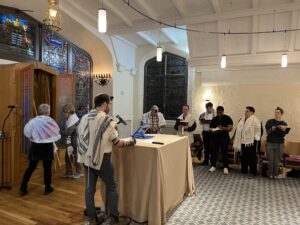
JTS welcomes emerging and established leaders who care deeply about Jewish community and seek to deepen engagement in its prayer and ritual life. Through our low-residency, cohort-based master’s program, students deepen their skills in prayer leadership, Torah, Hebrew fluency, and the choreography of communal ritual. Graduates earn an MA in Ritual Leadership from JTS and the professional title of Shamash—a steward of Jewish communal life who is equipped to serve and support communities and clergy with knowledge, presence, and care.
Core Curriculum
The MA in Ritual Leadership provides students with academic, skills-based, and practical experiential learning, grounded in JTS’s long-standing tradition of training Jewish clergy and educators. This part-time, online program consists of 30-credit hours of coursework and a total of eight days in residence at JTS.
Synagogue Choreography
Learn the ins and outs of facilitating tefillah and Torah services.
Liturgy
Explore the history, structure, and theology of Jewish liturgy.
Nusah
Learn melodies and musical modes for weekday and Shabbat prayer selections.
Cantillation
Master practical skills for chanting the Torah and haftarah.
Biblical Commentary
Engage with the intellectual traditions that shaped how Jews find meaning in Torah.
Hebrew Language
Hone your ability to read with fluency and precision.
Electives
Students in the MA customize their educational pathway with electives from JTS’s Center for Pastoral Education and The William Davidson Graduate School of Jewish Education. Students can choose from multiple classes:
Music, Art, and Texts of Comfort
Dying, Death, Grief, and Bereavement
Psalms and Spiritual Care
Teaching Prayer
Translating Jewish Theology for Educational Settings
Rhythms and Rituals of the Jewish Calendar
Residencies
Community Building: The MA in Ritual Leadership begins with a two-day, in-person residency at JTS, bringing the cohort together to build relationships and establish a shared foundation for learning.
Synagogue Choreography Intensive: The centerpiece of the Shamash Program, this course and accompanying four-day intensive residency trains students in the facilitation of tefillah and Torah services while deepening their understanding of how to effectively build and support prayer communities.
The Capstone: The program will conclude with a culminating project, a service designed and led by the student and workshopped by a panel of faculty, mentors, and peers over the course of the final two-day residency.
Frequently Asked Questions
Why Shamash?
In choosing the name Shamash (pronounced shah-MAHSH), we draw on the metaphor of the “helper” candle, which shares its light to illuminate the Hanukkah candles. We also invoke the historical role of the synagogueshamash, the community helpers and caretakers who were the stewards of the physical and spiritual spaces that allowed Jewish religious communities to thrive. This skilled sacred service tended to the practical and spiritual needs of the community and its clergy.
What is a low-residency program?
Low-residency programs combine synchronous and asynchronous distance learning with short, on-site residencies. Students pursuing an MA in Ritual Leadership spend a total of 8 days in residence at JTS, while taking online courses from wherever they live.
Do I need to complete this program in two years?
While this cohort-based program is designed to be completed in 2 years, there is flexibility for students to move through their requirements at their own pace.
Can my prior learning or professional experience count toward the degree?
Yes, the program recognizes that meaningful learning and skill development occurs beyond the classroom. Students may earn up to 12 credits through Prior Learning Assessment (PLA), which evaluates substantial learning acquired through professional and educational experiences. PLA credits are awarded only for learning that meets program standards and institutional policies on academic integrity.
Is financial aid available for this program?
Yes. To be considered for a tuition fellowship, please submit the FAFSA application.
Do I need to be affiliated with the Conservative movement to enroll?
No,the MA in Ritual Leadership is open to emerging and established Jewish leaders from all backgrounds. While courses in Nusah and Liturgy are grounded in the Conservative Movement’s siddur Lev Shalem, students engage these materials with attention to their broader relevance across Jewish communal life.
What Hebrew level is necessary to enroll?
Applicants should be able to read and vocalize the alef-bet and demonstrate a readiness to continue developing their Hebrew skills. All students complete a placement assessment upon matriculation so that they can begin their studies at the level best suited to them.
Our Visioning Team:
While newly launched, the MA benefits from JTS’s expertise and experience in the training of rabbis, cantors, and pastoral caregivers:
Dr. Alisa Braun, Academic Director, Center for Lifelong Learning
Dr. Lisa Springer, Associate Provost for Continuing and Digital Learning and Dean of the Division of Lifelong and Professional Studies
General Counsel
Who is JTS
JTS is a preeminent institution of Jewish higher education, training thoughtful, innovative leaders—rabbis, cantors, educators, lay leaders, and scholars—who strengthen our communities with a vision of Judaism that is deeply grounded in the Jewish past and thoroughly engaged with contemporary society. JTS also provides high-caliber lifelong learning and professional development to our alumni, adult learners, and Jewish communities throughout North America. Through its Library, JTS preserves and makes accessible to students and scholars throughout the world the greatest collection of Judaica in the Western Hemisphere.
Description of Position
The General Counsel (“GC”) is the chief legal officer of The Jewish Theological Seminary of America. The GC advises JTS’s Chancellor, administration, and staff and also serves as the principal legal advisor and assistant secretary to the Board. The GC reports to the Vice Chancellor, Chief Operating Officer. The GC is responsible for a wide range of legal, regulatory, compliance, insurance and risk management matters. The GC has confidential access to the Cabinet (senior management) and the Board of Trustees and provides them with legal advice and counsel on legal and governance issues, institutional concerns and any other matters that they or the GC deem appropriate.
Duties/Responsibilities:
Board governance issues and Board committee matters, including preparation of trustee materials, resolutions, and minutes.
Advise the Institute Advancement Department regarding gifts, estates, and trusts;
Student matters, including Title IX and other disciplinary matters, housing issues, accessibility, and other matters that impact campus operations
Faculty and staff matters, including employment, accommodation, and tenure issues;
Prepare, review and negotiate contracts, leases and other documents relating to all transactions to which JTS is a party
Intellectual property, including protection and licensing of JTS copyrights and trademarks;
Compliance with governmental regulations at all levels;
Advise on and update institutional policies as needed
General corporate governance issues;
Risk and litigation management
Management of outside legal resources
International compliance and regulatory matters for all affiliate organizations
Minimum Requirements:
A law degree from an accredited law school, a member in good standing of a state bar, at least seven (7) years experience, a strategic thinker with common sense and demonstrated leadership in the handling of varied legal work. Excellent interpersonal and communication skills, patience, and the ability to respond quickly and effectively to urgent matters are all required. Experience working with administrators in the ongoing daily activities of a college or nonprofit organization, knowledge of litigation practice and a sense of humor are all pluses. JTS encourages diversity, and qualified applicants from all backgrounds are welcomed. The General Counsel position requires a background check before hiring.
Salary: $200,000 (Commensurate with experience)
Application Instructions:
Review of applications will begin immediately and will continue until the position is filled. For fullest consideration, applicant materials should be received by February 5th. Candidates should provide a resume; a letter of application that addresses the responsibilities and requirements described above; and the names and contact information of three references. This search will be conducted with great respect for confidentiality, and references will not be contacted without prior knowledge and approval of candidates. Please e-mail your resume and cover letter to jtsaresumes@jtsa.edu. No telephone calls, please.
JTS is launching a new Master’s in Ritual Leadership launching in Fall 2026. This part-time online degree is designed for the people who help lead tefillah, chant Torah, and serve as spiritual anchors.
The new MA in Ritual Leadership offers:
A part-time, cohort-based online pathway
Coursework in prayer leadership, pastoral sensitivity, Torah skills, and Hebrew language
Experiential learning in synagogue choreography
Short in-person residencies at JTS
…grounded in JTS’s century-long practice of training rabbis, cantors, and chaplains.
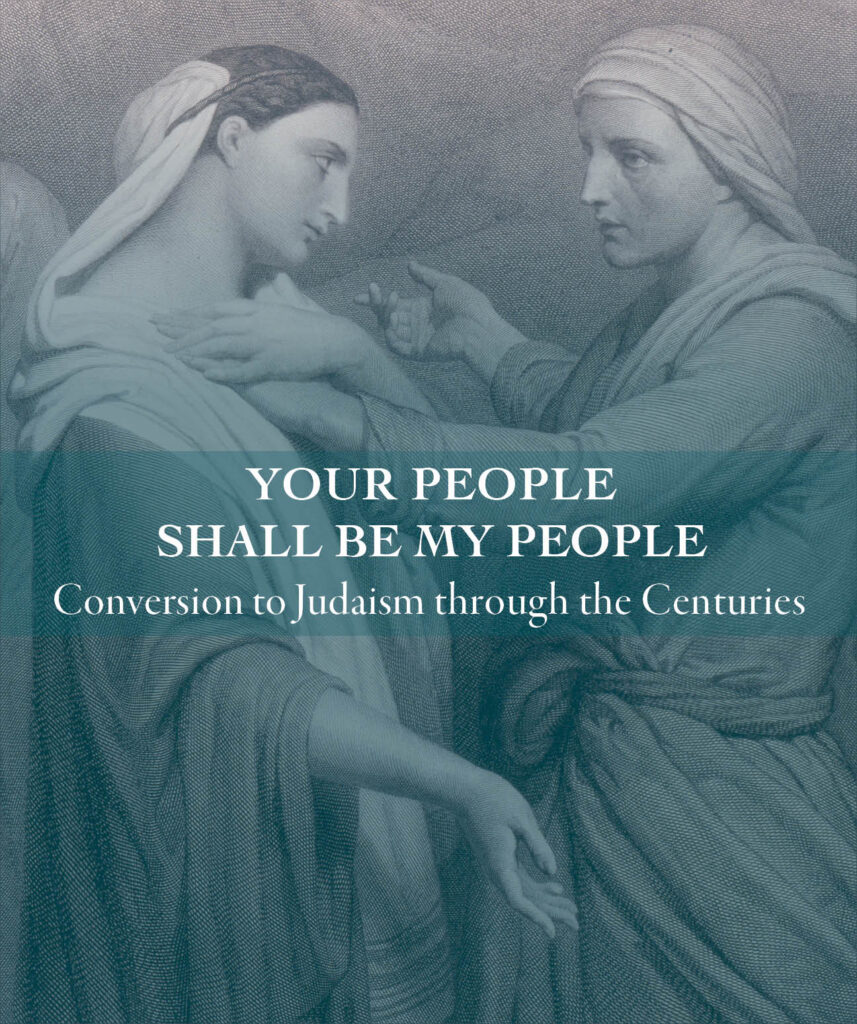
Your People Shall Be My People: Conversion to Judaism through the Centuries
January 22–July 23, 2026
Join us for the opening event on Wednesday, January 21, 2026 at 5:30 p.m. ET.
Throughout Jewish history, from biblical times to the present, non-Jews have joined the Jewish people. How they have done so, however, has differed greatly from one historical context to another. Changing conditions of Jewish life have led to striking variations both in the motivations of converts and in the requirements for their formal acceptance as Jews. Yet some features of conversion to Judaism, or giyyur (in rabbinic terms), have been remarkably stable over the long period since rabbinic law became normative throughout the Jewish diaspora.
A major element of giyyur that distinguishes it from conversion in other cultures is its dual nature: the convert not only adopts a religious practice but joins a people. This duality is famously expressed by Ruth the Moabite, the biblical figure most closely associated with Jewish conversion, when she declares that “your people shall be my people, and your God shall be my God” (Ruth 1:16). Contrary to popular assumptions, however, the Hebrew Bible lacks a concept of conversion. The biblical “ger” was not a convert either in an ethnic or religious sense but was rather a foreigner living among Jews. It was only in late antiquity that the rabbis of the Talmud articulated the process of conversion they called giyyur. Over the centuries, rabbinic authorities have produced a rich and varied literature dealing with novel issues raised by specific cases or by changing social realities. Other sources – among them Geniza documents, ketubbot (marriage contracts), autobiographical accounts, and chronicles – throw light on historical trends and on the lives of individual converts.
This exhibit draws from The Library of The Jewish Theological Seminary’s rich collection of manuscripts, rare books, and other items to illustrate some of the changes and continuities over time in the understanding and practice of conversion to Judaism.
From the Associate Director
I welcome you to the fall 2025 issue of Gleanings, a publication of The William Davidson Graduate School of Jewish Education. The issue, focusing on “Jewish Education: Casting a Wider Net,” comes out in a hopeful time. My heart is filled with relief and gratitude as we welcome the released living hostages home. In moments like these, Jewish educators help our students—and all of us—find the language and the tools for hope, compassion, and resilience. May the families still awaiting the return of their loved ones find strength and support.
As I watched the reunion videos over and over, I realized that even as each former hostage was the focus of so much attention, surrounding them was a broad and diverse community—family members, security team, healthcare providers, friends. All these individuals, not to mention those of us watching from around the world, experience tremendous impact from such powerful moments. Educators in the field know that learning and impact can indeed have a reach far beyond the students in their classrooms.
Mentoring, teaching, and constructing Jewish life can happen in many ways. As experienced, creative educators, we are faced with multiple ways of practicing Jewish education. In this issue, we are presenting four educators whose educational impact extends broadly into the surrounding community. We know that community is at the heart of Jewish education. Judaism is not only learned from books but lived with others—through shared practice, values, and relationships. In communities, students discover belonging, deepen identity, and see themselves as part of the Jewish story. It is through connection with others that Jewish learning becomes Jewish living
For this issue, we approached experienced educators whose thoughtful and innovative initiatives inspire, educate, and support not only the organizations where they are employed, but deep into the broader community.
Rabbi Anne Ebersman, a doctoral candidate at the Davidson School is the director of hesed and tzedek at the Heschel School; Allie Conn Kanter is the senior director of programs and engagement at Hadar; Rabbi Yael Beuchler is the rabbi and outreach coordinator at the Leffell Lower School; and Rabbi Charlie Schwartz is the co-founder of Lehrhaus. Each of these educators approach community in different ways, reaching out to the wider community with innovative tools and ideas. We, part of the broader community they reach, are the beneficiaries of these creative and original ideas about Jewish education.
Especially in this difficult time, amid the trauma of war and personal losses, educators face challenges and need all the support and compassion we can get. We hope you will find this issue interesting, hopeful, and helpful in your own practice.
We send our thoughts to the people who lost their dear ones and to the families of all who have suffered. As we write this in November, we still pray for peace and safety to the land of Israel and well-being to all who dwell there.
Ofra Arieli Backenroth The William Davidson Graduate School of Jewish Education
Relationship-Based Engagement
To Allie Conn Kanter, being an educator “by example” starts with knowing yourself and who you want to be to those you encounter. From hands-on engagement experience in campus work to her current work at Hadar, she understands how diverse the pathways can be to Jewish education.
“Engagement” has been in nearly every one of Allie Conn Kanter’s titles since her first job at University of Michigan Hillel, and the Hillel model of relationship-based engagement is core to how she defines herself as an educator.
Now serving as the senior director of programs and engagement at Hadar, Kanter entered the MA program in experiential education at the William Davidson Graduate School of Jewish Education in 2012 in order to professionalize the work she had been doing at Hillel and gain pedagogical skills and more background in studying Jewish text. “I wanted to be a Jewish educator by example, and I needed to boost my knowledge and skills to do that,” she said.
To Kanter, being an educator “by example” starts with knowing yourself and who you want to be to those you encounter. She learned from her own experience as a student intern at Penn State Hillel that relationships are “part and parcel” of the learning experience. Kanter sees being an educator as a mode, a professional identity that requires you to put yourself in direct relationship with those you seek to engage.
Kanter’s own career journey in engagement took root as an undergraduate at Penn State. Having grown up in a vibrant Conservative community in the Philadelphia area, Kanter attended public school and was active in Jewish life through programs like USY and the Alexander Muss High School in Israel. At the time Penn State was not known for a strong Jewish life, and Kanter forged her own personal path to keeping Judaism relevant to her life, choosing to keep kosher and opting to study abroad at Tel Aviv University.
Building on her “Big Ten” roots, after graduation Kanter accepted a position as a Berman Fellow at the University of Michigan Hillel. It was during a period of leadership transition at Hillel, and Kanter took on considerable responsibilities. “I was punching outside my weight class and learning a lot on the job,” Kanter recalled. She discovered that she truly enjoyed engagement work in the context of a vibrant Jewish community. From Michigan she moved to New York to attend Davidson.
One of the most significant parts of Kanter’s Davidson experience was her semester in Israel as part of the Kesher Hadash seminar led by Dr. Alex Sinclair, which drew students from across Davidson’s tracks. “This was a very intense semester where a small group of us were grappling with our own Jewish journey, relationship to Israel, and personal Jewish practice,” she said. For Kanter, who remains close with the members of her group, it was the opportunity to truly ask herself what it meant to become a Jewish educator.
Each student in Kesher Hadash took on a project, and Kanter chose to study the Nava Tehila singing prayer community in Jerusalem. “I have always been drawn to music and found it very accessible,” she said. Kanter approached the leaders of Nava Tehila intending to study the group and soon found herself drawn in to join the community. “My way in was in ‘educator mode’,” she said, “and it was this pathway that helped me truly grasp what that meant to my professional identity development.”
Kanter created a short video about Nava Tehila’s mission and community and, in the process, understood how important creating relationships was to becoming the kind of educator she intended to be. Becoming part of Nava Tehila’s Levite Circle, Kanter understood the impact being an educator has on the identity of the educator.
After Davidson, Kanter returned to campus work as director of engagement at Columbia/Barnard Hillel where she was able to test out the skills she gained in graduate school. “Whatever program or project I was working on, it was in relationship with students,” Kanter said. Hillel work bends to the interests of students, and Kanter loved the 1:1 work with students.
In her current role at Hadar, where she has worked for the past eight years, Kanter oversees program and engagement and brought these two teams together in recognition of how interdependent they are. “Hadar is an institution with a clear religious vision—we create opportunities for people to learn and observe mitzvot,” Kanter said. Alongside the faculty at Hadar who put text and religious practice at the center, Kanter ensures that everything Hadar does connects meaningfully to people wherever they are.
Kanter uses the term “audience arcs” to describe the diverse ways people engage with Hadar. “A big part of my role is to understand the very diverse pathways people take to Hadar and to ensure that my team is prepared to meet these people wherever they are on their individual pathway,” she said. She and her team are always considering demographics and how to best and most intentionally engage people with Hadar’s mission at different points throughout the year.
Having “engagement” in her title might seem like a more refined term than “marketing,” but to Kanter there is a substantial difference. While “marketing” might cover the activities it takes to bring people into a space, “engagement” speaks to the relationships that make Hadar a place where people feel at home, and comfortable accessing Torah, according to Kanter.
Kanter’s commitment to engagement—perhaps the part of her that will always remain a Hillel professional—extends to her role in supervision and team management. Mentorship animates Kanter, and she embraces “relational supervision,” the concept that access to any kind of on-the-job learning—perhaps especially Jewish education—depends on human connection and understanding. As a fellow in the Mandel Institute’s Executive Leadership Program, Kanter actually delivered a capstone project on the topic of relational supervision.
“I love where I work because learning is taken seriously both for the participants and for us personally,” said Kanter. “As an educator I am driven by a need to be constantly learning, and I feel very lucky to work at an organization—and across the wider Jewish landscape–with like-minded educators and learners.”
Designing and Building for Engagement
“Many people feel that there are a lot of barriers to Jewish life,” said Rabbi Charlie Schwartz, co-founder of the Lehrhaus Jewish tavern and house of learning in Somerville, MA. Schwartz is dedicated to designing and building creative ways and spaces for Jewish life and learning to spread.
It was the middle of the pandemic, when social isolation made the lack of community feel acutely painful. Rabbi Charlie Schwartz and his friend, creative entrepreneur Joshua Foer, daydreamed about a new type of authentically Jewish destination.
“Our goal was to create spaces where love of Jewish life and learning can spread,” said Schwartz, who received ordination from The Rabbinical School at JTS and an MA from The William Davidson Graduate School of Jewish Education.
With vision, enthusiasm, and philanthropic support—along with expert partners in the food and beverage industry—the team launched Lehrhaus in Somerville, MA, a “Jewish tavern and house of learning.” In 2023, Esquire magazine named Lehrhaus one of the 50 best new restaurants in the US, with the reviewer stating, “I’ve been to thousands of restaurants in the past couple of years, but I hadn’t truly felt at home until I walked into Lehrhaus.”
Accolades poured in for the culinary experience and so did those hungry for a Jewish experience. Converts came for a celebratory meal following their conversion; curious area residents popped in, including a Cape Verdean woman who shared the family legend that they were actually Jewish.
The menu and décor at Lehrhaus reflect a Jewish aesthetic—one dish features Old Bay spice which diners learn was invented by Gustav Brunn after his escape from the Nazis—and there’s a bar and cozy nooks for snacking and hanging out. Lehrhaus also features a well-stocked beit midrash and classroom space where two to three classes take place daily. Even the menu is designed to resemble a page of Talmud.
The decision to engage community through a dining and learning space made a lot of sense to Schwartz and his co-founder Foer, known for creative contributions such as Atlas Obscura, Sefaria, and Sukkah City.
“Many people feel that there are a lot of barriers to Jewish life,” said Schwartz. “At a restaurant, which is in the hospitality business after all, you know the rules—where to sit, when to go, what to wear. We are a place of comfort that serves all,” he said. “Our doors are open wide.”
Schwartz and his partners wanted to situate their venture in a neighborhood where young Jews were living with minimal existing Jewish infrastructure. “Our competition is not synagogues or Jewish organizations,” said Schwartz, “it is other restaurants or Netflix.”
Somerville fit the bill.
Partnerships and openness contribute to the popularity and accessibility of Lehrhaus. Schwartz described how the recent 3rd annual Oktoberfest was designed in collaboration with the German consulate of Boston as a celebration of German-Jewish life. A chaplain recently led a class on death and dying to his non-Jewish colleagues at Lehrhaus, which was a way for them to experience Jewish learning without feeling out of place as they might in a more traditional synagogue setting.
The earned revenue of the restaurant contributes to Lehrhaus’s ability to deliver on its mission of creating community and engagement. Schwartz said that a recent survey found that 75% who come report they have conversations they wouldn’t have in any other space.
“Wherever rabbis find themselves, they are educators,” Schwartz said. Lehrhaus is just the latest expression of his spiritual calling.
Growing up in Portland, OR, Schwartz was particularly inspired by Rabbi Joshua Stampfer, a Haganah veteran who built up many of the institutions that are core to Portland’s Jewish infrastructure. “Rabbi Stampfer saw a need and got to work building, whether it was a nursery school, summer camp, or Jewish museum,” said Schwartz.
After graduating from Oberlin, Schwartz followed in his mentor’s footsteps and joined the IDF where he served as an infantry squad commander. “I felt a profound connection to Israel’s land and society as well as to the values that should inform behavior,” he said.
At JTS, simultaneous with his studies in rabbinical school, Schwartz chose to concentrate on day school education at Davidson. He was drawn to 20th-century intellectuals such as E.D. Hirsch, author of Cultural Literacy, and curriculum design theorist Joseph Schwab.
Schwartz’s practicum took place at SAR in Riverdale, a school known for its innovative “open classroom” architecture. “I deeply appreciated the thought that went into building SAR’s space,” said Schwartz. His experience in the school complemented what he was learning with Davidson professor Shira Epstein on known and “unspoken” curriculum.
Committed to serving on the cutting-edge of educational innovation, Schwartz was tapped by former Chancellor Arnie Eisen to serve JTS as director of digital engagement and learning. Schwartz used social media and created online archives of Torah commentary in order to make learning more accessible.
Wherever he has worked—running the Brandeis Genesis and BIMA precollege program or spearheading professional development at Hillel International—Schwartz has opened up possibilities for deeper connections to Jewish life.
“At Brandeis we created a design lab where the teens applied design theory to real challenges,” said Schwartz, including renovating a cemetery chapel and redesigning the atrium space of a senior care facility to serve as a prayer space. “Even small tweaks like creating a threshold with hooks for tallitot can define an open space as sacred,” he said.
Schwartz sees opportunity for engagement all over and has created the Pocket Torah free mobile application where users can learn how to chant the weekly Torah and Haftarah portion wherever they are.
With a seemingly endless well of creative ideas, Schwartz feels deeply empowered to emulate Rabbi Stampfer and to keep building. Lehrhaus is planning to open a branch in the DC area next year.
“Every community should have synagogues, a JCC, day schools, a mikveh,” said Schwartz, “and they should have a Lehrhaus.”
Making Meaning Through Broad Engagement
Rabbi Yael Buechler finds opportunities for Jewish education even when shopping at Target. Her work as a day school rabbi, small business owner, and influencer draws on her enthusiastic and creative love of Jewish life.
Bloomingdale’s is not exactly where you might expect to promote meaningful Jewish connection, but for Rabbi Yael Buechler, marketing Midrash Manicures alongside luxury fashion items was a perfect fit. “Nail art is not typically part of the rabbinate. I love taking something I am already passionate about and channeling it into to Jewish life in ways that broadly engage others,” she said.
The spark behind Midrash Manicures (which now also features holiday-themed pajamas for all ages) ignited while Buechler was in rabbinical school. For fun she hand-painted manicures to match each parsha or holiday. Buechler was ordained in 2011 at JTS, where she also took classes in The William Davidson School of Jewish Education. Currently lower school rabbi and outreach coordinator at the Leffell School in White Plains, NY, she also served as a mentor in Davidson’s MA practicum component.
As an educator, small business owner, and social media influencer, Buechler draws on the love of Judaism and creative spirit she inherited from her parents—a rabbi and an art therapist—and the inspiration she gains from her two young children, who often model some of her merchandise at midrashmanicures.com.
Engagement and Jewish Education
Buechler’s success at Leffell, where she is in her fifteenth year, grows from her unique combination of complementary skill sets. As rabbi, she draws on authentic Jewish wisdom and pastoral skills, and as outreach coordinator, she enlists entrepreneurial spirit and what she knows about Jewish engagement.
Buechler deeply believes that while Leffell’s students and teachers are primary constituencies, her vision, personally and for the school as a whole, depends on creating relationships and interacting with members of the school’s kehillah (community) on and off-campus. “Parents, grandparents, community members. They are all part of who we partner with as we envision the future of Leffell and the Jewish people,” she said. “I am driven to connect with the next generation of the school, and that means families with children of all ages.”
As an example, Buechler points to the famous Spotify playlists that she curates around holidays and that Leffell plays on loudspeakers around school. “I am not a musician,” said Buechler, “but I appreciate the power of music.” She has heard from families who play her Spotify playlists during carpool in Westchester as well as from people across the country who find these resources online.
“At Leffell, we want to engage people in ways that feel joyful and meaningful so that they move forward on their Jewish journeys,” said Buechler.
Buechler compares the impact of these playlists to the feeling shoppers get when they walk into a mall at Christmas time and hear carols playing. “We can imbue the whole environment around us with opportunities for learning, loving, and finding meaning in Judaism.”
When Buechler supervised a rabbinical student who was also pursuing an MA at Davidson, she worked with him on integrating new families to the school. “Engagement does not end once a family has enrolled,” she said, “and paying attention to details and the ways technology can help—something as simple as adding a calendar link to the announcement of school-wide tefillah—demonstrates an investment in deep relationship.”
“Coming to Leffell is about participating as a family in the school,” said Buechler.
Years ago, in advance of a snowstorm when school was sure to be cancelled, Buechler led the effort to distribute yeast packets to all lower school families so that they could bake challah on the snow day and then share photos online. “This was before the pandemic, and the ‘Challahthon’ was such a fun way of being together even when we were physically apart,” she said, “that we’ve held the Challahthon annually on the first snow day of the season ever since.”
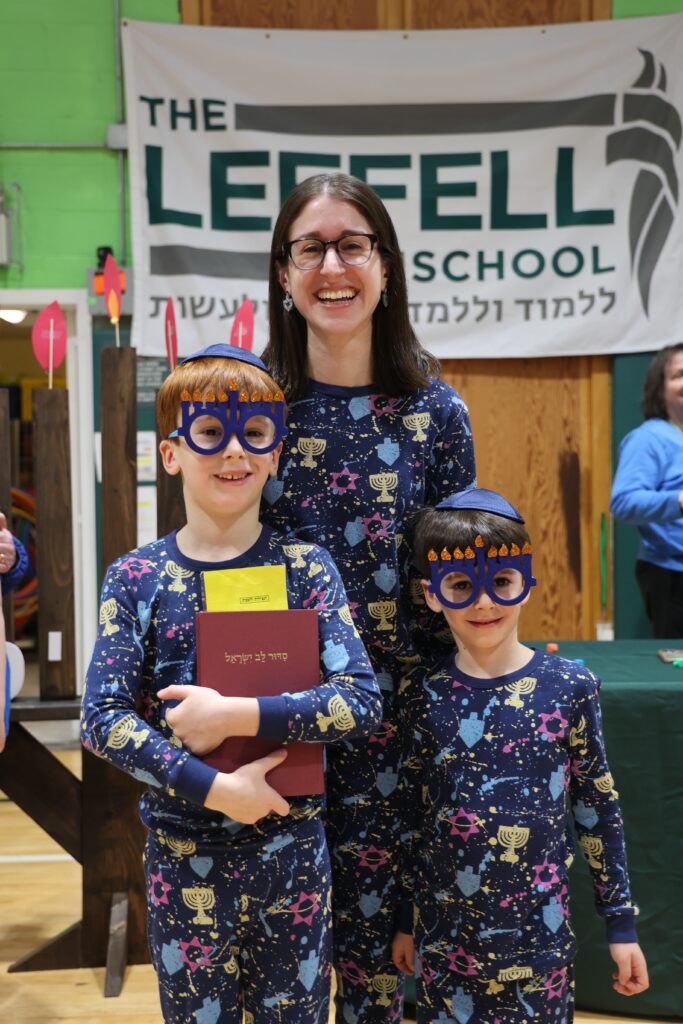
Rabbi Yael Buechler with her kids at The Leffell School, wearing matching Splatter Paint Hanukkah Pajamas
Education and Engagement in the Marketplace
In her small business, Buechler is committed to authenticity and high quality. “When my Hanukkah pajamas were featured on The Today Show, the producers were drawn to the idea that these PJs were created by a rabbi,” said Buechler. “What matters to me is that the products are made from cozy fabric in modern patterns, not based on an antiquated idea of what Judaism means.”
At first, Buechler avoided the crowded marketplace of Hanukkah products (the first pajamas she designed were actually for Passover, a night when kids are often up late). “There had to be more than just blue, white, and gold Jewish stars!” Buechler observed.
She was frustrated to find rampant errors in Hanukkah merchandise, either mistakes in Hebrew letters on dreidels, for example, or in the representation of a hanukkiyah without its required 8+1 branches. She now collects examples of what she calls “Hanukkah mishaps,” and posts clips on social media that have attracted a following.
Last Sukkot, Buechler found a holiday mishap that presented a more sophisticated educational opportunity. “I came across a pop-up Sukkah that was decorated with Hanukkah images and ‘Happy Hanukkah’ in Hebrew.
“I remembered a class that I took with Professor David Kraemer where we explored the importance of Hanukkah in the Talmud and delved into the Book of Maccabees to discover how Hanukkah was actually a redo of Sukkot.” Buechler seized upon this opportunity to share these ideas with her social media audience, many of whom had never heard of these origins of Hanukkah.
Buechler sees her role as an online influencer as another expression of Jewish engagement. Through her social media posts, she creates a sense of community in the virtual world, using easily relatable themes to connect people with Jewish life.
“When the Barbie movie was such a big hit, I developed tools for hosting a Barbie Shabbat dinner,” recalled Buechler, including a “dreamy” challah cover. “My kids are the source of a lot of my wild ideas.”
For Buechler, connecting pop culture or her family’s interests to Jewish life is just core to her identity. “I take things I am already passionate about and form a connection,” she said. “It is not hard to connect yourself—or others—to Jewish life when you start with passion and discover ways to make meaning.”