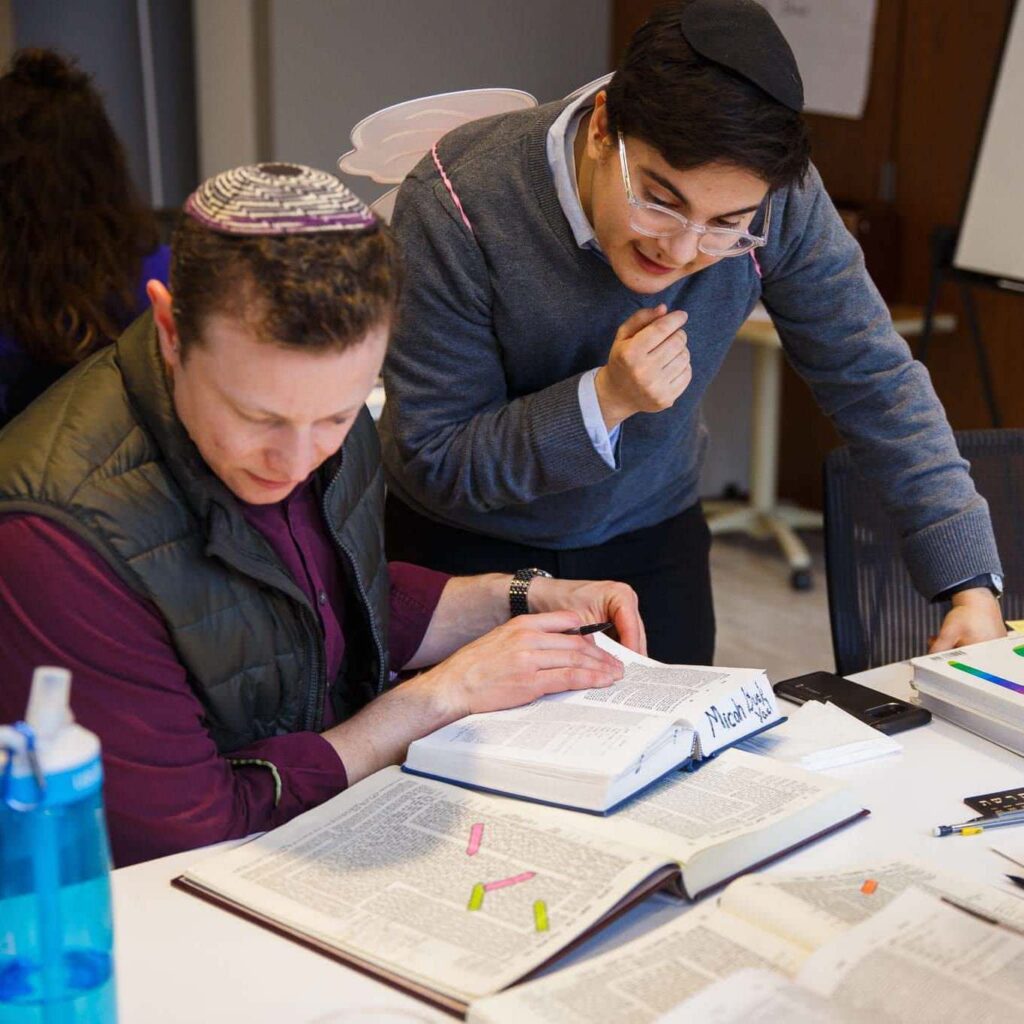
Mazal tov to our 2022 graduates who have taken on these positions:
Matthew Altman is an assistant director of Park Avenue Synagogue’s Congregational School.
Leehee Baruch is a teacher at the Abraham Joshua Heschel High School.
Anna Bruder is continuing her JTS studies and enrolled in The Rabbinical School.
Gabe Cohen is the assistant rabbi of Temple Emanu-el of Closter, New Jersey.
Shira B. Forester is a Judaic studies teacher at Luria Academy in Brooklyn.
Adam Gillman is continuing his JTS studies and enrolled in The Rabbinical School.
Harman Avery Grossman is assistant general counsel at Johnson and Johnson Inc.
Anna Hartman is the director of early childhood excellence at the Jewish United Fund in Chicago.
Aaron Hersh is an assistant director of Park Avenue Synagogue’s Congregational School.
Elyssa M. Hurwitz is a Jewish educator at the Moishe House in New York City.
Jesse Nagelberg is serving as the rabbi of Congregation Bnai Shalom of Olney, Maryland.
Jacob E. Nurick is the manager of adult engagement at the JCC Mid-Westchester.
Nancy Parkes is the founder and CEO of JTeachNOW.
Kayley Romick is a chaplain resident at Catholic Health Services of Long Island.
Alicia Rosenbaum joined Rutgers Hillel as its Israel engagement and programming coordinator.
Tab Scribner is the director of congregational learning at Temple Judea in Fort Myers, Florida.
Sara Shapiro-Plevan is the founder and CEO of the Gender Equity in Hiring in the Jewish Community Project and also of Rimonim Consulting.
Ben Varon is a chaplain resident at New York Presbyterian Brooklyn Methodist Hospital.
We wish continued success to our alumni from all years on these accomplishments:
Sara Stave Beckerman became the director of Hebrew Home Page, part of the JCC Manhattan’s Jewish Journey Project. Sara continues to teach at the Schechter School of Long Island.
Melissa Cohavi recently became the director of Park Avenue Synagogue’s Congregational School.
Lynn Davis is the director of the Jewish Community Relations Council for Tucson and Southern Arizona and works out of the Tucson Jewish Museum.
Makai Dorfman is completing a master of science degree in Marriage and Family Therapy from University of Wisconsin-Stout and serving as a marriage and family therapy intern at Evolve Therapy in Plymouth, Minnesota.
Daniel Dorsch and Sami Tanenbaum were included in this year’s Jewish Atlanta’s 40 Under 40 for 2022
Jenna Ferman is the assistant director at Penn Hillel, having previously served as its director of student and Israel engagement.
Jodie Goldberg is now the program officer at The Covenant Foundation.
Hillary Gardenswartz is the new director of student experiences at Civic Spirit.
Lesley Hoffman Goldenberg was promoted to director of family education at Congregation Temple Israel in St. Louis, Missouri.
Hannah Grossman assumeda new role at Repair the World as its New York program director.
Ben Herman became the senior rabbi of Mosaic Law Congregation in Sacramento, California in July 2022.
Brandon Johnson was recently promoted to be the Director of Business and Operations and Registrar at Camp Ramah in Northern California.
Daniela Kogan joined Jewish Community Relations Council of New York as its new program associate, fellowships and coalitions.
Debbie Kornberg is the founder and CEO of www.spiceandleaf.com. Through her cooking classes and live broadcasts, Debbie infuses her degree in Jewish education with her knowledge of Israel and passion for teaching others how to create delicious and healthy meals using ingredients from around the world.
Kelly Kossar became a Jewish learning guide at Temple Beth Shalom in Needham, Massachusetts.
Yigal Kotler is a 2022 Covenant Award recipient for his impactful work with the Russian-speaking Jewish community as the director of Jewish education at the Council of Jewish Emigre Community Organizations.
Rachel Krueger is the Chief Development Officer at ImpactIsrael.
Glenna Lee joined the JCC Manhattan as a meditation instructor in summer 2022.
Sarah E. Levine recently became the cantor at B’nai Aviv in Weston, Florida.
Rachel Alexander Levy was recently appointed the executive director of Jewish Federation of Eastern Connecticut in New London, Connecticut.
Jessie Lavintman is serving as the interim Newman School director for the 2022-2023 academic year. The Newman School is part of Talmud Torah of St. Paul’s offerings.
Jamie Mafdali was promoted to director of youth engagement: learning and program at Temple Dor Dormin in Weston, Florida.
Marla Field Olsberg joined Brandeis University’s Hornstein Program as its program manager in April 2022.
Ari Perten is the vice president of programming, New York for Moishe House.
Zac Price joined the faculty of Towson University as assistant professor of early childhood education.
Yanira Y. Quinones recently joined the professional team of the Harold & Elaine Shames Jewish Community Center as its director of Jewish life.
Amy Ripps retiredfrom Beth Meyer Synagogue as its director of congregational learning and now serves as the southern region coordinator for JSurge.
Mark Robbins is the new director of Jewish life and rabbi at Washington and Lee University.
Alyssa Rachel Schwager is the new director of youth and family engagement and director of programs of Beth El Synagogue Center in New Rochelle, New York.
Charlie Schwartz recently launched Leharus: A Jewish Tavern and House of Learning in Somerville, Massachusetts.
Vanessa Shamosh is the Director of Admissions & Enrollment Management at the Jewish Leadership Academy.
Yoni Stadlin, co-founder of Eden Village Camp, is now the chief program officer at Hazon.
Dana Levinson Steiner completed her studies and earned a Ph.D. from NYU Steinhardt in June 2022. Dana serves as the director of ACCESS Global at AJC.
Joshua Troderman is now the director of donor relations at Brandeis University.
Samantha Vinokor-Meinrath, senior director of knowledge, ideas, and learning at The Jewish Education Project, published her book, Coming of Age During the Resurgence of Hate, last June and was an Education and Jewish Identity finalist in the 72nd National Jewish Book Award. We also thank Samantha for co-facilitating an interactive webinar for Davidson alumni in November 2022, on best practices for scaffolding conversations with students about contemporary antisemitism and the implications of this learning for choices related to Jewish identity.
Hannah Wallick is the new director of Camp Young Judaea Midwest.
Allison Bratt Weil is the new director of early childhood education at the Rabbi Mark and Morah Renee Panoff Preschool of Temple Isaiah in Fulton, Maryland.
Aliza Weinstock transitioned out of the day school setting and now applies her knowledge and skills to better strengthen theGreater MetroWest Federation in New Jersey as its Quest for Excellence day school manager. Aliza works closely with local day schools including Golda Och Academy, Kushner, JEC, and Gottesman on their ongoing professional development initiatives.
Julie Wohl is now the director of education at the Baltimore Hebrew Congregation in Baltimore, Maryland.
Dahlia (Bernstein) Yafé is the new director of Jewish culture and programming at the JCC Mid-Westchester.
Mazal tov to all the outstanding Jewish educators, especially our Davidson alumni, who were selected to receive a 2022 Covenant Foundation grant to support their creative approach to Jewish education: Mara Braunfeld, director of children and families at the Hadar Institute, received a Signature Grant to create A Little Taste of Devash—original Torah content for young children and their families based on the weekly parasha; Susie Tanchel, vice president of community education at Hebrew College, along with her colleague received a Signature Grant to strengthen the spiritual formation of rabbinic education among current students; Pamela Barkley, vice president of programs of Moving Traditions, received a Signature grant to expand Kulam, a new-post-b mitzvah program for tends of all gender identities; Laynie Soloman, associate rosh yeshiva & director of transformative leadership of SVARA: A Traditionally Radical Yeshiva, received a Signature Grant to expand the Pedagogy Chaburah, a teacher-training program that facilitates SVARA’s method of Talmud study to be taught at other organizations and in other communities; Eliana Light, founder and head t’fillahsopher and podcast co-host of the Light Lab, received an Ignition grant to create the T’fillah Teachers Fellowship to train congregational educators in innovative pedagogy of spiritual development in religious schools across the country.
Mazal tov to all the rabbis and Jewish educators named in the 2023 JJGI Fellowship for Rabbis and Senior Educators, particularly all JTS alumni and these Davidson alumni: Saul Kaiserman, doctoral candidate; Etan Weiss, the director of Jewish life at the Milton Gottesman Jewish Day School; and Benjamin Herman, senior rabbi of Mosaic Law Congregation.
Mazal tov to all the Wexner Field Fellows in Cohort 7, especially our three Davidson alumni: Dr. Hannah Bennett, who is the head of school of Briskin Elementary, Temple Israel of Hollywood’s Day School in Los Angeles, California; Dr. Laura Herman, who isdirector of program and evaluation at JPRO Network; and Ivy G. Schreiber, who is thedirector of New York education initiatives at the Jewish Education Project.
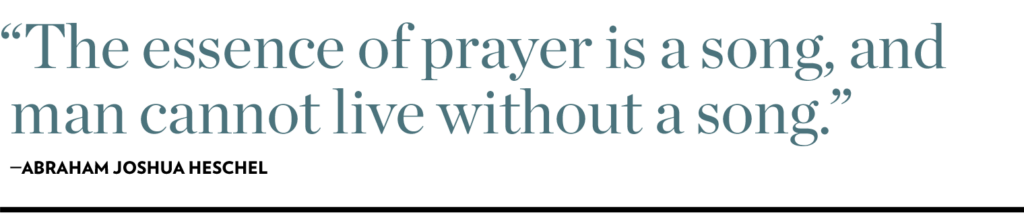
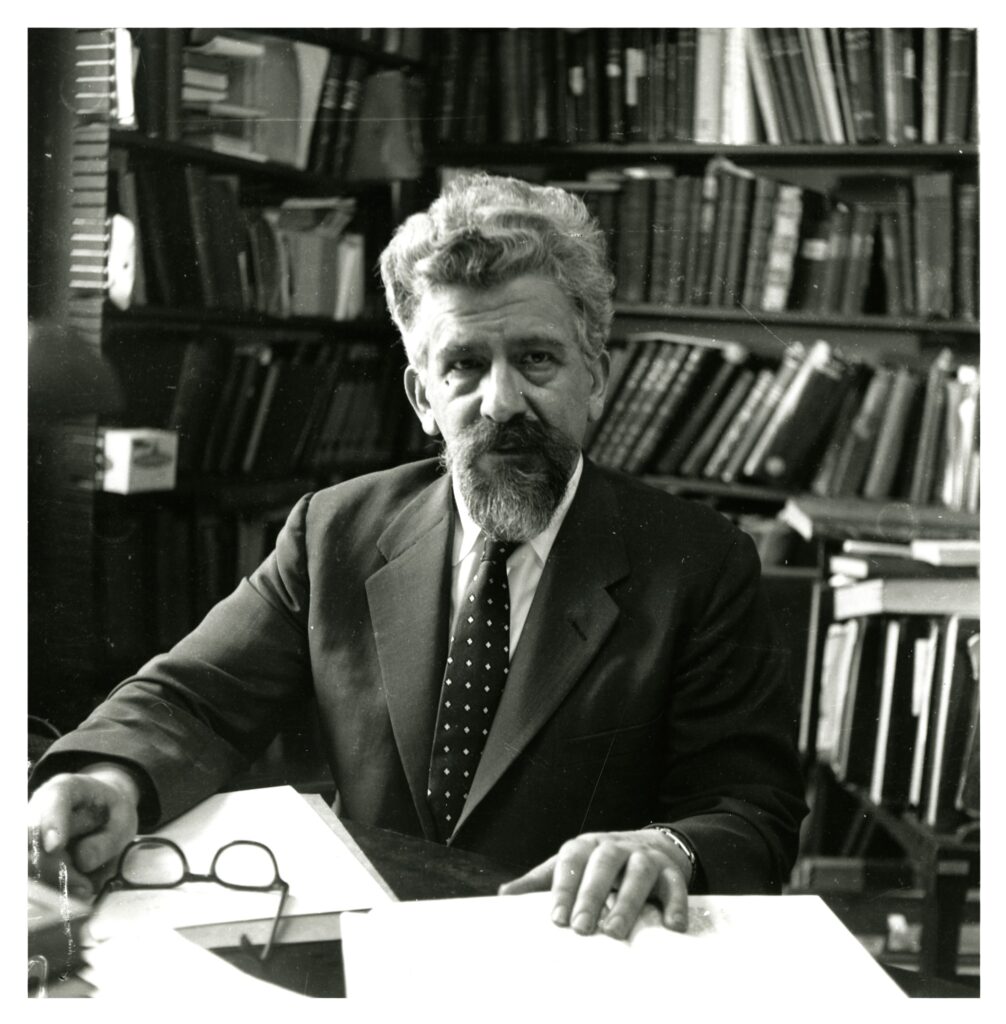
The Jewish Theological Seminary of America was Rabbi Abraham Joshua Heschel’s academic home for 27 years. At JTS, a few years after Heschel’s death, a professor of religious philosophy from another faith recognized something uncommon and irresistible about Heschel’s philosophical work. He gave it a memorable expression of appreciation when he noted that while it was expected that people in his profession would argue for their assertions, Heschel did something quite different: he sang. And this was what that professor now wished to introduce to his students.
It is now 50 years since the death of Abraham Joshua Heschel on 18 Tevet 5733.
In that half-century, as it was during the more than three decades of his teaching in the United States, so many had the privilege of benefitting from his prodigious scholarship and the inspirational humanity reflected in his teaching and writing. And all the while, his many disciples did more than drink from the well of his learning; they heard the songs that came both from his prophetic sadness at the injustices of the world, and most of all from his profound faith in God and in human beings. Those melodies have been woven into their lives and, in the greatest tribute of all, have been echoed in how those disciples’ students have been taught.
Heschel’s Abundance
The scroll of Ecclesiastes contains this verse: the rich man’s abundance doesn’t let him sleep (Ecclesiastes 5:11). The author of a midrash on this verse expressed puzzlement as to why wealth, of all things, would lead to tossing and turning at night. The answer offered was as follows:
“A man who is distinguished and wealthy in the knowledge of Torah will teach many students and disseminate his knowledge among the masses. When he dies, the disciples he raised do not permit him to be forgotten. They occupy themselves with his Torah, quoting in his name and recalling him to mind constantly. Thus they do not permit him to sleep undisturbed in his grave…..as it is said: Moving gently the lips of those that are asleep (Song of Songs 7:10). Hence, the rich man’s abundance doesn’t let him sleep.”
Has there been any teacher of religion in our time of whom this can be said more than of Abraham Joshua Heschel, of blessed memory?
A Living Treasury of Testimony
At this semicentennial observance, JTS, as the primary base from which Heschel taught, believes that a most fitting memorial to his life and work is to create a living treasury of testimonies to the effect that Heschel’s life and work has had on untold multitudes. We are reaching out to the extraordinarily wide universe of seekers, in virtually every faith and every language under the sun, whom he touched, and inviting them to write short pieces attesting to how they encountered Heschel’s thought, how it directed their intellectual and spiritual lives, and how it continues to sing within them.
This will create an enduring memorial to a peerless thinker, writer, and mentor, whose wealth will not allow him to sleep.
Rabbi Gordon Tucker Vice Chancellor of Religious Life
FOLLOW THE JTS HESCHEL PROJECT
We’ll send you updates as we expand this unique compendium of Heschel’s influence in the world.
The Fall 1973 Edition of Conservative Judaism was dedicated to the legacy of Abraham Joshua Heschel. The Rabbinical Assembly has made some of the articles available in honor of Heschel’s yahrzeit, including Heschel’s writing exploring death and its theological implications.
Conservative Judaism. Fall 1973 (Vol 28, Number 1)
JTS and the Association of Jewish Libraries are pleased to offer a certificate program in Judaica and Hebraica Librarianship.
Certification is awarded on completion of six modules: five online courses, taught by experts in their fields, and an internship at a local AJL member institution.
This project was made possible in part by the Institute of Museum and Library Services grant RE-254902-OLS-23. Generous support was provided by Haim A. Gottschalk.
How It Works
The certificate has been offered online as a 12-month series of modules, repeated in three cycles, consisting of remote online courses, taught by world experts in their fields.
Please note that this program began in 2023 and is currently scheduled to conclude in July 2026. While new applicants will still be considered, those who are admitted will be invited to take courses á la carte for professional development; certification will not be possible. Contact librarianship@jtsa.edu for additional information.
Required Courses for Certification
Introduction to Judaica Cataloging
The Judaica Cataloging class is team taught and includes and introduction to cataloging and overview of Judaica cataloging; ALA/LC romanization; descriptive cataloging; Hebraica access points and authority files; subject cataloging and LCSH; LC classification; current trends in Hebraica and Judaica cataloging; and an opportunity for an interactive whole-book cataloging session. Hebrew grammar and ability to romanize from Hebrew is required.
Collection Development for Judaic Studies
Judaica Reference
This required course will cover major aspects of Judaica reference and research. Taught by four instructors, this course will cover the question “What is Jewish Studies?”; Jewish Periodicals and Databases; Jewish Graphics, Arts, and Ephemera; Rabbinics; Area Studies and Jewish Studies; Jewish Languages and Literature; and Jewish History
Internship
Internships for North American participants must be at an AJL-member library
All internships must be supervised by a professional librarian.
The required time for an internship is 100 hours. This includes work on the actual project and meeting time.
The internship can take longer than the general six- to seven-week timeframe of the modules.
Participants must successfully complete the three required classes and any relevant modules (ie. Archives for an archival internship) prior to the internship.
The parameters of the internship are as follows:
Action plan (intern, supervisor and librarianship team)
Mid-point review (intern and member of the librarianship team)
Final project and review (intern, supervisor and signed off by librarianship team)
Internships must be a finite project such as cataloging a collection, processing an archive, creating a collection development policy or weeding policy, etc.
Elective
Two electives are required for certification. Choose from the options below.
Elective
Two electives are required for certification. Choose from the options below.
Electives (Two required for certification)
Funding for Judaica Libraries and Collections
This class explores the principles and practices of securing funding for Judaica collections in academic and research libraries. It covers the various types of funding sources available, grant-writing techniques, partnership projects, budgeting for projects, strategies for engaging potential donors, and working with funders.
Special Collections (Judaica Manuscripts, Early Prints, and Ephemera)
The Special Collections class is team taught. It will include identifying what is rare; a history of Judaica collecting; provenance; dealers and auctions; gifts collections; Judaica special collections cataloging; Judaica in a general special collection; and conservation and preservation of Judaica and digitization and copyright. This is an elective class.
Judaica Archives
In this elective course, we will discuss the broad spectrum of organizations that house Jewish archival and special collections, including synagogues, historical societies, private organizations, and academic institutions. The various types of collections (personal papers, organizational records, etc.) as well as the growing array of formats found in both contemporary and older records and how to steward these materials properly will be covered, as will evaluation and acquisition of materials. Topics such as access, processing, and identifying funding sources to support the work of making materials available will also be discussed.
Digital Scholarship and E-resources in Jewish Studies
This course will focus on Judaica digital scholarship: acquiring and evaluating e-resources, identifying major initiatives in Jewish digital humanities (DH), creating a DH project, digital preservation, and sustainability.
Intro to Judaic Paleography and Codicology
This elective course will provide an introduction to Judaic paleography, codicology, and bibliographic collation. Sessions will focus on medieval and early modern hands and identifying non-Hebrew languages in Hebrew script.
Jewish Libraries in Historical and Contemporary Contexts
In this elective course, we aim to equip Judaica librarians to serve and advocate for their specific Jewish studies collections by understanding the institutional contexts of these collections. Ranging from the development of Wissenschaft des Judentums in nineteenth-century Europe through the institutional complexities of contemporary universities and research institutions, we will seek to understand how the politics and structures of these organizations impact the scholars who work in them, and by building awareness of these factors support librarians in working with their diverse institutional constituencies.
Optional Courses
Please note that basic Hebrew reading comprehension and grammar are necessary for certain courses (cataloging, paleography) and sessions. An assessment test will be provided to assist with course placement.
Hebrew for Judaica Librarians I
This optional course will teach the practical application of the fundamental principles of Hebrew phonology and morphology: the vowel system, the vocalization of articles and prepositions, an overview of the verb system, and common forms of nouns and their pronominal suffixes.
Hebrew for Judaica Librarians II
This optional course will cover the verb system including strong and weak verbs, pronominal suffixes of the verb, select topics in syntax, and the use of dictionaries, grammars, and other resources. Prerequisite: Hebrew for Judaica Librarians I or permission of the instructor.
Costs
$50 nonrefundable registration fee (for the program).
Tuition is free for participants in the United States and Europe. For those outside of the US and Europe, tuition is $350/module. Please contact librarianship@jtsa.edu for more information.
Current and upcoming courses (see course descriptions above)
Introduction to Judaica Paleography and Codicology Mondays, February 9–March 30, 2026 (no class February 16 or March 2) 1:00–3:00 p.m. ET Instructor: Alexander Gordin
Introduction to Judaica Cataloging February 17–April 19, 2026 Due to instructor availability and Passover, classes for this course will meet on multiple days. All sessions begin at 12:00 p.m./noon ET. The complete schedule can be viewed in calendar form here. Team taught
Collection Development Mondays, April 20–June 1, 2026 (no class May 25) 11:00 am–1:00 p.m. ET Instructor: Rebecca Jefferson
Judaica Archives Wednesdays, April 22–June 10, 2026 (no class April 29) 12:00–2:00 p.m. ET Instructor: Melanie Meyers
Judaica Reference Thursdays, April 23–June 18, 2026 (no class May 21) 12:00–2:00 p.m. ET Team taught
Frequently Asked Questions
Who should apply for the program?
The JTS/AJL Certificate in Judaica and Hebraica Librarianship is a graduate-level program designed for those with an MLIS (or who are currently enrolled in an MLIS program), other relevant graduate degree, or equivalent work experience. We recommend that students with an undergraduate degree look at ALA-accredited schools of library and information science.
How long are the classes?
The classes take place once a week, for six to eight weeks, and are between 90 minutes and two hours long.
When in the day will the courses take place?
To accommodate our global membership, we will be offering courses in the middle of the day Eastern Time.
What do you mean by modules?
Modules are all of the elements of a program—this includes courses as well as the internship.
How many courses are required to complete the program?
Four required courses (including the internship) and two electives, for a total of six.
Are scholarships available? Is there a separate application process for scholarships?
Scholarships may be available for participants outside Europe. Requests can be made as part of the application process. Tuition is free for participants in Europe.
What does “a la carte” mean?
“A la carte” means you can take individual courses without committing to the whole certification. However, we expect there will be limited space in the courses, and priority will be given to students working on certification.
Can you explain the internship a bit more?
One registers for the internship like a course – the internship will vary based on the student’s location and interests. For North American participants, the internship must be at an AJL member institution and/or supervised by an AJL member. Funding is available for internships outside of participants’ home institutions. While we recommend that students take their internships in a location other than the one that they are currently working in, it must be with a discrete project that is supervised and evaluated by a professional librarian.
Each year, JTS alumni around the world make generous contributions to support the next generation of students. We extend our heartfelt gratitude for these gifts. Thank you, and we hope you’ll consider supporting JTS again as you plan your future giving.
A special thank you to the JTS alumni who have included JTS in their estate plans. They are esteemed members of the JTS Tzaddikim Society who care deeply about the Jewish future and have made a commitment to leave a lasting legacy at JTS. For more information on how you can become part of this special group, or if you have already included JTS estate plans, please contact Lucy Posner, director of Planned Giving at (212) 678-8865 or plannedgiving@jtsa.edu.
See all of our alumni supporters listed below by school.
Teachers Institute / Seminary College
Robert Alpert
Deborah Berlinger Eiferman
Fredda Bisman
Elizabeth Bloch-Smith
Annette Botnick
Geoffrey Botnick
Joseph Brodie
Miriam Brous
Nina Cardin
Robert Chazan
Joel Chernikoff
Alan Cohen
Gary Creditor
Stephanie Dickstein
Marlynn Dorff
Risa Doris
Gail Dorph
Edwin Farber
Ruth Fath
Charles Feinberg
Judy Fellner
Donna Fishman
Joseph Freedman
Elliot Gertel
Leslie Goldress
Bella Goldstine
Richie Hammerman
Robbie Harris
Eli Havivi
Sheila Hecht
Rita Herskovitz
Marc Hirshman
Howard Hoffman
Rivkah Horowitz
Carol Ingalls
Ron Isaacs
Allen Juda
Tom Kagedan
Harold Kasimow
Stuart Kelman
Vicky Kelman
Paul Kerbel
Jason Kintzer
Francine Klagsbrun
Sam Klagsbrun
Shoshana Knapp
Jay Kornsgold
Alisa Kurshan
Haviva Langenauer
Bruce Leipzig
Sue Levin
Richard Magidson
Sherwood Malamud
Daniel Margolis
Richard Margolis
Dassy Mark
Sandy Meyers
Michael Meyerstein
Jeannette Miller
Raphael Miller
Flora Musleah
Joel Newman
Kayla Niles
Dan Ornstein
Celia Platek
Phil Pohl
Raquel Pomerantz Gershon
Joseph Prouser
Ora Prouser
Avram Reisner
Selma Roffman
Judy Rohn
Beverly Rose
Judith Rosner-Berman
Menorah Rotenberg
Arthur Rulnick
Yaffa Schlisserman
Jonathan Schwartz
Marla Segelman
Ruth Shapiro
Susan Shevitz
Mark Silk
Chana Simckes
Priva Simon
Robert B. Slosberg
Ken Stern
Esther Stern-Bloom
Ken Tarlow
Daniel Teplitz
Helene Tigay
Karen Vogel
Sol Warhaftig
Leonard Wasserman
The Rabbinical School
A. Nathan (Buddy) Abramowitz
Seth Adelson
Ben Adler
Rachel Ain
Dan Alder
Morris Allen
Robert Alpert
Joel Alter
Julia Andelman
Ron Androphy
Noah Arnow
Stanley Asekoff
Toba August
Guy Austrian
Shaina Bacharach
Adam Baldachin
Barry Baron
Bernard Barsky
Marvin Bash
Laurence J. Bazer
Viki Bedö
Matthew Bellas
Chaya Bender
Joshua Ben-Gideon
Rebecca Ben-Gideon
Alfred Benjamin
Kenneth Berger
David Berkman
Allan Berkowitz
Mitch Berkowitz
Gordon Bernat-Kunin
Mark Biller
Mark Bisman
Leonardo Bitran
David Blumenfeld
Jacob Blumenthal
Neil Blumofe
Sam Blustin
Eliav Bock
Geoffrey Botnick
Joseph Brodie
Sharon Brous
Howard Buechler
Yael Buechler
Richard Camras
Debra Cantor
Gadi Capela
Ariana Capptauber
Nina Cardin
Margaret Cella
Gary Charlestein
Bruce Charnov
Robert Chazan
Joel Chernikoff
Geoffrey Claussen
Alan Cohen
Ayelet Cohen
Burton Cohen
Diane Cohen
Martin Cohen
Mitch Cohen
Elli Cohn
Moshe Corson
Elliot Cosgrove
Tirza Covel-Schmelzer
Deena Cowans
Gary Creditor
Melissa Crespy
Michelle Dardashti
Alexander Davis
Mark Diamond
Stephanie Dickstein
Bruce Dollin
Elliot Dorff
Shelly Dorph
Daniel Dorsch
Joshua Dorsch
Gilah Dror
Ryan Dulkin
Shoshana Dworsky
Moshe Edelman
Amy Eilberg
Rick Eisenberg
Bernie Eisenman
David Englander
Jerry Epstein
Gideon Estes
Murray Ezring
Edwin Farber
Charles Feinberg
Edward Feld
Ted Feldman
Aviva Fellman
Azriel Fellner
Robert Fierstien
Jeremy Fineberg
Ron Fish
Jessica Fisher
Lyle Fishman
Elihu Flax
Wayne Franklin
Paul Freedman
Gordon Freeman
Michael Friedland
Avi Friedman
Jason Fruithandler
Baruch Frydman-Kohl
Jodie Futornick
Aaron Gaber
Ilana Garber
Wes Gardenswartz
Stephen Garfinkel
Dov Gartenberg
Debra Gelberg
Elliot Gertel
Henry Glazer
David Glickman
Laura Gold
Michael Gold
Benjamin Goldberg
Nechama Goldberg
Daniel Goldfarb
Megan GoldMarche
Mina Goldsmith
Nason Goldstein
Matt Goldstone
Shayna Golkow Zauzmer
Arnold Goodman
Izzy Gordan
Daniel Graber
Sarah Graff
Michael Greenbaum
Katie Greenberg
Ariel Greenberg-Platt
Frederick Grossman
Susan Grossman
Mayer Gruber
Seth Haaz
Eytan Hammerman
Richard Hammerman
Yael Hammerman
Jules Harlow
Robbie Harris
Avi Havivi
Eli Havivi
Joshua Heller
Lauren Henderson
Benjamin Herman
Howard Hersch
Ami Hersh
Sherre Hirsch
Shimon Hirschhorn
Howard Hoffman
Jeff Hoffman
Scott Hoffman
Victor Hoffman
Bill Horn
Jonathan Infeld
Ron Isaacs
Daniel Isaacson
Ari Isenberg
Alan Iser
Jill Jacobs
Abby Jacobson
Michael Jay
Allen Juda
David Kalender
Naomi Kalish
Jeremy Kalmanofsky
Sylvan Kamens
Elana Kanter
Rafi Kanter
Louis Kaplan
Tracy Kaplowitz
Barry Katz
Michael Katz
Alvan Kaunfer
Neal Kaunfer
Herbert Kavon
Stuart Kelman
Allan Kensky
Barry Kenter
Eytan Kenter
Paul Kerbel
Sheldon Kirsch
David-Seth Kirshner
Leora Kling Perkins
Shelley Kniaz
Lori Koffman
Randy Konigsburg
Helene Kornsgold
Jay Kornsgold
Charles Kraus
Harold Kravitz
Jonathan Kremer
Paul Kurland
Neil Kurshan
Vernon Kurtz
Gail Labovitz
Jay Lapidus
Bill Lebeau
David Lerner
Dov Lerner
Alan Lettofsky
Melanie Levav
Mort Levine
Shlomo Levine
Judd Levingston
Chai Levy
Dave Levy
Jill Levy
Leonard Levy
Shalom Lewis
Shelly Lewis
Dan Liben
Micah Liben
Miriam Liebman
Howard Lifshitz
Steven Lindemann
Ari Lucas
Jacob Luski
Paula Mack-Drill
Mitchel Malkus
Mark Mallach
Howard Mandell
Noam Marans
Richard Margolis
Fred Margulies
Jeffrey Marker
Barry Marks
Myrna Matsa
Amy Mayer
Jonathan Medows
Aryeh Meir
Juan Mejía
Andi Merow
Daniel Merritt
Joel Meyers
Michael Meyerstein
Cliff Miller
Jason Miller
Raphael Miller
Victor Mirelman
Joel Mishkin
Jack Moline
Michael Monson
Steven Morgen
Lionel Moses
Beth Naditch
Yoni Nadiv
David Nelson
David Nesson
Blair Nosanwisch
Rachel Nussbaum
Dan Ornstein
Luciana Pajecki Lederman
Michael Panitz
Ita Paskind
Lee Paskind
Ephraim Pelcovits
Harry Pell
Micah Peltz
Andrew Pepperstone
Carl Perkins
Ari Perten
Kevin Peters
Kendell Pinkney
Joel Pitkowsky
Jeff Pivo
Richard Plavin
Shalom Podwol
Phil Pohl
Lindsey Pollack
Moshe Pomerantz
Michael Pont
Charlie Popky
Bezalel Porten
Charles Primus
Irit Printz
Joseph Prouser
Jama Purser
Josh Rabin
Mayer Rabinowitz
Michael Ragozin
Jonah Rank
Mark Raphael
Adam Raskin
Josh Ratner
Esther Reed
Steven Rein
Avram Reisner
David Resnick
Mira Rivera
Richard Rocklin
Adam Roffman
Kayley Romick
Carnie Rose
Paula Rose
Elliott Rosen
Daniel Rosenberg
Herbert Rosenblum
Shira Rosenblum
Cara Rosenthal
Gil Rosenthal
Francine Roston
Amy Roth
Ron Roth
Moshe Rothblum
Jason Rubenstein
Steven Rubenstein
Jeremy Ruberg
Robert Rubin
Arthur Rulnick
Ariel Russo
Marc Sack
J.B. Sacks
Mickey Safra
Alvin Sandberg
Neil Sandler
John Schechter
Craig Scheff
Phil Scheim
Rob Scheinberg
George Schlesinger
Jennifer Schlosberg
Menahem Schmelzer
Paul Schneider
Jonathan Schnitzer
Aaron Schonbrun
Ismar Schorsch
David Schuck
Michael Schwab
Amanda Schwartz
Charlie Schwartz
Herbert N. Schwartz
Mordy Schwartz
Moshe Schwartz
Steven Schwartz
Daniel Schweber
Laurence A. Sebert
Jeff Segelman
Erica Sekuler
Ahud Sela
Bruce Seltzer
Joel Seltzer
Leonard Sharzer
Sanford Shudnow
Ron Shulman
Diana Siegel
Michael Siegel
Steven Silberman
Zachary Silver
Rachel Silverman
Joseph Simckes
Michael Singer
Melvin Sirner
Zachary Sitkin
Jonathan Slater
Robert B. Slosberg
David Soloff
Sidney Solomon
Jonathan Spira-Savett
Raphael Spitzer
David Starr
Daniel Stein
Jay Stein
Peter Stein
Ken Stern
Sholom Stern
Ari Sunshine
Ken Tarlow
Kara Tav
Bradley Tecktiel
Daniel Teplitz
Albert Thaler
Malcolm Thomson
Jeff Tigay
Mervin Tomsky
Annie Tucker
Gordon Tucker
Jan Uhrbach
Daniel Victor
Burt Visotzky
Stewart Vogel
Shira Wallach
Andrew Warmflash
Lewis Warshauer
Efraim Warshaw
Michael Wasserman
Jonathan Waxman
Deborah Wechsler
Stefan Weinberg
Philip Weintraub
Sam Weintraub
Simkha Weintraub
Raysh Weiss
Eugene Wernick
Steve Wernick
Joseph Wernik
Bryan Wexler
Scott White
Ed Winter
Ethan Witkovsky
Adam Wohlberg
Jeff Wohlberg
Joey Wolf
Michael Wolk
David Wolpe
Eric Yanoff
Dave Yedid
Herbert Yoskowitz
Rachel Zerin
David Zisenwine
Neil Zuckerman
Deborah Zuker
List College
Rachel Ain
Keith Apple
Adam Baldachin
Nicole Berman
Erin Beser
Shachar Binyamin
Eliav Bock
Talya Bock
Staci Brill
Sharon Bromberg
Deborah Bromberg Seltzer
Adam Brown
Rebecca Calzontzi
Suzanne Chipkin
Robbie Cohen-Millstein
Chava Creque
Alisha Deluty
Jamie Diamond
Daniel Dorsch
Joshua Dorsch
Benjamin Ehrlich
Carly Eilender
Shoshana Farbman
Nora Feinstein
Jessica Fisher
Casey Fishman-Braunig
Jason Fruithandler
Aaron Gaber
Rebecca Gaebler
Ilana Garber
Debra Gelberg
Rachel Gildiner
Reena Glazer
Ilana Hamer
Eytan Hammerman
Rebecca Hammerman
Yael Hammerman
Jodi Hirsch Rein
Shanna Hocking
Dani Holtz
Jaime Horowitz
Alan Imar
Alison Joseph
David Kalender
Tracy Kaplowitz
Michelle Katz
Suzanne Katz
Eliana Katz-Seltzer
Eitan Kensky
Doron Kenter
Eytan Kenter
Abby Kerbel
Orly Klein
Suzanne Kling-Langman
Ohad Klopman
Helene Kornsgold
Talia Kovacs
Lisa Kravitz-Mamaysky
Dana Lande
Elie Lehmann
Chavie Lescher
Jacob Levenfeld
Dave Levy
Josh Lieberman
Becky Lurie
Jill Mainzer
Anya Manning
Paul Margulies
Andi Merow
Ben Metsch
Adina Milgram
Jonathan Milgram
Rebekah Monson
Uri Monson
Yoni Nadiv
Dan Ornstein
Shira Osher
Isaac Ostrow
Susan Palefsky
Iris Paltin
Ita Paskind
Ari Paul
Ari Perten
Rebecca Perten
Jonah Rank
Yael Rayport
Richard Reaven
Jessica Rezak-Schwab
Danu Rojzman
Pauline Rose
Lisa Rosen-Metsch
Robin Rubenstein
Jeremy Ruberg
Julia Russell
Ariel Russo
Matthew Russo
Evan Schaffer
David Schnitzer
Yoni Schwab
Andrea Schwartz
Jocelyn Seidenfeld
Ethan Shapiro
Ellen Shaw
Charlie Sherman
Dina Shtull-Leber
Tyler Silver
Noah Small
Jason Sokol
Kenny Sperber
Tova Sperber
Jay Stein
Sarah Steinmann
Todd Surden
Bradley Tecktiel
Danielle Truglio
Justin Truglio
Shira Wallach
Michael Wolk
Seth Wolkofsky
Missy Zedeck
Alexander Zuckerman
Gershon Kekst Graduate School
Ellen Abramson
Seth Adelson
Ben Adler
Ronald Androphy
Guy Austrian
Beverly Bailis
Adam Baldachin
Viki Bedö
Rachel Beit-Halachmi
Ken Berger
Elizabeth Berke
Mitch Berkowitz
Dina Bernat-Kunin
Leah Bieler
Robert Bildner
Neil Blumofe
Scott Bolton
Joseph Bravo
Sharon Bromberg
Deborah Bromberg Seltzer
Adam Brown
Shoshana Brown
Yael Buechler
Ellen Cahn
Nina Cardin
Margaret Cella
Dina Charnin
Geoffrey Claussen
Martin Cohen
Elli Cohn
Janice Colmar
Martin Cooper
Ruth Corson
Debbie Cosgrove
Jacob Cytryn
Julie Deluty
Eliezer Diamond
Stephanie Dickstein
Alisa Doctoroff
Tamra Dollin
Gail Dorph
Joshua Dorsch
Ryan Dulkin
Alan Edelman
Debbie Edelman
Charles Edelsburg
Amy Eilberg
Judith Eisenberg
Laurie Farber
Robert Fierstien
Jeremy Fineberg
David Fishman
Casey Fishman-Braunig
Joan Freeman
Dori Frumin Kirshner
Baruch Frydman-Kohl
Hillary Gardenswartz
Debbie Geller
Gary Geller
Henry Glazer
Ben Goldberg
Megan GoldMarche
Leslie Goldress
Izzy Gordan
Ariel Greenberg-Platt
Pearl Greenspan
Susan Grossman
Seth Haaz
Nellie Harris
Robbie Harris
Lauren Henderson
Sonia Herzenberg-Kleinman
Marc Hirshman
Jeff Hoffman
Laurie Hoffman
Alan Iser
Jill Jacobs
Sara Jamison
Marcie Jonas
Naomi Kalish
Amy Kalmanofsky
Ben Kamine
Karen Kaplan
Annette Kasle
Larry Katz
Eliana Katz-Seltzer
Jan Kaufman
Allan Kensky
Barry Kenter
Doron Kenter
Melissa Kerbel
Carol King-Berkman
Suzanne Kling-Langman
Shelley Kniaz
Lori Koffman
Jonathan Kremer
Mikhail Krutikov
Paul Kurland
Alisa Kurshan
Bryna Kurtz
Gail Labovitz
Barbara Lerner
Melanie Levav
Judd Levingston
Benjamin Levy
Dave Levy
Leonard Levy
Miriam Liebman
Howard Lifshitz
Adele Lobel
Jonathan Lopatin
Ari Lucas
Paula Mack-Drill
Jill Mainzer
Mitch Malkus
Ruth Margolin
Guy Massie
Miriam Meir
Debby Miller
Michael Monson
Flora Musleah
Yoni Nadiv
Shira Newman-Wohlberg
Phreddy Nosanwisch
Rachel Nussbaum
Dan Ornstein
Luciana Pajecki Lederman
Michael Panitz
Ephraim Pelcovits
Micah Peltz
Carl Perkins
Lindsey Pollack
Isaac Pollak
Irit Printz
Ora Prouser
Jonah Rank
Mark Raphael
Josh Ratner
Esther Reed
Steve Rein
Avram Reisner
Adam Roffman
Paula Rose
Daniel Rosenberg
Zahava Rosenfeld
Barbara Rosenthal
Gil Rosenthal
Amy Roth
Marian Rothenberg
Jason Rubenstein
Shuly Rubin Schwartz
Halina Rubinstein
Mickey Safra
Susan Sandler
Rob Scheinberg
Yaffa Schlisserman
Jane-Rachel Schonbrun
Andrea Schwartz
Aviva Schwartz
Mordy Schwartz
Bob Sherman
Lorraine Sherman
Robyn Shoulson
Andrew Siegel
Laurie Siegel
Stefanie Siegmund
Zachary Silver
Zachary Sitkin
Sidney Solomon
Jon Spira-Savett
Daniel Stein
Jay Stein
Pete Stein
Alan Stern
Lori Sumberg
Burton Visotzky
Susan Wagner
Adam Weisberg
Bracha Werber
Ethan Witkovsky
Dave Yedid
Rachel Zerin
Deborah Zuker
William Davidson Graduate School of Jewish Education
Rachel Ain
Tali Aldouby-Schuck
Joel Alter
Matthew Bellas
Chaya Bender
Eliav Bock
Talya Bock
Scott Bolton
Sharon Brooks
Treasure Cohen
Michelle Dardashti
Alexander Davis
Jamie Diamond
Daniel Dorsch
Joshua Dorsch
Anne Ebersman
David Englander
Jason Fruithandler
Jessie Fruithandler
Ilana Garber
Hillary Gardenswartz
Annie Glickman
Shayna Golkow Zauzmer
Izzy Gordan
Wilhelmina Gottschalk
Daniel Graber
Katie Greenberg
Amy Greenfeld-Dorsch
Joe Griminger
Yael Hammerman
Wendy Heller
Benjamin Herman
Howard Hersch
Ami Hersh
Amy Kanarek
Tracy Kaplowitz
Eliana Katz-Seltzer
Sharon Katz-Solomon
Eytan Kenter
Abby Kerbel
Jane Kessler
Leora Kling Perkins
Michelle Konigsburg
Helene Kornsgold
Sarah Levine
Judd Levingston
Micah Liben
Seth Linfield
Jill Mainzer
Mitchel Malkus
Andi Merow
Debby Miller
Jason Miller
Orlea Miller
Alli Moses
Beth Naditch
Yoni Nadiv
Gail Nalven
Blair Nosanwisch
Phreddy Nosanwisch
Luciana Pajecki Lederman
Sheila Panitz
Ita Paskind
Harry Pell
Micah Peltz
Andrew Pepperstone
Ari Perten
Kevin Peters
Michael Pont
Barbie Prince
Joshua Rabin
Ilene Richman
Amy Ripps
Frieda Robins
Kayley Romick
Daniel Rosenberg
Shira Rosenblum
Rhonda Rosenheck
Jeremy Ruberg
Ariel Russo
Sharon Safra
Barbara Saunders-Adams
Jennifer Schlosberg
Aaron Schonbrun
Michael Schwab
Amanda Schwartz
Charlie Schwartz
Moshe Schwartz
Anna Serviansky
David Shemesh
Charlie Sherman
Zachary Silver
Rachel Silverman
Terri Soifer
Adrian Strizhak
Annie Tucker
Daniel Victor
Mike Weis
Joel Weissglass
Bryan Wexler
Michael Wikes
Eric Yanoff
H. L. Miller Cantorial School and College of Jewish Education
Seth Adelson
Elizabeth Berke
Steven Berke
Neil Blumofe
Caitlin Bromberg
Jennie Chabon
Katy Claussen
Jen Cohen
Farid Dardashti
Joshua Diamond
Elisheva Dienstfrey
Joanna Dulkin
Gil Ezring
Elihu Flax
Adam Frei
Arthur Giglio
Izzy Gordan
Jake Greenberg
Julie Jacobs
Deborah Jacobson
Amy Kanarek
Barry Kanarek
Malachi Kanfer
Sam Levine
Sarah Levine
Bill Lieberman
David Lipp
Riki Lippitz
Leon Lissek
Anna May
Brian Mayer
Bat-Ami Moses
Paula Pepperstone
Misha Pisman
Raquel Pomerantz Gershon
Alisa Pomerantz-Boro
Wendi Portman-Fried
Elliot Portner
Sid Rabinowitz
Ken Richmond
Marina Shemesh
Scott Sokol
Steve Stein
Marcia Tilchin
David Tilman
Ben Tisser
Eliot Vogel
Lorna Wallach-Kalet
Mike Weis
Elaine Zimmerman
Center for Pastoral Education
Sheri Allen
Guy Austrian
Adam Baldachin
Jeannie Blaustein
Sam Blustin
Amy Bolton
Scott Bolton
Ariana Capptauber
Bonnie Cramer
Joshua Diamond
Gil Ezring
Jeremy Fineberg
Jessica Fisher
Michael Friedland
Megan GoldMarche
Shayna Golkow Zauzmer
Izzy Gordan
Katie Greenberg
Ariel Greenberg-Platt
Lauren Henderson
Sally Kaplan
Leora Kling Perkins
Lori Koffman
Melanie Levav
Anna May
Molly O’Neil-Frank
Kevin Peters
Lindsey Pollack
Jama Purser
Joshua Rabin
Mira Rivera
Amy Roth
Ariel Russo
Jennifer Schlosberg
Amanda Schwartz
John Shellito
Sally Shore-Wittenberg
Zachary Sitkin
Marina Smith
Raphael Spitzer
Philip Weintraub
Mike Weis
Ethan Witkovsky
Rachel Zerin
Tzaddikim Society
Kassel Abelson
Joseph Brodie
Alan L. Cohen
Moshe Corson
Donald D. Crain
Gary Creditor
Tamra Dollin
Bruce Dollin
Gideon Estes
Deena (Goldstein) Friedman
Michael B. Greenbaum
Richard Hammerman
Sheila Diamant Hecht
Rochelle Hutchings (z”l)
Carol Ingall
Karen Kaplan
Lilly Kaufman
Barry Kenter
Jonathan Kremer
Robert Layman
Sheldon Lewis
Richard J. Margolis
Eliot P. Marrus
Michael Meyerstein
Richard Plavin
Jack Riemer
Arthur D. Rulnick
Lifsa Schachter
Stanley Schachter
Shuly Rubin Schwartz
David C. Seed
Lori Seed
Matthew Shore
Malcolm Thomson
Annie Tucker
Burton L. Visotzky
Marilyn Werman (z”l)
Anonymous
Welcome from the Dean
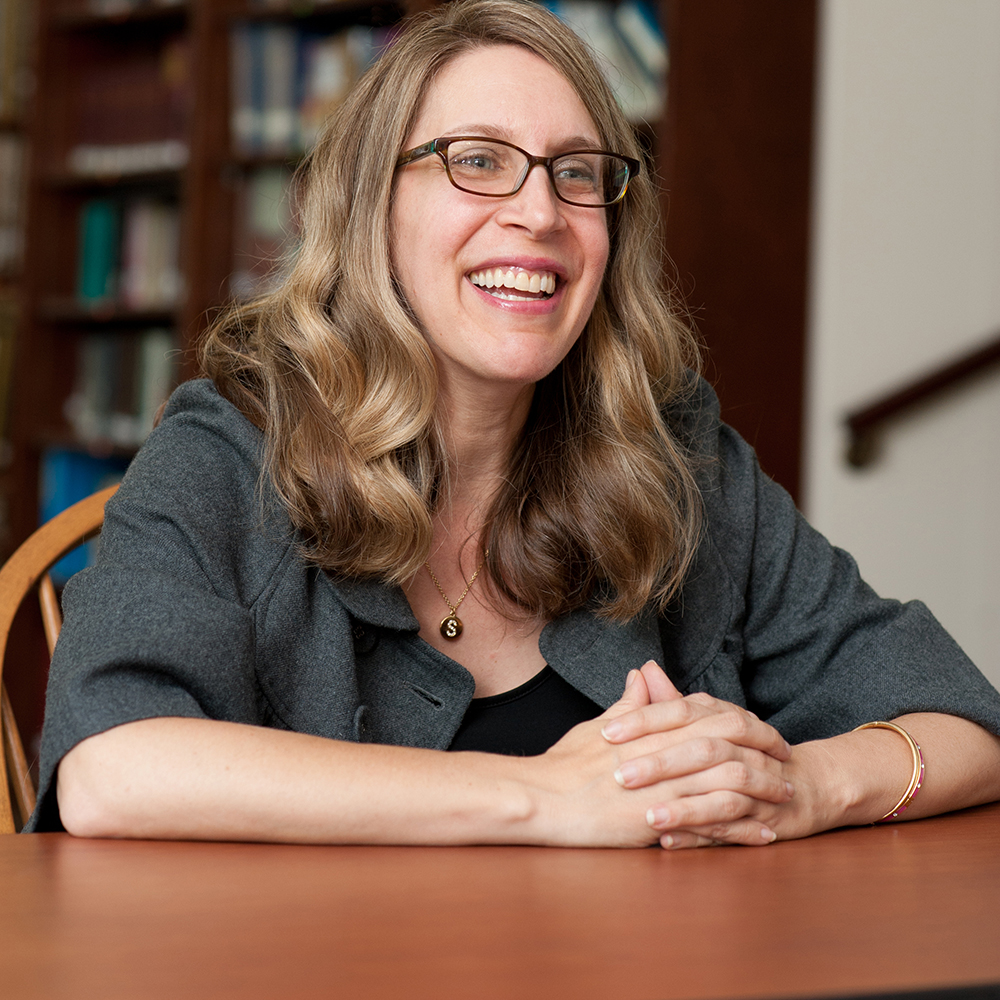
Shira D. Epstein, EdD
I welcome you to the Summer 2022 issue of Gleanings: Portraits of Jewish Educational Leadership from The William Davidson School. We remain true to the original vision of Gleanings, “introducing the cutting-edge principles, concepts, and programs that continue to be developed and implemented by The William Davidson School through profiles of changemaking educational leaders.” The theme of this issue, “Teaching Sacred Texts,” highlights four innovative pedagogues and the ways in which their instructional leadership and teaching practices are inspiring learners to develop personal connection to Jewish traditional written works, including Bible, Talmud, midrashic literature, liturgy, and mystical texts.
Fiery debates continue to ignite both within general and Jewish education as to the aims and goals of literacy. At the core of these debates are strong belief systems regarding “What is literacy?” Some maintain that literacy is a state of being that is achieved via individual, cognitive study. In reflecting back to my own memories of sixth-grade humash, the high-anxiety weekends I spent memorizing long passages and the Monday morning tests of short-answer questions typify such a stance.
In contrast to the perspective of literacy as an intake of knowledge, others view it as an experience. While written text is at the core of this experience, the educator guides learners to find their own meanings by making connections to other texts and ideas (intertextualities), to their memories, to current events, to emotions. The common thread across all learning interactions is that that there is never a final point–rather, it is ongoing, unfolding, and evolving, dependent on the context of who our learners are and what they, themselves, bring to bear on their understandings of the texts. In this way, the texts come alive within each unique social context.
One sees such an educational approach reflected across William Davidson School instructional leadership projects and academic offerings, alike. This summer, the staff of the Jewish Day School Standards and Benchmarks project will be teaching a new summer 3-credit course, Teaching and Learning Sacred Texts with Standards-Based Curriculum Design.The title reflects the William Davidson School stance that we, as educators, utilize methodologies that intentionally and mindfully support learners to be in conversation with the written word, with all of the complexities and, sometimes, the problems. We want our learners to engage in equal measure with what is inspiring and what is troubling, with what brings joy, and what feels dissonant:
Through 1:1 havruta, as well as group discussion
Through arts-based activities
In reading through contemporary lenses of social justice and change
Through verbal and written reflection
The four portraits in this issue of Gleanings highlight these approaches to Jewish literacy and sacred text study: Laynie Soloman, alumn of our in-house MA program, associate rosh yeshiva and director of transformative leadership at SVARA; Shira Forester, recent graduate of our in-house MA program and Judaics teacher at Luria Academy; Dr. Barry Holtz, professor of Jewish education at JTS; Rabbi Adina Allen, cofounder and creative director of the Jewish Studio Project. I invite you to read these portraits and hope that they will serve as inspirations to your own teaching and leading.
Shira D. Epstein, Ed.D, Dean, William Davidson Graduate School of Jewish Education
Talmud Study and Transformative Theology: Laynie Soloman
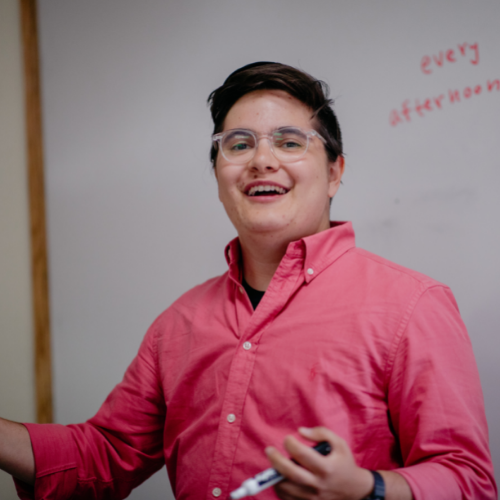
“When you learn, you feel more whole, more joyful, and you feel called in to creating these conditions for others,” said Laynie Soloman, who received an MA from The William Davidson School in 2020 and now serves as the associate rosh yeshiva and director of transformative leadership at SVARA, a traditionally radical yeshiva dedicated to the serious study of Talmud through the lens of queer experiences.
Teaching sacred texts, for Soloman, should be an empowering experience. “I see my work as a teacher as being in pursuit of connection, of grounded-ness,” they said.
Soloman grew up in a mainstream Conservative synagogue, attended Reform summer camp, NFTY, and USY, and gained a sense of piety and religious curiosity from family. “My whole life I felt a calling to religious questioning,” said Soloman.
The draw to Talmud study emerged, surprisingly, out of a deep engagement with Christian liberation theology[1] while an undergraduate at Goucher College. “As I studied progressive theological expressions, I felt drawn to a deeper relationship with sacredness, with God, and with justice,” they said. “At the same time that I was diving in and grappling with liberation theology and its concern for the oppressed, as a Jew I didn’t feel like these texts were mine.”
Soloman wanted to find moving and transformative theological expressions in their own tradition. Graduating early, they studied in Israel at Pardes and were exposed to rabbinic discourse for the first time. “The minute I started learning Talmud, I felt, ‘This is it.’”
Returning from Israel, Soloman went on to study at Hadar, where they first learned about SVARA. Studying with Rabbi Benay Lappe, SVARA’s Rosh Yeshiva, Soloman immediately understood why Talmud had been so powerful. “I used to think I was finding Jewish sources that would support liberation theology, kind of like prooftexts for theologies that inspired me,” Soloman said. “What I have realized from many havrutot and teachers is that we can create Jewish expressions that are liberatory in their approaches.”
“The core idea of liberatory Judaism is that God is with people who are oppressed. With Benay and at SVARA, I came to understand that the Talmud is a record of that,” said Soloman.
Soloman sees the Rabbis as radical theologians. “What’s amazing is that they show us their work at every step,” said Solomon. “They don’t hide when they make changes or take text out of context in order to serve their ideology. Their ideology was to restore Torah, to create a world in which God could be felt. At SVARA we connect that pious audacity with queerness.”
For Solomon, the Rabbis themselves are a model of how to study and teach text. “The Rabbis did not just do that so we would learn it, but so that we would do it as well. I’m not learning Talmud to find out what the Rabbis said or did but to see how they said or did what they did,” said Soloman.
The connection between study and action infuses Solomon’s own ideology and guided them to a career in education. Soloman uses the phrase “liberatory Torah” to describe the kind of “permeating learning that moves us toward living into our own freedom and shifting the material conditions of the world so everyone else can too.”
While enrolled in Hebrew College’s rabbinical school, Soloman started teaching a class through the Boston Worker’s Circle on the Secular Talmud. They found themselves thinking more and more about the class and the processes of teaching and learning.
“Learning midrash helps students make midrash of their lives,” Soloman said. It became clear that Soloman was drawn to teaching more than to a traditional rabbinic role, and they transferred to The William Davidson School in order to focus more on their teaching and to become part of a community of reflective practitioners.
At The William Davidson School, Soloman found peers who were thinking about “how we shape Jewish human beings.” They also found valuable tools and practical skills in areas such as lesson planning and curriculum design. The community of colleagues explored ways of relating to each other while teaching. “This is the model for the kind of reflective practice I have brought to Svara,” Solomon said.
In class with JTS faculty member Dr. Marjorie Lehman, Soloman gravitated to the emotional aspects of teaching Talmud, even when the texts themselves could be incongruous with contemporary values. “There is no text that is not problematic,” Soloman said. “My expectation is that the Rabbis were misogynistic and that they were shaped by and shaping a patriarchal culture.”
Soloman’s yearlong William Davidson School practicum placement at Hadar led to a teaching position there after graduation. Studying sacred texts, for Soloman, is “an amazing skill that every Jew should have—the ability to read yourself back into the history even when you weren’t there.” Soloman believes that queer people are gifted in their capacity to do just that.
Quoting the midrash about Rabbi Akiva drawing meaning out of the calligraphic crowns on the letters of the Torah, Soloman identifies with the power of the interpretive act. “That makes him even more incredible than if he were simply reading what the text says—he was creatively hooking his ideas—and himself—onto the Torah itself,” said Soloman.
At SVARA, Soloman teaches, stewards faculty teams, and directs the two-year Teaching Kollel. SVARA has various online learning spaces including daily remote Mishnah learning, and a pedagogy chaburah to support educators in existing institutions to incorporate aspects of SVARA’s approach into their own teaching.
Soloman’s core pedagogy when teaching sacred texts is to create conditions that enable learners to construct a Jewish expression that is liberatory. “Our work is not unpacking the prooftexts for why God is with the oppressed but rather to discover how we can all become free ourselves.”
Written by Suzanne Kling Langman
[1] Liberation theology generally refers to a theology applied to the core concerns of marginalized communities in need of social, political, or economic equality and justice. During the 1960s, African American and Latin American theologians began to ask new questions about the application of Christian theology to their experiences of oppression. The answers to these questions led theologians to think theologically from the perspective of the oppressed groups rather than ask questions from the perspective of the dominant cultures. (https://www.oxfordbibliographies.com/)
SHARE THIS PAGE
Subscribe to Gleanings
Our e-journal covers timely, important issues in the field of Jewish education, written by educational leaders from the William Davidson School and beyond.