
When Does Hagar See

When I grew up in Givataim, I loved to study a little book of the Bible with Gustave Dore’s illustrations. The illustrations depicted many biblical scenes, often included sweeping landscapes and deep contrast of light and shadow, and expressed intense, theatrical, and emotional energy. Artists often turn to biblical stories to demonstrate their artistic skills and their interest in the human condition.
Looking at art books, visiting museums, and studying the arts became my passion. The first course I taught at the William Davidson School was titled Arts as Exegesis in Jewish Education, and following it was a popular course called The Arts as a Window to Israeli Society. I loved teaching these courses and learned together with the place the arts have in making hard topics accessible. This week’s Torah portion Vayera presents readers with the expulsion of Hagar. As always, the biblical text limits mentioning emotions and avoids presenting the readers with judgment. This style allows readers to constantly engage in the act of interpretation and fill in any gaps left by the Bible’s editors. My colleague, Professor Barry Holtz, posits that this manner of interpretation helps readers understand the text and makes it continuously alive (Holtz, 1984). Readers are encouraged to fill the gaps in the story with meanings and emotions.[1]
The story of Hagar poses difficult questions about loyalty, trust, and, eventually, the meaning of evil. Beginning in chapter 16, the narratives opens with a promise from God to Abram: “I will establish My covenant with you, and with your descendants after you, for all their generations, an everlasting covenant” (Gen. 16:7).[2] However, there is tension between God’s promise to Abram to be the father of a great nation and have many descendants and the fact that Sarai is barren. Hagar, an Egyptian maid, is brought to Abram by the childless Sarai, and later becomes his wife and the mother of his first-born son, Ishmael. Sarai initiates this chain of events while a mostly inactive Abram follows Sarai’s wishes and God’s commands.
In chapter 21, we meet Hagar again. In the intervening time, God and Abram have forged a covenant. The new names, Abraham and Sarah, reflect changes in identity and serve as a reminder of the covenant. Sarah, now a mother to her own child, convinces Abraham to send Hagar away. We are witnessing a heartless action. Abraham listens to Sarah, who wants to prevent Ishmael from inheriting: “Throw this slave girl and her son out. The son of this slave girl is not going to share in the inheritance of my son Isaac” (Gen. 21:10). Carrying only a small portion of bread and waterskin, Hagar is banished to the desert with her son. The text relates, “She wandered aimlessly in the wilderness of Beersheba. When the water in the skin was all gone, she cast the child away under a bush” (Gen. 21:15). Hagar, certain that her son is dead, desperately puts him far from her and bursts into tears: “She walked away and sat down on the other side at a remove of about a bowshot, thinking: ‘Let me not see the child’s death.’ There on the other side, she sat and wept in loud voice” (Gen. 21:16). Approaching from above, an angel calls her name and repeatedly tells her to pick up the young boy, who will be the patriarch of a great nation. As she opens her eyes, she sees a well. Picking up her son, she realizes that he is alive. In her moment of despair, Hagar experienced divine intervention and receives a promise of a future for her and her son.
Camille Corot, a 19th-century French artist (1796–1875), was mainly a landscape artist. His masterpiece, Hagar in the Wilderness, can be seen at the Metropolitan Museum in New York City. Exploring this artwork has expanded my understanding of the story.
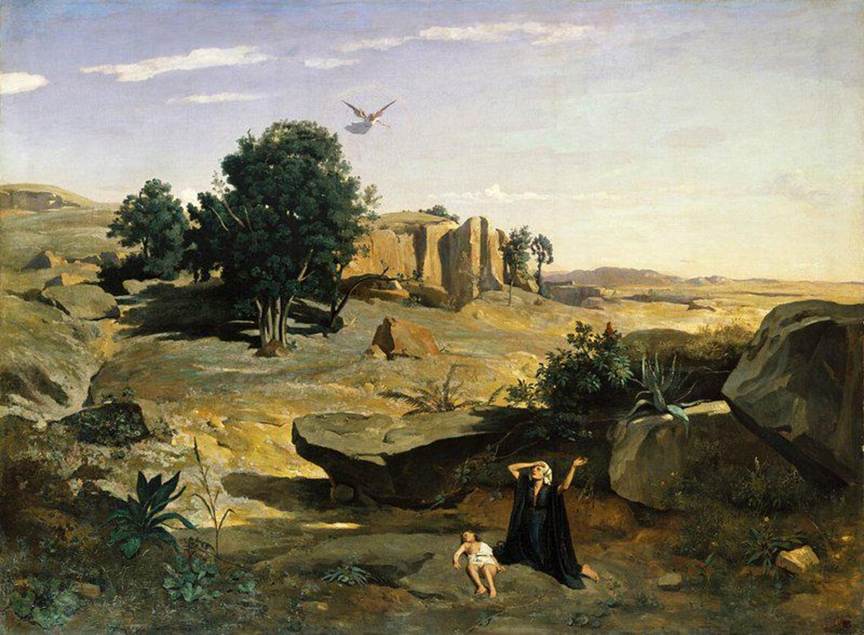
At first, the observer is led to believe that this is a landscape painting of mixed identity. It contains a desert-like view with greenery that does not seem to belong to the desert. After close inspection, the observer notices a woman’s figure on the bottom right corner. Hidden in the shade, the woman is crouching on the ground, holding her head in despair, and looking at the sky above her. A child who appears to be dead lies next to her. After looking at the two figures, the viewers lift their eyes to the direction of the woman’s outstretched arms. The painting offers a solution; the vast landscape informs the observer that this is the place of the numinous, awe, and mystery. As the spectator carefully moves their eyes to the sunny side of the painting, they discover an eagle-like angel soaring at the horizon above the hot dry section of the landscape. A landscape Hagar cannot see because she is looking in the other direction. Corot paints a great drama similar to what Heschel calls “awe and wonder.”[3] He draws attention to the fact that this is a wondrous place that God visited, and by showing an inexplicable combination of nature and human, he underscores the drama of divine rescue. Reading the story in its visual interpretation, the viewer is moving from darkness to light as Hagar realizes her son is alive.
Corot depicts the moment of Hagar’s final breakdown. As the angel approaches in the distance, she beseeches God to pity her. The light cuts across the arid landscape, dividing the whole canvas in two. Desperate, Hagar is covering her eyes in the dark while the angel approaching behind her signals help, a stream of water just behind her. Her son is saved as well as the promise: “Hold him with your hand, for I am going to make him a great nation” (Genesis, 21:18).
Corot’s painting offers an optimistic message as a resolution to the story of Hagar’s expulsion. Corot, as a naturalist, believed in the power of nature to improve humanity. Even though he is depicting a difficult scene, he is still optimistic and brings the scene to a positive resolution. This is appropriate as Corot was born to an established family and was known for his charitable actions and social activity, especially to children and the sick. I wonder what we, both in our reading of this story and as viewers of Corot’s painting the readers of the Bible, feel about the conclusion of the story. Do we have the same sense of positive resolution?
Sending you and your families Shabbat Shalom
The publication and distribution of the JTS Parashah Commentary are made possible by a generous grant from Rita Dee (z”l) and Harold Hassenfeld (z”l).
[1] Holtz, B. (1984). Back to the sources: Reading the classic Jewish texts. Summit Books.
[2] I consulted The Torah: A Women’s Commentary (edited by Dr. Tamara Cohn Eskenazi, Dr. Lisa D. Grant, and Rabbi Andrea L. Weiss, Ph.D, published by Women of Reform Judaism & URJ Press) in writing this commentary.
[3] Heschel, A. J. (1955). God in search of man: A philosophy of Judaism. Farrar, Straus and Cudahy.


