
Expanding the Conversation: Raquel Ukeles

What role can a library play in a time of national crisis?
In this episode of Expanding the Conversation, Dr. Raquel Ukeles, Director of Collections at the National Library of Israel, reflects on how cultural institutions like the library serve as spaces of dialogue, connection, and resilience. Drawing on her experience overseeing one of the most important repositories of Jewish, Israeli, and Middle Eastern culture, Dr. Ukeles shares how the National Library has responded to war, social fragmentation, and political tension—not by retreating from controversy, but by doubling down on its mission to collect, curate, and make accessible the voices of all communities.
This conversation, recorded as part of the “Israel at a Crossroads” convening hosted by JTS, challenges us to consider the power of memory work, the ethics of curation, and the library’s potential to shape the public square.
Discussion Questions
- The Role of Cultural Institutions
Dr. Ukeles describes libraries as civic spaces that hold and reflect a nation’s complexity. How do you see the role of libraries, museums, or archives in your own society? How do they shape public values or political culture? - Collecting in Times of Crisis
How should institutions decide what to collect during moments of upheaval or war? What are the risks of documenting events too quickly—or too slowly? - Pluralism and the Public Good
The National Library of Israel collects materials across religious, ethnic, and ideological lines. What does it mean for a state institution to be inclusive in this way? What tensions might arise from such a commitment? - Memory as Responsibility
Dr. Ukeles suggests that memory is not only about preservation but about shaping the future. How can remembering—or forgetting—impact a society’s direction? - Libraries as Spaces for Dialogue
Should libraries be places for civic repair or democratic renewal? What would that look like in practice?
Show Notes
Video/Image
- Raquel Ukeles speaking at Israel at a Crossroads
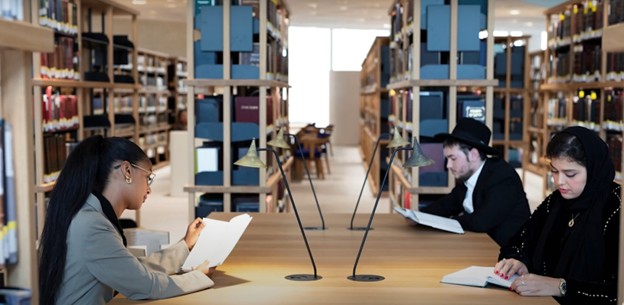
- Image described in Raquel Ukeles’s presentation
Further Reading
- “National Library of Israel launches ‘unprecedented’ effort to collect everything it can about Oct. 7 attacks“ eJewishPhilanthropy (November 9, 2023)
- National Library of Israel Links:
Return to Expanding the Conversation Page
Transcript
Ellie Gettinger
Welcome to Expanding the Conversation, a podcast series that brings the Jewish Theological Seminary to you. The series focuses on the messages that emerge from Israel at a crossroads navigating religion, democracy and justice. A Convening that took place at JTS in April 2025. I’m Ellie Gettinger, director of outreach for the Center for Lifelong Learning, and I will be curating the series, which will highlight key messages from the convening itself with insights from our panelists that were recorded separately.
In this episode, we hear from Raquel Ukeles, the head of collections for the National Library of Israel. She spoke about the role a national library plays, and particularly the roles of the National Library of Israel has taken since October 7th, 2023. She was on the panel, “Israeli Culture: Art, Artifacts and Texts for a Shared Future.” She opened her talk by showing this quote from author Jorge Luis Borges.
“The Universe, which others call the library, is composed of an indefinite and perhaps infinite number of hexagonal galleries with vast air shafts between surrounded by very low railings. She went on to say, Men usually infer from this mirror that the library is not infinite. If it were, why this illusory duplication? I prefer to dream that its polished surfaces represent and promise the infinite.”
Raquel Ukeles
I want to start by introducing a dialectical role of the National Library in general. Libraries are spaces of infinite potential, as Borges beautifully described. The library is a symbol or a reflection of the universe. What’s beautiful about a library is that it can contain almost infinite stories. A library is one of the few places where opposing viewpoints sit very comfortably together on the shelf, and I don’t see that trivially.
It means that a library has a capacity to encompass difference, diversity and conflict all at the same time without choosing sides. When you talk about a national library, there seems to be some kind of paradox or, you know, I want to use the word dialectic because I don’t think it’s resolvable. I think it’s there. And that is the role of a national library is first and foremost not to take on the universal, but to take on the literary heritage of the nation, however construed.
I would even as far as to say the National Library of Israel is a microcosm of modern Israel. And even just in this sentence about the National Library Law that was passed, fun fact, unanimously in the Knesset in 2007 that you see the that the library first and foremost plays to national rules. We are a national library in the geographic sense of the state of Israel, which we interpret as broadly as possible.
And we are a national library in the ethnic sense representing the Jewish people worldwide. And there’s even a third role in the National Library Law, which is that we serve as the premier research library in the humanities. And so I hope you can see right away that all the different tensions in Israeli identity, Jewish and democratic, particularist or universal, are situated in the three missions of the National Library.
That space of inclusion, that Borges is envisioning that, yes, we are collecting the national heritage, but we also are all the time looking for broader and broader ways to collect cultural memory. The fall of 2023, we launched a new era at the National Library. I started working at the National Library at the end of 2010, and from the day I arrived we were planning this move.
And it’s not just a physical move, it was an existential move because the library, which historically was predominantly connected to the Hebrew University as a research institution, has transformed into becoming much more than in an institution of memory, but to be a thriving, open, engaging cultural institution. And the architecture signifies all of these values. The huge windows, the openness.
There are no fences around, around the library, and the public is invited in. We were supposed to open on October 17th, 2023, on October 6, everything was ready. We had been planning for literally years a weeklong extravaganza. There were hundreds of people who were flying in, including the director of the National Library of Morocco. And on October 7th, our world fell apart.
On October 8th, we shut down all the parties. We canceled all the happenings. And then we had a question What is the role of a national library in crisis? And after several rounds of discussions, we came to the conclusion that we needed to become available for the public. We opened three weeks later, and since then we’ve been full.
People have come from all over the country. From October 29th onward, when we open, people said that this was the only place in the country where one could breathe. Part of it was the gorgeous architecture, which is the Swiss architects, Herzog & de Meuron. And it’s really I’ve never had a spiritual connection to a building until we moved into the national this National Library, because the library holds the center.
Just look at this picture sitting at one desk. This is a cross-section of Israeli society because the library is one of the few places in Israel where everybody is welcome and everybody finds their place. And that’s, again, goes back to or has this notion of a library being able to encompass universal stories.
Ellie Gettinger
The table pictured in NLI showed three Israelis, one Muslim, one Haredi and one secular sitting and studying.
How did you build that trust in a space which is and in a world not just Israel, but everywhere, we find that people are increasingly divided.
Raquel Ukeles
It didn’t happen on its own. It’s something that we have been working on for a very long time. The library used to be a place that was very highly regarded but very removed from broader society, and the public really wasn’t welcome.
It was a place of scholars. It didn’t have signs of anywhere. So if you didn’t know where you were going, you didn’t belong there. And that was fine for the people who were using it. And it was a kind of Garden of Eden for academics, but it was not a space for the public. Over the last 15 years, we have taken very concrete steps to change the face of a library and to create a welcoming space for different communities in Israel.
One of the ways we worked is that the staff of the library really represents, reflects the populations of Israel, and that’s very important. When you walk in, you see people who look like you. The library speaks in three languages in Hebrew, English and Arabic, both on our websites and also signage in our exhibitions. And that also we’ve developed educational programs for different communities, including Haredi communities.
And that’s been actually even harder than outreach to the Arab community because the library, as a multicultural site with material, not just Jewish material, but also Muslim and Christian material and all different cultures, that was problematic for, you know, do you bring Haredi children into that environment? And so we’ve been moving very, very consciously and carefully in terms of building trust and and the trust happens through language staffing and programing and having dedicated programing for different communities to signal that we are interested in their finding space in the library.
And then the final piece of it is: it’s a gorgeous building. It’s a spacious building that really invites the public. And that was one of the architect’s main principles. They’re huge windows, it’s airy, it’s light of a fabulous cafe. But it’s even I mean, we joke around that success is being defined by we’re cool with teenagers. There are Haredi shidduch updates at the library.
When soldiers are off duty for a few hours, they come to the library. We have East Jerusalem school kids running around all the time and that makes us so happy because that’s what a library can be. A library is a place that connects people to learning texts and other artifacts, and it’s a place of meaning, of cross-cultural understanding and respect. And it’s so needed both in Israel and in any place.
Ellie Gettinger
In her speech, Raquel shared the new roles that the library took on after October 7th.
Raquel Ukeles
After October 7th. We didn’t want to just be available for the public. On October 9th, we got to work. The first work we do is as a library, that our role as the institution for collective memory in Israel and then for the Jewish people worldwide is to start documenting.
And my team and I on October 9th started documenting. And we have built over time, a massive project unprecedented in scale, definitely in Israel. And we haven’t found an example anywhere in the world. All its complicated diversity. What happened to Israeli society on October 7th and since that how that has affected each and every one of you and people around the world.
Our goal is to build an indisputable historical record of the events that took place for our time and future generations. But interesting things happened at the library beyond our traditional library work. We found ourselves crossing a border between documenting and commemorating that the trauma was so deep that we wanted to create space for people to remember in a very active way.
On the Shloshim, 30 days after October 7th, we started to build this memorial wall. And unfortunately, we keep adding and behind the scenes we created an index. All the people in Israel who were killed, soldiers who fell, hostages and didn’t return, and to create what’s called a name authority record to identify each and every person. And we have shared this with institutions and initiatives all throughout Israel. And that is another way of understanding what it means to be the institution for the collective memory of a country.
Another new role of the library that we’re experimenting with is how the library can serve a therapeutic role. You know, our documenting work has a therapeutic function. We find that people, especially people who are in the first circle of what happened on October 7th, when they when they know that their stories and their loved ones’ stories are collected and are preserved and will be preserved for many, many generations, that it allows them to, this eases something in them.
But there are many, many people who have turned their lives upside down. And so we started doing a program we call Ararat: Hosen shel Haruah, Resilience in the Spirit, to help the first responders, the doctors, the therapists, the social workers to allow that library becomes an intellectual, spiritual refuge, a haven for them as well.
And the final role of the library is that we happen to be neighbors with the Knesset. We’re in the national precinct. And as you’ve read, there have been ongoing demonstrations in this neighborhood. We’re watching as that how the demonstrators more and more are incorporating the library into their demonstrations? Just a few days ago, watched as a group of demonstrators who were marching down Rupin Boulevard. They stopped in front of the National Library and they said the library is what we’re fighting for.
The library is the symbol of what is good about this country. And that’s where we’re trying to go, that we are building a society based on culture of learning, of mutual respect. And that’s why we have to keep marching. The National Library is one example of Israel’s cultural institutions that we are working in a very dynamic way to be present in the moment, but also to hold that center and also to build over the long term.
And that’s really what a library can do. And I think there’s something very valuable about analyzing these strategies, as well as strategies of partner institutions for thinking about how to rehabilitate the society.
The work we’re doing to document October 7th feels very, very different from previous attempts, but we have mine’s history extensively because we want to be very thoughtful about how do we how do we craft collective memory. What’s different about this work is we’re in a digital age. For much of Jewish history. It was about gathering the fragments.
It’s about finding a document. There’s the famous Oneg Shabbat archive of Emanuel Ringelblum, blown from the Holocaust. That’s such a treasure trove because he was collecting in real time during the Holocaust and he put three caches in different places, hoping some of them would be found. Two were found. And the reason why it’s so valuable is it was so rare.
You think about stories about the Crusades. We know about them from chronicles, from poems. When it comes to October 7th, we are inundated with material and information. The acts of October 7th were horrifically physical, but the documentation is almost exclusively digital. And there are two aspects of digital that are distinct. The first is the sheer quantity. We’ve collected until now about 50 terabytes of material and we’re we have a lot more to do.
50 terabytes is in the hundreds of millions, if not billions of documents. There’s nothing to compare it to. We’re collecting thousands and thousands of WhatsApp conversations. We have moment to moment unfolding of what happened on October 7th that no one ever had access to that in the past. We have 200,000 videos from Hamas GoPro cameras and from the street cameras, from the different kibbutzim and shuvim.
So that’s on the one hand. On the other hand, digital material, ironically, is much less stable than a piece of paper. And the reason why we got to work on October 9th was because we all watched in real time everybody here, we all got a lesson of why we need to do real time collecting in the digital age, because Hamas uploaded videos on Telegram at the beginning of October seventh.
12 hours later, it was gone. There were websites we collected right after October 7th. Three weeks later were gone, we’re the only ones that happened. And so that’s very distinct. We’re very mindful of what are the ramifications of collecting so furiously, so much so quickly without any perspective. I think a lot about the work that was done after the Kishniev massacres in 1903.
It was a remarkable effort by Bialik and Dubnov and others to go, and they did real time collecting. But they were so horrified by what they found that Bialik used the raw material to write his Be’ir Ha-Haregah, In the City of Murder. That became a seminal moment in the in the beginning of the Zionist movement. And the polemics around that poem brought more people into the Zionist movement than almost anything else, took over from the documentation.
And so for us, that was a kind of warning sign. How do you hold that center? How do you maintain that line between historical record collecting and all the different kinds of agenda driven work that we are surrounded by?
Ellie Gettinger
In my conversation with Raquel, I wanted to get a better idea of how they are collecting and archiving material related to October 7th.
What is the process of both having people get things in and then authenticating pieces? Is I just want to know a little bit more about your process with that? Is there an access point for this collection?
Raquel Ukeles
Of course. And we can talk generally about how we work at the National Library and specifically about how we’re working on this project we call “Bearing Witness,” which is to document October seven, 2023, and its aftermath, both in Israel and around the Jewish world.
When it comes to this project, “Bearing Witness,” we are being challenged to work in very new ways and in particular the need to collect massive amounts of material in real time. The library today collects a lot of digital material, but we’ve never collect WhatsApp messages before.
Ellie Gettinger
Yeah, what does that even look like? Is it screenshots? We don’t want it to be screenshots.
Raquel Ukeles
If it’s a screenshot, you can search it. And today the focus is on how do you create a textual corpus that you can search? Anyone who’s used catch up understands that if the eye can’t get to the material, then the next generation is not going to look for it. I have I have teenage children and they’re my laboratory for how young, younger generations are using textual sources.
And it’s become clear to us in libraries around the world that we need to provide not just the artifact, not just the book or the manuscript or the photo, but the textual information in in that artifact. So when it comes to WhatsApp messages, which really October 7th unfolded on WhatsApp and it’s the most authentic, you asked about, how do you authenticate it’s the most authentic moment to moment description, a real time description of what happened to these people over the course of October 7th and then for some cases into October 8th and ninth.
We are working with a partner called Memorial 7/10. So a group of individuals from primarily from the South who are going person by person, community by community to encourage people to share their WhatsApp’s, which is both the texts and the video and the audio. So it’s photographs, it’s videos, and it’s horrifying. It’s just, it’s heartbreaking every single day.
But it’s so important to collect that raw material, which is the most authentic data about what happened October 7th. That’s thousands of material. We have hundreds of thousands of videos. They are literally going person to person. They tried all sorts of technological methods to automate the process and they didn’t work. We even help them reach out to WhatsApp and we had several rounds with WhatsApp and WhatsApp made certain changes.
Actually, they expanded the amount of material of data that you can download in any one sitting for this project, because as they say, everything we do, we have to make sure works for our several billion clientele. Well, it’s been hard for them to be as responsive as as we need them to be, and so they keep reverting back to manual one by one persons.
But the numbers in terms of where are the terabytes? So it’s a huge amount of material we’ve download from the Web, both news sites for the first few months and also dedicated websites that went up and social media, which is a whole complicated subject because it’s proprietary, you know, it’s not it belongs to companies. And so they’re not so interested in sharing this information and libraries around the world struggle. How can we capture social media? Because as again intuitively, we know, like a lot of culture, a lot of public dialogue takes place there. We have collected a huge amount of a huge number of websites and videos and photographs from October 7th itself, and that was given to us by this remarkable, just inspiring group of people who gathered on October 7th.
And there were about 400 Cyber, AI, Tech people gathered in a hangar outside of Tel Aviv under what was called the civic headquarters, Hahama Ezrahi, you know, for three weeks they worked on culling all the different video and photo material that came from Hamas telegram accounts right at the beginning of October 7th, from street cameras from the different communities, and eventually some material from from the security forces.
The goal at that point was to track down what happened to people. On October 7th, there were 10,000 people who went missing on October 7th, and so they spent three weeks using AI to extract data of facial recognition. And after three weeks they were done. But they wanted this to be preserved. They gave a copy to the State Archive, and State Archive has a very stringent policies. They’ll they’ll lock it up for the next 50 plus years. And then they gave it to the National Library. So it will be to some degree in the public. Public art we are moving very slowly in product is going to be to create a dedicated platform where you can search and browse and also develop your own stories. But it’s also just going to be a website.
It can it can be low tech and it can be high tech. But the idea eventually is to make as as much as this material as possible available. And I say that because we’re very mindful of both copyright issues, but really privacy issues, we’re dealing with really intimate, painful moments in people’s lives where they shared a lot of very private information about themselves and others.
And so we’re working very carefully, and that will take a little more time to figure out what we can make available, when and for whom. For example, we don’t want, you know, Hamas horror films showing up on Google when your ten year old is, you know, accidentally searches for Kibbutz Be-eri. Right. And so there’s a lot of issues to take into account.
In fact, one of the ways the library has been working is not just to do direct collecting and working in partnership with both grassroots initiatives and institutions, but we have been working at the meta level. We’ve convened a consortium of the major institutions to think through these ethical issues. So we’re actually writing an ethical code right now of how do you do this work.
Because it’s clear to us that this is unprecedented today, but it’s going to become a precedent for, unfortunately for whatever the next catastrophe, trauma, crisis, war looks like.
Ellie Gettinger
Returning to her speech, Dr. Douglas elaborated on the October 7th project and reflected more broadly on the role of libraries in civil society.
Raquel Ukeles
We’re building an encyclopedic collection of October 7th, and we really want to collect the entire spectrum, including we’ve done dedicated work to collect Palestinian discourse, the experience of Arab Palestinian citizens of the country, and to the best of our ability to to get experiences of people in Gaza, which is definitely an ongoing challenge.
There’s another dimension to this, and that is for us in being a national library. And again, that dialectic is all all the time in front of us. It’s not just about the our choice when it comes to certain communities in Israel that don’t feel part of the national story then. But one of the reasons why we didn’t have archives of Arab cultural figures. It wasn’t just because the National Library wasn’t seeking them out, but also because Arab cultural figures didn’t see the National Library as a trusted repository. That’s this process in we actually built. When I got to the library and I understood the situation we were in, it became clear that it was going to take a decade. An archive of Arab cultural figure and in fact took a decade.
And that was how do you build trust with different communities? And we’ve done similar parallel work with the Arab community, with the Ethiopian community, with Russian community, with Haredi communities. And that’s to me, what it means to be a national library today. How do we in fact, put our arms around the entire kaleidoscope of Israeli culture and society?
Also true for Jewish communities around the world, we do parallel work. We want the mainstream. We want to get the key dominant figures, however defined. But we also want to make sure to encompass and to document Israeli society and culture, Jewish society and culture and of course, Islam and Middle East and humanity as a whole. I would say that there’s a distinction between a library and museum, especially in terms of this, you know, capturing it, documenting the full spectrum that is of a value and a principle with us and the challenge of how do you do that in a way that’s, dare I say, authentic demands that the staff of the library had to change.
And so over the course of the last 15 years, when I started, there was one Arab staff person at the National Library, and now there are over 40. And and that’s the way. So it’s not me trying to learn the language of an other, even though I’ve been studying Arabic for over 30 years. And it was a goal of the heads of the library that the staff of the National Library would reflect the population of the country.
And that has shaped the way we think about a lot. If you were to walk into the the new library with me before we walk through that door, I would turn around in and introduce our neighbors on the other side of the Israel Museum, and that is the Knesset. And I say that I’d like to believe that the people in the Knesset would look at us and it helps remind them what they’re working for.
Libraries and museums are barometers of democracy. When the democracy is healthy, institutions thrive. When democracies are under threat. And we see it all over the States today. Libraries and museums become these battlegrounds. A few years ago, the Minister of Education tried to introduce a an amendment to the budget law in order to take over the library. And very explicitly, he planned to fire the board and install his own.
This is in Israel, and I know that there are echoes and in American there was such an extraordinary groundswell of support throughout Israel that it was exhilarating. Thousands of academics, thousands of writers, all but one of the Nobel Prize winners, almost all of the Israel Prize winners. You’re wondering who was. And there were even people who said, I don’t know what the National Library of Israel is, but I love it.
And it goes back to the symbolic role of our institutions, the broad understanding of of the function that they play in a democracy. I don’t believe in neutrality. I don’t think that it exists and it certainly doesn’t exist in Israel and it certainly doesn’t exist in a national library anywhere. And so the work is not to maintain neutrality.
The work is to constantly aspire to do better and constantly aspire to build richer and more expansive and more authentic ways to document and celebrate our cultures and our societies.
Ellie Gettinger
I enjoyed speaking with Raquel Ukeles. Raquel Ukeles provided insight into the ways in which libraries are bastions of collective memory and the challenge of gathering these pieces in a digital age.
Consider how you would document historical events. How we transmit our Facebook posts and WhatsApp conversations to future historians. I was fascinated by the National Library of Israel’s proactive approach in the face of this incredible trauma and overwhelming magnitude of possible collections.
Thank you for listening. I hope you will expand this conversation, sharing your concerns and questions, and maybe this podcast with friends and family members. If you want to see complete footage of this session or of any of the sessions of the meeting, Israel at a Crossroads.
You can find a link on our website jtsa.edu/podcasts. Look for the “Expanding the Conversation” icon. Each episode includes discussion questions for individuals or groups to consider and links to our speakers, organizations and publications. If you would like to attend a Convening, you can find information about our upcoming programs at jtsa.edu/convenings
I’m Ellie Gettinger, director of Outreach for JTS. This podcast was produced by me with technical support from Chris Hickey, director of New Media. This is a production of the Jewish Theological Seminary. No part of this podcast may be reproduced or transmitted in any form without the written permission of the Jewish Theological Seminary. The views expressed here in may not be those of the Jewish Theological Seminary.


