Chancellor Schwartz Reflects on the World Zionist Congress
November 5, 2025
Read more about Chancellor Schwartz’s meaningful week in Israel.
In August of 2022, I had the opportunity to join over a thousand individuals to mark the 125th anniversary of the first Zionist Congress in Basel, Switzerland, in the same place and on the same date as Theodore Herzl’s initial gathering of 197 delegates with varying Zionist views to discuss the idea of creating a homeland for the Jewish people.
While celebratory in nature, this anniversary conference nevertheless revealed—often by their absence—the many challenges that had not yet been resolved in what was then the almost 75-year-old State of Israel.
From the time of Herzl until the founding of the State of Israel, the World Zionist Organization had engaged in developing institutions such as the Palestine Airways (the precursor to EL AL), The Hebrew University of Jerusalem, and Keren Kayemet L’Israel (the Jewish National Fund). After 1948, the World Zionist Congress met about every five years to suggest policy and initiate programs to further fortify the State as envisioned by Herzl, and to strengthen Jewish communities around the world and foster deeper ties between them and the State of Israel.
Because of the constraints of the pandemic, the Congress had not met in person for ten years. It made this year’s gathering of over 1,400 delegates from across the globe all the more meaningful. I—along with Chris Penello, a third year JTS rabbinical student—had the honor of serving as delegates on the MERCAZ/Masorti slate, which included intergenerational representation from Latin America, Europe, and Africa, as well as Israel and North America.

I approached the Congress tentatively. Following the traumas of October 7, the hostages, the war, the deaths of too many soldiers and civilians, the humanitarian tragedy in Gaza, increased antisemitism worldwide, and the deep challenges Israel still faces, the prospect of healing—both physically and spiritually—at times felt out of reach.
And yet, happily, throughout the days of the Congress, I experienced an overpowering sense of hope, a sentiment so many of us have been desperately yearning for these past few years. Why?
Because delegates proposed, debated, forged alliances, and voted on resolutions that addressed the tough issues festering in society. Even though recent political moves have jeopardized the ability to reach final agreement on the composition of leadership for the next five years, last week’s events still offer an important precedent for building a consensus among a large swath of the principled middle, a precedent that hopefully, will ultimately pave a positive path forward.
For example, MERCAZ Olami and Masorti Olami, led by Dr. Yizhar Hess, Vice Chairman of the World Zionist Organization and the senior representative of MERCAZ, the Masorti/Conservative slate, introduced resolutions calling for:
- a State Commission of Inquiry to investigate the events of October 7
- an equitable Draft system
- accessible access to the Egalitarian Kotel
All three passed with wide margins—as did many of the other resolutions that MERCAZ Olami and Masorti Olami supported; while resolutions that we chose not to support, such as extending sovereignty over Judea, Samaria, and the Jordan Valley, were roundly defeated.
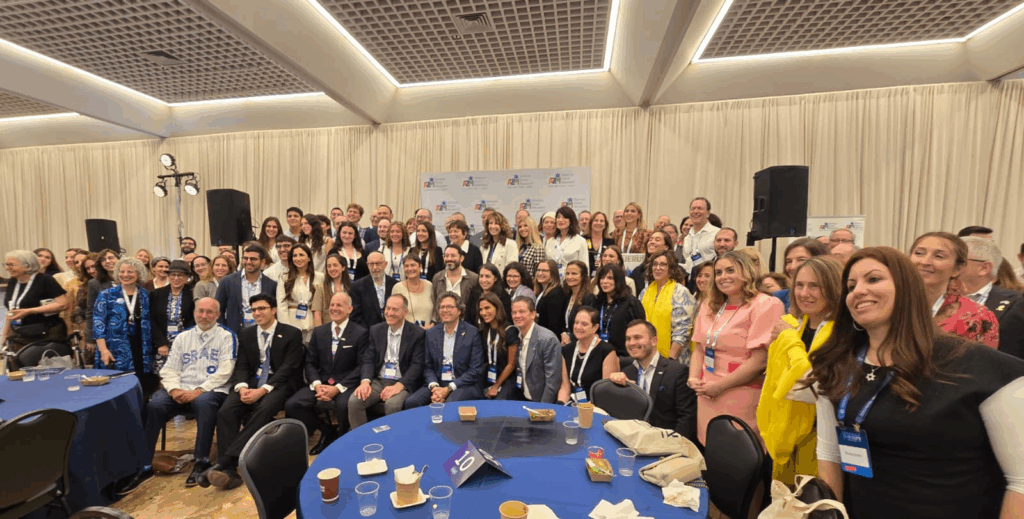
The process was exhilarating for several reasons. First, it was inspiring to see a genuine desire for a strong, principled, and moderate voice, one that reasserted the moral vision at the heart of Israel’s founding. Second, when Israel and the Jewish people are under siege, we have a natural tendency to blame others for our problems. But at this Congress, a broad group of deeply committed Zionists came together spurred by their love for Israel to acknowledge the country’s challenges and propose concrete solutions that would lead to a stronger, more morally grounded future.
Third, many delegates worked together to build bridges. MERCAZ/Masorti leadership initiated dialogue with other slates and found great receptivity. Through intensive negotiation, the center-right and center-left joined forces, for they recognized that their values and priorities aligned more than they differed.
Ultimately, the Congress reaffirmed that our destinies as a Jewish people are intertwined, that what happens in Israel impacts Jews globally and vice versa, and that, as a result, we must work harder to understand and appreciate one another, and to mutually assume responsibility for crafting a more just, respectful, future.
While the World Zionist Congress itself holds no formal power to enforce its resolutions, the process modeled the power of collaboration, and hopefully will ultimately impact leadership decisions, determine policy priorities, and drive budget allocations to institutions such as the World Zionist Organization, the Jewish National Fund, and the Jewish Agency for Israel. With time, perseverance, generosity, and trust, the heads of the various institutions will hopefully come together to secure a better future for a Jewish, democratic Israel and stronger ties among Jews around the world.
It is noteworthy that the WZO Congress concluded just days before the New York City mayoral election. Though the two events differ greatly in constituency, process, and outcome, they share important similarities in charting a new path forward. Just as we worked at the Congress to build a better future for the State of Israel and Jews around the world, I hope the new incoming NYC administration will work to create a brighter future for all New Yorkers, including the city’s large, vibrant Jewish community.