Love Through Knowledge
Rabbi Laura Novak Winer knew she had found a doctoral research project when she was facilitating a group of supplementary schoolteachers and found them struggling when teaching about Israel. The research and evaluation skills she learned through her William Davidson Executive Doctoral Program continue to enrich her work and inform the field of Israel education.
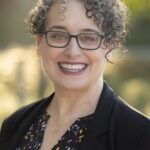
For Rabbi Laura Novak Winer, the decision to pursue an executive doctorate at The William Davidson School of Jewish Education emerged directly from her consulting work with congregations. She had already worked as a congregational educator and held senior leadership positions in the youth and education departments at Union for Reform Judaism (URJ) when she began consulting. She engaged with congregations who were setting their educational vision and goals, and she found herself being asked to assess and evaluate programs and models, an area where she did not have rigorous training.
“I was hearing a lot of the same kinds of questions in my consulting practice, and at the same time, I was about to become president of Association for Reform Jewish Educators (ARJE), where I knew I would encounter ‘big picture’ challenges,” she said. “I was asking myself what I wanted to do with the next chapter in my career, and the executive EdD was just the kind of opportunity I needed to expand my own learning and gain important skills in educational assessment and measurement.”
Winer had known since high school that she wanted a career in the Jewish world. A graduate of University of California at Santa Barbara and Hebrew Union College-Jewish Institute of Religion (HUC-JIR), Winer had been trained to develop and use her pastoral skills in educational settings, possessed considerable content background and experience as a Jewish educator, and had already dipped her toes in the academic study of Jewish education with a number of publications. She was ready to pursue a doctorate, as she put it, “to swim in the pool of big ideas and get my hands dirty in the big question of assessment.”
When she entered the executive doctorate program at The William Davidson School in 2013, she was fortunate to be part of a unique cohort of six professionals, most of whom knew each other well from the Reform movement. The community they created supported them through their coursework and research. “It was my first time learning online, and I had to learn how to learn all over again,” she said. From the faculty, many of whom were themselves teaching material for the first time in the new program, she gained pedagogic models she now uses in her own online teaching.
Winer kept up her consulting practice while she was in the program, and alongside her volunteer leadership position in ARJE, these became the “sandbox” in which she reflected on and processed her coursework. One of her consulting projects was with the iCenter, which is dedicated to professional development for Israel educators. As she worked with both American-born and Israeli-born Israel educators in supplementary schools, she found herself at a pinnacle moment that became the catalyst for her dissertation research and has had ripple effects in her ongoing research.
She was co-facilitating a professional development workshop in the Bay area for about 30 supplementary schoolteachers. An American-born teacher spoke about the challenge of teaching about Israel given her own personal ambivalence about the Israeli government. Winer recalled the response of an Israeli-born teacher in the room: “What’s so hard?” she said. “It’s Israel, you teach it!” At that moment, Winer understood that American-born teachers have a very different experience teaching about Israel than their Israeli-born colleagues, and she knew she wanted to study how the way teachers understand their own connection to Israel shapes what they do in the classroom.
Using the research and evaluation skills she had gained from her coursework, Winer studied four American-born teachers in two different progressive synagogues. “I spent half the time with these teachers just getting to know them and their connection to Israel,” said Winer. “The other half of the time we talked about their teaching, unpacking decisions they made or observations that emerged from their own reflection.” She identified moments in their teaching when they revealed something about themselves and the dynamic of their own relationship with Israel.
Her dissertation, entitled “Teaching Who They Are: American-Born Supplementary School Teachers’ Connections with Israel,” yielded an articulation of these relationships and a typology.
Since completing her EdD in 2019, Winer has continued researching and publishing about Israel education. She has a chapter in Teaching Israel: Studies of Pedagogy from the Field, a compendium edited by Sivan Zakai and Matt Reingold that is widely viewed as a core text for Israel education. As a senior fellow at the Jack, Joseph and Morton Mandel Center for Studies in Jewish Education at Brandeis University, she is currently working on a philosophical piece that calls for reframing the goals of Israel education, a topic that emerged directly from her dissertation.
“For many years, the goal of Israel education in North America was to develop in learners ‘ahavat Yisrael,’ love of Israel,” said Winer. “Yet how do you measure love? You can’t teach love, other than a kind of indoctrination, and our communities tend to measure it a binary love/hate way.” At a time when measuring impact is so prevalent in educational discourse, Winer believes we need to be sure that our goals are sophisticated enough to bear the weight of nuanced assessment.
Historically, said Winer, Israel education in Israel focused much more on Land of Israel studies, “yediat ha’aretz,” knowledge of Israel, which included experiential opportunities like hiking or rafting and formal study of topics like geography or botany, in order to build knowledge about and a connection to the land. “I believe the goal of Israel education should shift from love to knowledge,” said Winer. “Love is not an educational outcome.” She is developing a new paradigm for Israel education, which she calls “yediat Yisrael.”
The wisdom of the yediat Yisrael goal, said Winer, is that “there is an understanding that before one can love a place, one first has to know it.” Yediat Yisrael may lead to ahavat Yisrael, but that is not the primary goal. “The goal of yediat Yisrael is for learners to find and navigate their own meanings and connections with Israel as the historic homeland, as a global, diverse Jewish community, and as the modern State,” said Winer.
In addition to her ongoing research, Winer has continued as an educational practitioner. She directs the masters in educational leadership program at the Rhea Hirsch School of Education at HUC-JIR in Los Angeles and teaches in both the school of education and the rabbinical school. This coming July, Winer will become associate rabbinical school director at HUC-JIR.
“I have always considered myself a Jewish educator who happens to be a rabbi,” Winer said. “As I teach in the rabbinical school and look ahead to this new administrative role, I am committed to modeling and promulgating the stance of the reflective, supportive educator-rabbi. My hope will be to apply an educator’s mindset—using concepts such as educational goal-setting and assessment—directly into rabbinic training.”