Curriculum, Community, and Connection
For nearly three decades, Merav Tal-Timen has turned Hebrew class into a joyful, deeply meaningful experience—one her students joke about but carry with them for life. By blending culture, text, and a curriculum she built herself, she shows that teaching Hebrew isn’t just about language—it’s about identity, connection, and truly knowing your students.
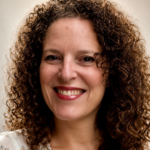
Each year at the Ma’ayanot Yeshiva High School for Girls’ Shabbaton, the students do skits, and inevitably they poke fun at Merav Tal-Timen, their beloved Hebrew teacher. “Listen, what I am telling you is very important, not for the test, but for life,” they quote, imitating her Israeli accent remarkably accurately. Tal-Timen, who received her MA from The William Davidson Graduate School for Jewish Education in 2019, has taught at the Modern Orthodox girls high school in New Jersey for 27 years.
In the skit, whatever phrase or vocabulary Tal-Timen is said to impart garners laughter (it usually has to do with how to approach an attractive young person at the bus station). What is serious, though, is the way Tal-Timen teaches and the deep connection and relevance she embeds in her classroom. She really is teaching them “for life.”
Having grown up in the Galilee, Tal-Timen trained as a teacher and taught math in Israeli public schools. Her extended family was living in New Jersey when Tal-Timen and her husband had their first child, and they decided to move to be closer to family. Her mother connected her to the assistant principal of Ma’ayanot which was then a brand-new school. “Even in my very first interview, I got excited about being in a school where I would be learning as much as I was teaching,” she recalled.
“Coming to the United States and to a Modern Orthodox school, I knew that my first objective was to quietly observe, listen, and absorb this culture that was new to me,” she said. “I had to learn to speak my students’ language so that they could speak mine. In order to teach Hebrew well, I needed to know the community very, very well.”
During her first years at Ma’ayanot she found deep support from the administrator who served as her mentor. To this day, Tal-Timen believes having a strong mentor—from outside the Hebrew department—can make all the difference for new teachers to successfully make a bridge to the broader school community.
While becoming familiar with Ma’ayanot’s culture, Tal-Timen came to see that Hebrew was a direct reflection of the school’s values. “My students are actually craving to learn Hebrew,” she said.” Over 95% of Ma’ayanot graduates spend a gap year in Israel, and many of them consider or make Aliyah. “We teach Hebrew at Ma’ayanot not just as a language, but as part of a living culture.”
Unsatisfied that any of the curricula she tried were the right fit for Ma’ayanot, Tal-Timen wrote her own, a four-year spiral curriculum with annual themes that covers Hebrew skills as well as learning about Am Yisrael and Eretz Yisrael. The curriculum was informed by all that Tal-Timen had learned about Ma’ayanot and her students. “If you don’t know your students and you don’t care about them, even the best curriculum won’t work,” she said.
At Ma’ayanot, the strong link between Hebrew classes and limudei kodesh, religious subjects, means that in any given class, Tal-Timen might teach popular Israeli songs alongside ancient texts. “Part of what is special about Ma’ayanot is that this is a community with a real hunger for relevant and meaning-based learning,” she said. “Hebrew is an important key that provides access to this kind of study.”
From day one, Tal-Timen took advantage of “any and all” professional development opportunities. “I was not trained as a Hebrew teacher, never mind as a teacher in a religious school, and I was eager to learn as much as I could.” Tal-Timen knew that investing in her own learning would lead her to become what she called, “a better version of myself as a teacher.”
When Tal-Timen met Davidson professor Ofra Backenroth, she was already interested in pursuing a graduate degree and was excited to learn about the flexible MA program in Jewish education then offered at JTS. “I needed to be able to learn online during the school year and then to participate on campus during the summers,” Tal-Timen said. “The faculty understood that we were working teachers with a busy workload.”
In addition to a course on Hebrew children’s literature with Backenroth where she wrote her own children’s book, Tal-Timen recalled learning Gemara for the first time with Rachel Rosenthal, then an adjunct instructor. “The way she brought the text to life was astounding,” Tal-Timen said. “She created a visualization of a complex text, exposing the way of thinking behind the words that helped make the concept clear.” Tal-Timen believes this kind of teaching is particularly relevant for learning a foreign language.
Tal-Timen brings her whole self to her Ma’ayanot classrooms. “You can’t pretend in front of teenagers,” she said. “Learning has to be fun, and you need to be a little bit of a child yourself.”
“One of the things I always ask my students when I am teaching them something new is ‘how are you going to remember this?’ Sometimes the most ridiculous association allows you to make a connection,” she said.
For Tal-Timen’s lucky students, the association with a teacher who clearly loves what she is doing enables them to develop a lifelong connection to Hebrew and the Jewish people.