Turning a Barrier into a Bridge
“Hebrew opens up literacy, Jewish life, connection to Israel, Jewish peoplehood and an internationally shared common lens,” said Rabbi Dr. Andrew Ergas. As CEO of Hebrew at the Center, Ergas is driving a bold shift in Hebrew education—professionalizing teachers, expanding access for all learners, and redefining what success looks like.
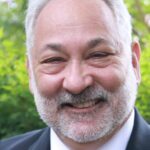
When he is feeling philosophical, Rabbi Dr. Andrew Ergas, who received his EdD from The William Davidson Graduate School of Jewish Education in 2024, has a big question about North American Jewry. “Hundreds of years from now, what contributions will American Jewry be known for? Will we be like the Hellenistic Jewish culture in Alexandria, remembered for its translations into the lingua franca (Greek), or Spain, where the majority of creative and scholarly Jewish writing was in Hebrew?”
Ergas wants to give an American Hebrew legacy a fighting chance.
As the chief executive officer at Hebrew at the Center (HATC), Ergas leads an organization whose mission is “to revolutionize Hebrew language education and engagement as [they] advocate for Hebrew as a more prominent and intentional feature of Jewish life.”
“We want to take the potent but underutilized tool of Hebrew to create opportunities for what Hebrew opens up: literacy, Jewish life, connection to Israel, Jewish peoplehood, an internationally shared common lens,” said Ergas.
Hebrew at the Center was founded 18 years ago as the result of a successful teacher-focused trial by day school parents from Boston’s Jewish Community Day School who wanted to improve the likelihood that their 8th grade graduates would have the skills to speak Hebrew. The organization has since grown to be the central address for Hebrew education in North America.
“We represent Hebrew in the broader Jewish ecosystem,” said Ergas, who for now works primarily with Jewish day schools, camps, and congregations. This year alone, they coach and mentor 50 educational leaders, and professionals from over 150 day schools have attended HATC webinars or events.
“So many Hebrew educators in America have a great passion for teaching but do not have enough of the tools they need to really strengthen the learning experience,” said Ergas.
Tools such as assessments and measures of student progress are critical, said Ergas. “It is somewhat ironic that while Jews have been teaching children to read Hebrew for centuries, the professional field of Hebrew education is actually very young.”
According to Ergas, there are approximately 2700 Hebrew teachers in Prizmah-associated day schools in North America. About half do not have degrees in education. “They may even be morim shlichim, ambassador teachers from Israel with a great sense of mission, but they have generally not received explicit training in teaching a foreign language.” he said.
Hebrew at the Center works to support Hebrew teachers, creating professional learning opportunities for teachers to access networks and resources much like math teachers do at conferences, trainings, and with their peers, said Ergas. And the development of MA and PhD programs in teaching Hebrew at Middlebury has opened up tremendous possibilities for the field. Ergas expects a significant increase from the current 12% of day school teachers with graduate degrees in teaching Hebrew.
Along with increasing professionalization of teachers, Ergas sees three bright spots on the horizon for Hebrew education: a new narrative of achievement; the development of research-based strategies for teaching Hebrew to those with language-based learning disabilities; and a historic opportunity to recalibrate what constitutes a “good” Jewish education, including Hebrew.
Narrative of Achievement
For a long time, the narrative about Hebrew education has been about how it wasn’t being taught. Many wondered if it was even possible to teach Jewish kids their language, said Ergas. Thanks to substantial efforts over time and the investments of funders and educational leaders with whom HATC partners, real progress is being made in the tools teachers need and in the ways student progress can be measured.
Assessment and achievement tools such as MaDYK and Avant STAMP are being used by more schools who allocate time and assets to grow the proficiency of their teachers and students.
“Last year,” said Ergas, “more than 350 students received the global seal of biliteracy in Hebrew language at levels set by ACTFL (formerly known as the American Council on the Teaching of Foreign Languages).”
“We now have quantifiable indicators of progress in Hebrew learning, and the conversation is much more about opportunities and achievements than deficits,” he said.
Teaching More Learners
When he was head of school at Beit Rabban in New York City, one of the hardest conversations Ergas would have was with parents of children with learning disabilities who struggled with Hebrew. “It was so difficult to talk about children not being able to remain in the school,” he said. “Learning differences can’t become barriers to Jewish engagement and belonging.”
HATC sees itself as the address for field-wide solutions. In partnership with funders, providers, and educators who are putting resources on the table, robust approaches are being piloted through an initiative called Pritzat Derekh: Hebrew for All to support the learning needs of learners with dyslexia, an estimated 20% of the population. “We have raised close to $1 million towards this, and we are already thinking down the road about how these tools can be applied to congregational school settings,” said Ergas.
Recalibrating Educational Goals
Against the backdrop of “the surge” in Jewish communal identity and expression that has been observed in the aftermath of the 10/7 terror attacks, Ergas recognizes an opportunity to “recalibrate” what we mean by good Jewish education. “In these moments of uncertainty, we can respond by making certain that students know who they are and where they come from. Hebrew—the language of the Jewish people for centuries–is part and parcel of that,” he said.
Hebrew is a tool for unpacking Jewish text study, participating in prayer and ritual, and understanding Jewish history and modern-day Israel, said Ergas. “It is a bridge to so much, and we have the chance now to lower the barrier,” he said.
Davidson Experience
Ergas was head of school at Beit Rabban when he decided to begin a doctorate at Davidson. He wanted to engage in rigorous thought and was certain his research would focus on praxis, the intersection of practice and theory. “I wanted to anchor my practical career experience in the critical literature of Jewish education,” he said.
Pursuing an executive doctorate while working a full-time job was not easy. “It was a challenge to switch your mindset from scholarly curiosity to responding to the day-to-day concerns of running a school,” he said. “You might be in the middle of a brainstorm related to your research when the phone rings and you need to address an urgent call from a parent, donor, or teacher.”
One of the characteristics of Davidson that drew Ergas, who had been ordained at Hebrew Union College, was the non-denominational environment. “It was very special be able to learn among people from all movements and backgrounds,” he said.
As he focused his dissertation on Hebrew pedagogy and identity, he drew a parallel to the pluralism he found among his classmates to his area of research. “Hebrew is one of those Jewish priorities that crosses ideology, theology, geography,” he said. “You can talk about Hebrew and Jewish culture with all types of Jews.”
Ergas had hoped to work closely with the late scholar of Hebrew literature Professor Alan Mintz z”l, whose loss was immense to the field of Jewish education. He found a great mentor in Professor Aryeh Davidson and greatly appreciated the opportunity to learn with faculty such as Miriam Meir from the Hebrew department and Professor Ofra Backenroth.
He also valued the chance the study at Teachers College. “One course I took there, called ‘Schools, Languages, and Identity’ could have been the subtitle of my dissertation!” he said.
The cohort environment of executive doctorate students was also a great component of his Davidson experience. “It was a blessing to have an intense and intimate group of fellow students to help propel me forward, especially while I was working on my dissertation,” said Ergas, who also benefitted from the support and collegiality of the Mandel Doctoral Fellows Program.
Ergas prefers to talk about Hebrew as a second language as opposed to a foreign one, and he is dedicated to finding ways to move people forward on what he calls their “Hebrew journey.” His passion for Hebrew education stems from a belief that it is a key to Jewish meaning-making. “As humans we create meaning in the world through words; Jews create meaning through Hebrew,” he said.