Teaching Hebrew as a Profession and Calling
Adi Raz directs the modern Hebrew language program at the University of Michigan and co-leads Middlebury’s School of Hebrew in Vermont. With a doctorate from the William Davidson School, she draws on the science of language acquisition and decades of classroom experience to reshape how Hebrew is taught. She champions rigorous teacher training, immersive learning, and classrooms that double as vibrant, supportive communities.
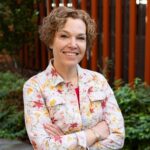
As co-director of Middlebury’s famed School of Hebrew in Vermont, Adi Raz, who received her EdD from the William Davidson School in 2009, has a front-row seat to what it looks like to teach Hebrew successfully. As director of the modern Hebrew language program at the University of Michigan, she also knows why learning Hebrew is so important.
“Hebrew connects the Jewish people across the world and across history,” said Raz. “It can open the door to culture, spirituality, community, and even romance,” she said, noting that at least two couples who met in her Hebrew class at the University of Michigan are now married.
Raz was born in Israel and grew up in New York as the daughter of diplomats. A natural-born “code-switcher” between Hebrew and English, she was drawn to the art and science of language learning. Her first MA (she holds three) was in TESOL (Teaching English to Speakers of Other Languages). Raz was committed to taking what she learned about teaching English and applying it to Hebrew.
While pursuing her EdM in applied linguistics at Teachers College, Raz discovered the Jewish Theological Seminary just a few blocks away and found what she called a “home,” a safe space where faculty appreciated her passion for research about teaching Hebrew. “At Davidson, they got what I was trying to do,” she said.
With great appreciation to the Davidson Foundation, Raz completed her doctorate debt-free. Dr. Adina Ofek was her advisor, and classes with Dr. Aryeh Davidson and Dr. Barry Holtz stand out in her memory even after more than fifteen years. Her dissertation focused on teaching Hebrew as a second language to students with language-based learning disabilities, a challenge she observed in the Jewish day schools where she taught.
The Science of Second Language Acquisition
Research has shown that what happens in the brain while learning a foreign language (processing syntax, gaining vocabulary, etc.) is the same no matter the language. At Middlebury’s immersive language school, any student pursuing a doctorate in foreign language teaching is required to learn a language that they do not already know, experiencing first-hand the process of second (or third or fourth) language acquisition.
“Teachers need to know the theoretical framework of how language is learned in the brain,” said Raz. Watching other teachers teach is also extremely important.
Teaching and learning a foreign language is an emotional experience. “Learning a foreign language is incredibly humbling,” said Raz. “You start like a child, learning the words for colors and shapes.” The best Hebrew teachers, according to Raz, understand the science of learning a second language and who also know what it is like to learn a language from scratch. “They can connect with learners and create a safe space where it is okay to stumble over your words.”
Contrary to what many people think, Raz believes that Hebrew is not hard to learn–or teach. “You just need to know how to do it,” she said. “Like building with LEGOs, you need a good foundation and then build up.”
Filling a Need
The need for qualified Hebrew teachers is nothing new in Jewish education, and merely being able to speak Hebrew is not enough. “Years ago you might have had Israelis in America being hired purely on that basis,” said Raz, “but in today’s educational settings, especially in full-time Jewish day schools, there is agreement that teachers need specific training in order to succeed.” The frequent turnover and dissatisfaction that many schools experience with Hebrew teachers can be addressed by increasing the professionalization of these educators.
Being able to understand North American Jewish culture is critical and an area where native-born American teachers, even if they speak Hebrew with an accent, can serve their students well. Raz believes that once they are proficient enough in the language themselves, non-Israelis can make excellent Hebrew teachers.
“If day schools and universities want to fill their searches for Hebrew teachers with candidates who really have staying power, they need to select candidates with skills and ability,” said Raz. “They actually need to be more selective.” At the University of Michigan, for example, Raz said that they only hire Hebrew teachers with at least an MA in teaching Hebrew.
Attracting more Hebrew teachers requires systemic change, Raz acknowledges. “Not many people grow up with the dream of being a Hebrew teacher!” From her experience, however, learning Hebrew can be truly transformative for students of all ages, and Hebrew teachers can be uniquely positioned to make a lasting impact on more than just the language skills of those in their classroom.
What Happens in Hebrew Class
“Hebrew classes on university campuses are not political, and they are not religious,” said Raz. “They can be a safe haven for those who share an interest in Jewish life.”
Because most language classes are small and meet multiple days a week, they become a community unto themselves. “I am a mom, and I treat my students a lot like my children,” said Raz. “Hebrew class might be the only place where they can share their feelings and get supportive feedback.” Raz frequently witness students at Michigan complete their foreign language requirement and then stay on for advanced coursework in large part due to the close classroom community.
Hebrew falls in the category of Less Commonly Taught Languages (LCTL) which means that even at a large school like Michigan, the classes are taught by real professors and not graduate students, as is often the case with languages like Spanish or French.
Raz relies on authentic Hebrew material in her classroom, using clips from Israeli television like Eretz Nehederet and actual weather reports rather than artificially constructed worksheets. “We want people to experience a living language, not a mediated encounter,” she said. “Technology today, like YouTube, provides so much direct access.”
Passion defines Raz’s work, both at Michigan and in the summers at Middlebury, where the immersive environment even includes her children teaching how to crochet in Hebrew.
Raz recalled one beginning Hebrew student who returned to campus after the High Holy Days, amazed that for the first time, he understood what he was saying in synagogue. “I really, really love my job,” Raz said. “It is not often that a teacher can help someone prepare for a personally meaningful life.”