
In Every Generation: Renewing the Story of the Jewish People
Posted on
An Interview with Dr. Shuly Rubin Schwartz, Chancellor and Irving Lehrman Research Professor of American Jewish History, JTS
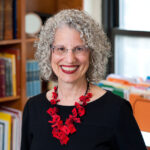
In thinking about Passover, Chancellor Shuly Rubin Schwartz began with the Haggadah. For her, the seder is a living textual exercise—one that demonstrates how Jewish tradition holds continuity and change in tension. The obligation to tell the story remains constant; how that story is told must always respond to the moment. What follows is adapted from this conversation.
WHAT DOES THE HAGGADAH REPRESENT TO YOU?
To me, the ongoing exchange between teaching and learning lies at the heart of the Haggadah. And the Haggadah takes this one step further. It invites us not only to study and recite it, but to bring the experience to life. While there are essential elements that must be included, there is also enormous space for interpretation, creativity, and adaptation.
This dynamic makes the Haggadah the quintessential educational document of the Jewish people.
Passover’s central imperative is to ask questions and tell the story. In addition to reciting fixed questions, participants in every era will ask—and should be encouraged to ask—unanticipated questions. Similarly, how the Passover story is told is up to us. While drawing on the traditional themes, we strive to convey them in a language our audience can hear. In this way, each seder will uniquely reflect the people gathered around the table.
WHAT DOES THAT KIND OF FLEXIBILITY TELL US ABOUT HOW JUDAISM UNDERSTANDS TRADITION?
It is incumbent upon us to continually reframe, re-energize, and evolve so that the message of the Exodus—of liberation and possibility—can speak to every generation. In this way, the Haggadah conveys the essence of Conservative Judaism, retaining the traditional framework with its required elements and timeworn melodies, foods, and rituals, while encouraging us to add our own stamp to it.
Each year, we are asked to confront the question: what does experiencing liberation require of us now? The answer is never fixed. It shifts from generation to generation, year to year, and changes depending upon who is gathered around the seder table and what each person is feeling at that time.
The seder was never meant to be static. I think those reading every word with no additions and doing the same thing every year misunderstand the seder’s purpose. The Haggadah and the seder itself were designed to be fluid, inviting continual renewal, interpretation, and growth.
CAN YOU GIVE AN EXAMPLE OF HOW THE SEDER ITSELF HAS EVOLVED IN RESPONSE TO CHANGING PERSPECTIVES?
The Four Sons (what we now refer to as the “Four Children”) is a wonderful example. Think about the rasha, the so-called wicked child. Our understanding of that child has changed dramatically.
Instead of seeing the child as bad, we ask: What does it mean to be labeled as bad and to feel alienated as a result? What does it mean to feel like you’re doing something wrong without understanding why? This new interpretation shifts the meaning entirely. Anyone who has felt marginalized can see themselves in that child. This adaptation allows them to feel represented in the Haggadah and comfortable being at the table, while offering an opening for conversation around a sense of otherness or judgment should this person want to initiate it.
WHAT ISSUES HAVE RESHAPED SEDARIM AND HAGGADOT IN YOUR LIFETIME?
In one generation, questions of women’s roles led to the inclusion of Miriam’s Cup. Today, many children grow up with Miriam’s Cup on the table and don’t even think to question it.
The same pattern holds for those marginalized because of sexual orientation, whose experiences inspired the orange on the seder plate—another poignant response to a feeling of exclusion.
Other moments shaped the seder as well: The postwar generation added readings to remember the victims of the Holocaust. During the struggle for Soviet Jewry, prayers were added for those Jews living behind the Iron Curtain.
One of my most memorable sedarim took place in 1981, when we hosted an Iranian Jewish couple who had escaped the Ayatollah. In that moment, freedom was not an abstract idea, but a palpable presence in our midst.
Passover resonates because its message of liberation continues to meet the moment.
WHAT MAKES THE SEDER UNIQUELY OPEN TO THIS KIND OF EVOLUTION?
Much of the seder is minhag rather than halakhah. There are a few obligatory rituals and recitations, but beyond those, observing the holiday is deeply personal. Traditions and customs—such as the food you use for karpas, what kind of haroset you eat, and how you orchestrate finding the afikomen—vary depending on where your family comes from; what adult children, newer family members or long-time guests have introduced; and what community you find yourself in. Because of this, no two sedarim are the same. The more we internalize from others, the richer the seder becomes.
Pesah has always been the most observed holiday among American Jews. There’s a reason for that—it draws people in and the barrier to entry is low. The seder represents both a living Judaism and a practical Judaism that anyone can both access and contribute to.
The seder reminds us that no one generation owns the story. We inherit it, shape it, and pass it forward. That has been true around dining room tables for centuries, and it is true of institutions as well.
To publish a Passover reader is to take that obligation seriously. It signals that we all must continue to respond to the questions of this moment, just as Jews have done in generations before us. The story remains. The voices around the table change. The responsibility to elaborate on the narrative endures.


