
Impact Through Community
“The best help you can give people is to be in relationship with them,” said Rabbi Anne Ebersman. As director of hesed and tzedek at the Heschel School in Manhattan, she lives that statement every day, and in her doctoral work at The William Davidson Graduate School of Jewish Education, she has experienced how learning as a community can have tremendous impact.
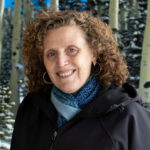
“The reward of community engagement is not always where you expect it to be,” said Rabbi Anne Ebersman, director of hesed and tzedek at the Heschel School in Manhattan. “Our students regularly prepare and deliver meals for people who live near us and are food-insecure, and that definitely benefits our neighbors, but it also has an important impact on the students. They learn to recognize the needs in their broader community—and they come to see themselves as empowered to help make things better.”
As she approaches completion of The William Davidson Graduate School of Jewish Education’s executive doctoral program, Ebersman believes that engaging with and in the broader community is a critical component of Jewish education. Learning itself happens most effectively “in community.”
An Upper West Side native, Ebersman only started to deepen her own connection to Judaism after she graduated from Barnard and attended a Friday night service and Shabbat dinner with a classmate. “It so happened that my ‘very Jewish’ friend was the niece of Rabbi Marshall Meyer, and from that first evening at B’nai Jeshurun, I felt drawn powerfully into the spirituality and ritual of Jewish life.”
Fast forward from that experience, and Ebersman entered rabbinical school at Hebrew Union College and taught in a number of synagogue supplementary schools. Ebersman served as principal of BJ’s Hebrew School at the time when the Heschel School was based in the same building. With a toddler at home and a second child on the way, unsure about continuing in the role as principal of an afterschool with late hours, she was offered a job at Heschel, where she “fell head over heels in love with day school.”
Ebersman’s career at Heschel began in the Lower School and Early Childhood and then expanded to a school-wide role as she was named the director of hesed and tzedek. “At Heschel, an important aspect of hesed is about how we connect to the community around us,” said Ebersman, “so we look for ways to create ongoing partnership with community-based organizations in the city.”
Connecting to the Community
“It is hard to tackle big, systemic issues like food insecurity,” Ebersman said, as an example, “but we can get outside of our own walls and do our part in our own neighborhood.” Through Heschel’s Cooking for Community initiative, students cook and deliver 75 meals a week for residents living in the nearby Amsterdam Houses. The school has made a commitment to cook for its neighbors every Thursday when school is in session.
Similarly, when Heschel fifth graders each month welcome to lunch older adults from Project Ezra, a social service agency on the Lower East Side, they share a meal and develop ongoing relationships. “Our students learn that even a fifth-grader can play a part in the epidemic of loneliness, one conversation at a time.”
The school has also built an ongoing relationship with the Manhattan Children’s Center, a school for children on the autism spectrum. “At first, our middle and high school students were volunteering after school. But then we heard from the teachers at MCC that their younger students needed to gain experience in neurotypical settings.” Ebersman and Heschel then began a program in kindergarten where the MCC students come to Heschel and play together.
As the relationship with MCC developed, they incorporated the volunteering that the older students were doing into formal learning. Ninth graders read and discussed The Curious Incident of the Dog in the Night-Time and invited different speakers to talk about disability. “When one of our 11th graders spoke about what it was like for him to have a brother who is on the spectrum, that was incredibly impactful,” said Ebersman.
When Heschel students volunteer at MCC, the staff explains to them how important it is for the MCC students to learn how to relate to new people in the classroom. “Our students appreciate feeling like they are making a material difference,” said Ebersman. “For us as teachers, we also appreciate the difference that learning and volunteering together affect the way the Heschel students see themselves and their capacity to contribute to a complicated world.”
For Ebersman, cultivating relationships and authentic partnerships and dedicating time and space for reflection elevate what could be seen as random acts of kindness to a more holistic—and holy—concept of hesed.
In a Community of Learners
When Ebersman considered expanding her own professional capacity through the Davidson executive doctorate program, she was looking for a new challenge and a deeper understanding of what it means to be an educator. It was the community of learners in her cohort that provided support and encouragement and perspective throughout the undertaking. “None of us in my cohort had research skills, so we were really not facing the challenge of doctoral research individually,” she said.
Faculty at Davidson inspired Ebersman during coursework and beyond, ultimately encouraging her to take on an “action research” project that brought both personal meaning to the work and an appreciation for what her research can contribute to the field of Jewish education. Ebersman’s combined her love of studying and teaching Tanakh with feminist biblical scholarship, two ideas that “don’t naturally speak to each other,” she said.
Doing action research enabled Ebersman to participate in her research project alongside the study participants, a group of five high school Tanakh teachers from East Coast community day schools. “I was not an objective outsider,” she said, “and the idea of community ended up being a very important component of my work.”
The cohort of teachers studied feminist biblical scholarship and talked about what it would be like to teach Tanakh using these ideas. Ebersman then observed the teachers in their classrooms.
“Together, we studied Tanakh from a perspective of something we believed in,” said Ebersman. “Whether we were reclaiming women’s stories in the Bible or confronting painful ways in which women were represented, we drew strength from our small community as we tried to figure out what teaching this material could look like.”
When Ebersman observed the teachers with their students, she was amazed at the skill and creativity they applied to bringing feminist biblical scholarship into the classroom. “One of the conclusions in my dissertation is that while the teachers predicted significant pushback to learning this material, they significantly underestimated their own ability to find ways to build a bridge between the students and the material.”
Throughout her research and writing process, Ebersman has felt a tremendous sense of her Davidson faculty rooting for her. “Our success is their success,” she said, noting that at her proposal defense the faculty helped her consider new questions and enabled her to “workshop” some of her ideas in collaboration.
As she anticipates completing her dissertation, synthesizing the content and pedagogy and impact on the teachers themselves, Ebersman has been fortunate to count on another community to spur her progress: the Mandel Center Doctoral Fellowship.
“The best help you can give people is to be in relationship with them,” said Ebersman. “I have learned that personally over and over in my Davidson experience, and that is what we want our students to take away from their hesed experiences. There are all different ways of having relationships with people, and the pursuit of tzedek calls on everyone to contribute.”


