
The Bromberg-Seltzer-Gabers: Three Generations of JTS
Posted on Sep 16, 2025
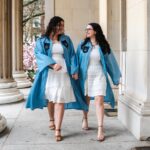
For first cousins Adeena Bromberg-Seltzer and Reena Bromberg-Gaber, attending JTS isn’t just about academics; it’s about legacy. Both recent graduates from List College, they represent the third generation in their family to walk JTS’s halls, daven in its minyanim, and wrestle with its texts. Their parents met here, studied here, and built their lives around the Jewish education they received. Now, Adeena and Reena are building their own identities within the same institution, even as they forge new professional paths. Their story is one of continuity, friendship, and the changing face of JTS from one generation to the next.
Reena’s parents, Sharon Bromberg and Aaron Gaber, met during their freshman orientation and graduated from JTS together in 1991. Aaron Gaber was ordained in 1996 and served as a pulpit rabbi for over two decades, while Sharon Bromberg mother pursued Jewish education and now works as a hospice chaplain. Her brother, Ben, also graduated from JTS, majoring in architecture and Midrash before going on to Harvard for graduate studies.
Adeena’s parents, Deborah Bromberg and Bruce Seltzer, met through Ramah. Her mother graduated from Barnard/JTS in 1995 and completed a master’s degree in Jewish education in 1996, while her father was ordained at JTS in 2000. Both cousins grew up surrounded by Jewish professionals, camp culture, and dinner-table Torah. Adeena and Reena were deeply connected to JTS before they even applied.
Though their family roots at JTS run deep, Adeena and Reena each chose List for different reasons. For Adeena, JTS was always on her radar. “In fifth grade, my mom told me this was where I would want to go to college,” she recalls, “and I really believed her.” Rather than feeling pressured, she felt like it was a perfect fit. Adeena sought a school that combined her passions for architecture and Jewish learning, and Barnard/JTS offered a rare intersection of both. She trusted her parents’ sense that she would thrive here, and she has.
Reena’s path was shaped more by observation than direction. Watching her parents’ lifelong friendships from JTS, and seeing her brother remain close with his college friends showed her the power of the community. “I grew up with JTS,” she says. “They didn’t really need to convince me.” While Reena didn’t plan on becoming a Jewish professional, she knew she wanted a college experience that valued Jewish identity as deeply as she did.
As children of alumni, Adeena and Reena are uniquely positioned to observe how JTS has evolved and what has stayed the same. The physical campus may look sleeker, but that shift has also changed the culture. “The dorms were totally different,” Reena notes, referring to the suite-style housing that JTS students had in Goldsmith (now Barnard’s 121 dorm). “Everyone used to live on campus all four years. It really fostered a tight-knit community.” Today, many students live off campus or in different housing styles, creating a more dispersed social scene.
Both cousins highlighted the loss of some communal rituals that once defined student life; the Beit Midrash as a social hub, or Shabbat davening next to professors, used to create informal mentorship. Instead, the Kraft Center is a primary home for undergraduate Jewish life, replacing a purpose that JTS used to serve in a more all-encompassing way.
But not all has changed. “The jokes in my parents’ yearbook? Same exact humor as my friends now,” Reena laughs. And in some ways, JTS has expanded its inclusivity. “Queer culture didn’t exist on campus for our parents,” Adeena says. “Now it’s a visible and vital part of community life.”
While their parents entered JTS on paths toward Jewish professional life, Adeena and Reena are forging different routes that reflect their own interests, but still draw deeply from their Jewish education.
Adeena is majoring in Architecture and Jewish Gender and Women’s Studies (JGW), a combination that may seem unexpected but makes perfect sense to her. “I love architecture, and JGW felt like the coolest, most distinctive thing I could do,” she said. Reena, meanwhile, studied Sociology and Bible, with hopes of pursuing journalism. “I’m interested in telling people’s stories,” she explained, noting that Columbia’s lack of an undergraduate journalism program nudged her toward sociology as the next best fit.
Though neither plans to become a rabbi or educator, both view their JTS education as formative. “JTS has given me the confidence to walk into any Jewish space and feel like I belong,” Adeena shared. Reena agreed, emphasizing her commitment to being a knowledgeable and engaged Jewish lay leader.
Though Reena and Adeena grew up celebrating holidays together and sharing family stories, attending JTS at the same time has transformed their relationship from childhood cousins into close college friends. “We’ve grown so much closer,” Reena said. “We don’t hang out as much as we’d like to, but honestly, who does in college?”
The two share more than family ties. As first-year students, they were even classmates in a Talmud course, giggling together in the back row and surprising their professor when he realized they were related. They’re often mistaken for each other on campus, and occasionally fall into each other’s social circles, but they also maintain distinct identities and friend groups.
“We’re cousins, but we’re also friends,” Adeena said. “That’s really cool.” In moments of stress, celebration, or family news, having someone nearby who knows your world has been both comforting and grounding.
For both Adeena and Reena, attending JTS comes with a sense of pride and also complexity. They carry family stories, expectations, and institutional memories that many of their classmates do not. “I feel like I’m carrying on a family legacy,” Adeena said, “and I think my parents are really proud of me for being here.” At the same time, she’s aware that the institution she inherited isn’t the one her parents knew. “I feel nostalgia for a JTS I didn’t experience,” she added.
Reena frames the legacy more inwardly. “I’m a third-generation JTS student. That’s important to our family. Who my parents are—who I am—is shaped by this place.” While they are choosing different paths than their families, both cousins see themselves as part of something enduring. Whether through ritual, relationships, or learning, they’re leaving their own imprint on an institution that has long shaped their family’s Jewish identity.


