From the Associate Dean
I welcome you to the fall 2024 issue of Gleanings, a publication of The William Davidson Graduate School of Jewish Education. The issue, focusing on “Learning on the Move” comes out while times are still difficult. We are dealing with losses and sorrows and facing many challenges here in our country and in Israel. Notwithstanding, learning from professionals in the field, we need to provide our learners the education they deserve, and we need to practice it the best way we can, with joy, movement, and creativity.
For this issue, we approached educators whose thoughtful and innovative initiatives inspire, educate, and support learners at all stages–early childhood, elementary school, teens, and adults—and in diverse settings such as camp, schools, and universities. We seek to highlight their knowledge and understanding of how they provide their learners (and themselves) with opportunities to learn by moving and using their bodies. Highlighting dance and movement, we are profiling four educators, three of whom are Davidson alumni. We invite you to read more about Amy Kalmanofsky, professor of Bible and dean of both Albert A. List College of Jewish Studies and the Gershon Kekst Graduate School; Rabbi Ami Hersh, who received a Davidson MA a year after ordination; Eva Bogomolny Kaufman, whose MA concentrated in special education; and Sammie Brenner, a graduate of the Hitlamdut Fellowship.
My own educational career began when I was seventeen and was entrusted by my dance teacher with a group of sweet young children whom I taught literacy through movement. My last teaching dance experience occurred just before I joined the ranks of JTS and the Davidson School, teaching interpretation of Bible through dance at the Revivim educational program for advanced students at the Hebrew University in Jerusalem.
The picture below is an example of a dance phrase created by students expressing their interpretation of Genesis 4:9-10 culminating with “What have you done? Hark, your brother’s blood cries out to me from the ground.” Stance, movement, use of space are all elements that contribute to the interpretation.
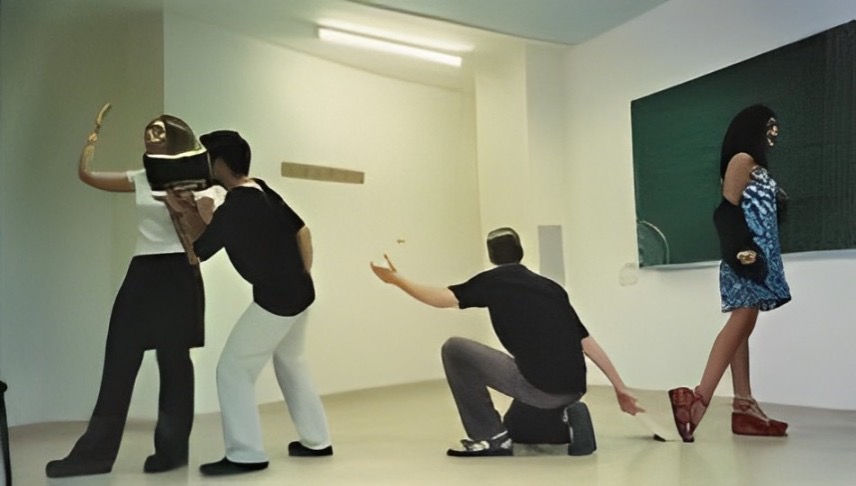
Movement is a powerful way to teach, learn, and innovate and engages skills such as discipline, skill, and stamina. In this kind of holistic educational mode, we think about the body, content, and aesthetic expression. Whether the subject is Bible or reading, math or Hebrew, involving the body and recognizing that moving helps embody the learning and make it everlasting helps us and our learners to create a deep, meaningful, and engaging learning environment.
Especially in this difficult time, amid the trauma of war and personal losses, educators face challenging time. We need all the support and compassion we can get. Taking care of our bodies and souls can help to relieve some of the stress we all feel, consequently helping our learners. We hope you will find this issue interesting and helpful in your own practice.
We send our thoughts to the people who lost their dear ones and to the families of all who have suffered. As we write this in November, we still pray for the hostages’ return to safety and to the land of Israel and safety to all who dwell there.
On a personal note, I wish you, your families, and friends strength as we all hope for calmer and more peaceful days.
Ofra Arieli Backenroth
Associate Dean, William Davidson Graduate School of Jewish Education