
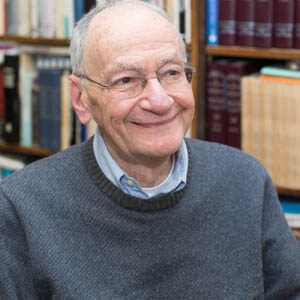
Isaiah Berlin and Kant
Oct 21, 1995 By Ismar Schorsch | Commentary | Bereishit
I like Isaiah Berlin’s favorite quotation from Kant: “Out of timber so crooked as that from which man is made nothing entirely straight can be built.”
Read More
A New Purpose to the Creation Story
Oct 12, 1996 By Ismar Schorsch | Commentary | Bereishit
It happens every year: A fresh, slow reading of the Torah brings to light things I had not noticed before. Like Hagar lost in the wilderness with her son Ishmael, I failed to see the well which had always been there till God opened my eyes (Genesis 21:19). No chapter of the Torah is more familiar to me than the first, with its compressed and majestic story of the creation of the world. And yet here I sit astir with insights that eluded me till now.
Read More
The Day Begins with Night
Oct 25, 1997 By Ismar Schorsch | Commentary | Bereishit
The Mishna, Judaism’s first legal compendium after the Bible, opens with a treatment of the proper times to recite the Shema in the evening and in the morning. The first line reads: “From when to when do we [liturgically] read the Shema in the evening.” The ensuing discussion in the Gemara (Mishna + Gemara = Talmud) asks why the Mishna doesn’t first take up the morning Shema. Since the day starts in the morning, wouldn’t this be the logical place to start? The answer of the Gemara is brief and far-reaching. The Mishna follows the order of creation. Six times the opening chapter of the Torah repeats the poetic refrain, “And there was evening and there was morning,” to signal the completion of a divine day’s work. The Torah seems to be going out of its way to establish the fact that the day does not begin with the crack of dawn, but rather with the setting of the sun (or halakhicly, with the appearance of three stars).
Read More
Between Moses and Genesis
Oct 17, 1998 By Ismar Schorsch | Commentary | Bereishit
For the rabbis, the gap between the death of Moses at the end of the Torah and the creation of Adam and Eve at the beginning is bridged by divine compassion. The Torah closes as it opens, with an act of kindness, in order to establish the doing of good deeds (gemilut hasadim) as the supreme value of Judaism. Our exemplar is none other than God, who in each instance is moved by human plight.
Read More
Genesis As Hindsight
Oct 9, 1999 By Ismar Schorsch | Commentary | Bereishit
The opening chapter of a book is often the last to be written. At the outset, the author may still lack a clear vision of the whole. Writing is the final stage of thinking, and many a change in order, emphasis, and interpretation is the product of wrestling with an unruly body of material. Only after all is in place does it become apparent what kind of introduction the work calls for.
Read More
The Genome Project
Oct 28, 2000 By Ismar Schorsch | Commentary | Bereishit
The genome project holds out the promise to alleviate some social as well as physical ills. This past summer the New York Times ran a long article in its weekly Science section (my favorite) to the effect that the noxious concept of race has no genetic foundation. Caucasians, Africans and Asians are genetically indistinguishable No more than .01 percent of our gene pool determines our external appearance, the basis on which we make racial distinctions. In contrast, many thousands of our 80,000 genes combine to produce such traits as intelligence, artistic talents and social skills.
Read More
The Conversion Controversy
Oct 5, 2002 By Ismar Schorsch | Commentary | Bereishit
Conversion is back in the news. During the High-Holy-Day period just ended, a Conservative rabbinic court in Eastern Europe completed the conversion process of eighteen Czech and nineteen Polish converts to Judaism. Some 80 per cent had Jewish roots. All studied formally for at least a full year (many more) and were obliged to be active in their respective Jewish communities. Prior to conversion, the men underwent either a full or symbolic ritual circumcision (if already circumcised), while both men and women went through ritual immersion. Another half-dozen in Prague are on their way to completing the conversion process.
Read More
The Garments of Adam and Eve
Oct 25, 2003 By Ismar Schorsch | Commentary | Bereishit
When Franz Rosenzweig published his unconventional German translation of ninety-two Hebrew poems by Judah Halevi, he headed his afterword self-effacingly with a plea from a German translator of The Iliad: “Oh dear reader, learn Greek and throw my translation into the fire.”
Read More

