Your People Shall Be My People: Conversion to Judaism Through the Centuries
Date: Jan 21, 2026
Time: 5:30 pm - 7:00 pm
Sponsor: The Library
Category: Library Events Visit Library Exhibits
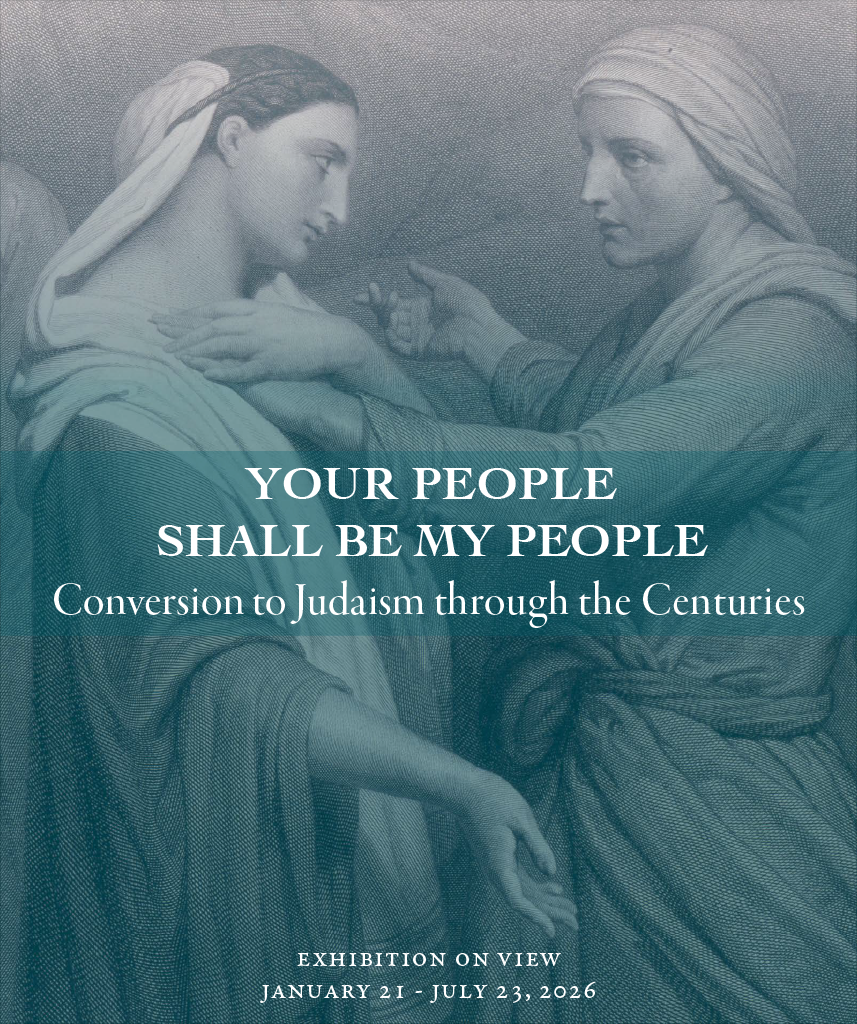
Opening Event: Your People Shall Be My People: Conversion to Judaism Through the Centuries
Wednesday, January 21, 2026, at 5:30 p.m. ET
In Person at JTS or livestream
3080 Broadway (at 122nd Street)
New York City

Join us at the opening event for Your People Shall Be My People: Conversion to Judaism through the Centuries. We’ll hear from Miriam Bodian, Professor of History Emerita, University of Texas at Austin, and author of the just-released book Conversion (Rutgers U. Press, Keywords in Jewish Studies series). She will present, “Who Became a Jew?: Jewish Conversion in Historical Perspective.” This new exhibit features manuscripts, rare books, and other items illustrating some of the changes and continuities over time in the understanding and practice of conversion to Judaism.
About the Exhibit
Throughout Jewish history, from biblical times to the present, non-Jews have joined the Jewish people. How they have done so, however, has differed greatly from one historical context to another. Changing conditions of Jewish life have led to striking variations both in the motivations of converts and in the requirements for their formal acceptance as Jews. Yet some features of conversion to Judaism, or giyyur (in rabbinic terms), have been remarkably stable over the long period since rabbinic law became normative throughout the Jewish diaspora.
A major element of giyyur that distinguishes it from conversion in other cultures is its dual nature: the convert not only adopts a religious practice but joins a people. This duality is famously expressed by Ruth the Moabite, the biblical figure most closely associated with Jewish conversion, when she declares that “your people shall be my people, and your God shall be my God” (Ruth 1:16). Contrary to popular assumptions, however, the Hebrew Bible lacks a concept of conversion. The biblical “ger” was not a convert either in an ethnic or religious sense but was rather a foreigner living among Jews. It was only in late antiquity that the rabbis of the Talmud articulated the process of conversion they called giyyur. Over the centuries, rabbinic authorities have produced a rich and varied literature dealing with novel issues raised by specific cases or by changing social realities. Other sources – among them Geniza documents, ketubbot (marriage contracts), autobiographical accounts, and chronicles – throw light on historical trends and on the lives of individual converts.