
A Knife Raised, a Page Left Blank
Posted on
Reflections on the Akedah and a Woodcut in The JTS Library
The Akedah
Marcus Mordecai Schwartz, Ripps Schnitzer Librarian for Special Collections; Assistant Professor, Talmud and Rabbinics
The most terrifying moment in the Binding of Isaac comes just before it ends. Abraham has built the altar. He has bound his son. He has lifted the knife. And then—suddenly—a voice from heaven calls, “Do not stretch your hand against the boy. Do nothing to him.”
The Akedah stands at the heart of Rosh Hashanah, not only as story but as liturgy. In the Zikhronot section of the Musaf service, we remind God not of Abraham’s belief, but of his submission—his impossible willingness to sublimate paternal love and fulfill a terrible command. We ask God to do the same: to sublimate divine anger, to restrain the strict demands of justice, to turn away from what is deserved and toward what is merciful. Abraham turned from love to duty. We ask God to turn from judgment to compassion.
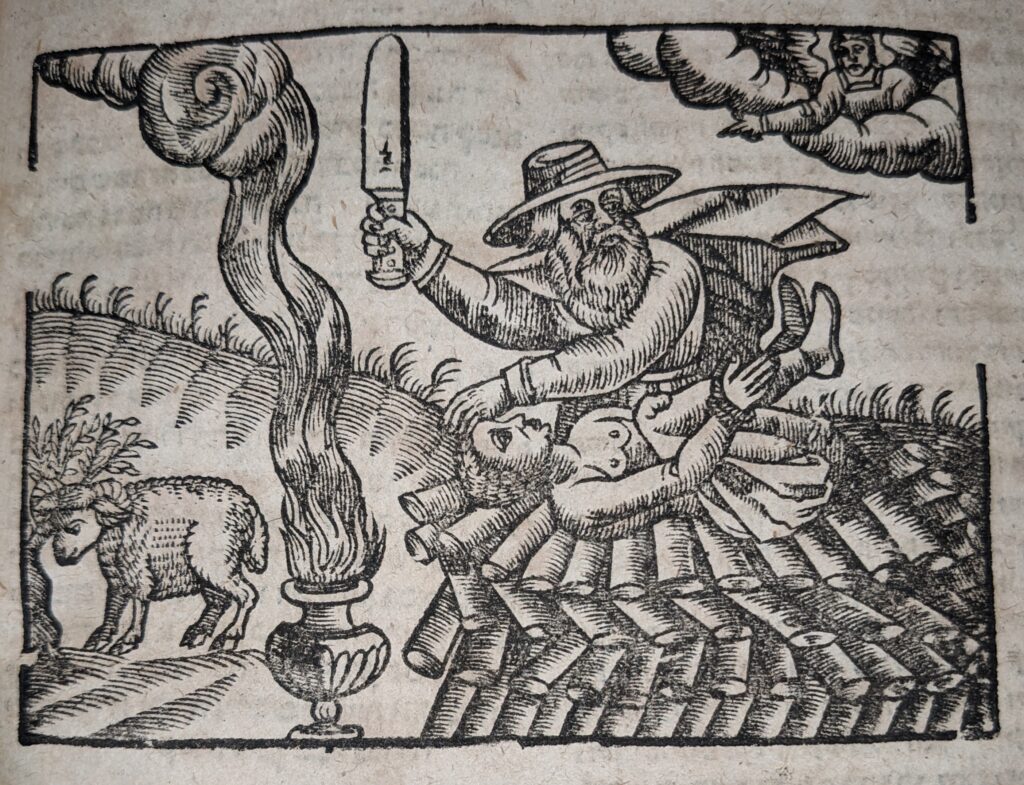
At The JTS Library, a rare woodcut of the Akedah is tucked into a 17th-century volume of Seder Kodashim. It appears not in a prayer book or Bible, but between two Talmudic tractates on Temple offerings—Zevahim and Menahot. It fills what would otherwise be a blank page, a silence in the structure of the book. On the left side of the image, a ram is caught in the thicket. On the right, Abraham stands over Isaac, knife raised. Smoke rises toward heaven. And in the upper corner, an angel leans out of a cloud.
The artist meant to draw logs beneath the altar—fuel for a burnt offering. But they resemble the pages of a book. Perhaps that’s coincidence. Perhaps not. Books, after all, are made from wood. And sometimes they are burned. In rabbinic memory, Rabbi Ḥanina ben Teradyon was wrapped in a Torah scroll and set alight. As the flames rose, his students asked him what he saw. He said, “The parchment burns, but the letters fly upward.”
Isaac was spared; Rabbi Ḥanina was not. The olah (burnt offering) is not always interrupted. The Greek word holocaustos—consistently chosen by Septuagint to translate olah—means “wholly consumed.” Rosh Hashanah asks us to remember a sacrifice that did not happen and to draw merit from the willingness nonetheless. Abraham offered more than faith. Isaac offered more than submission. They offered the human will—restrained, terrible, and transcendent.
When we open the book to that old woodcut, we see wood shaped like pages, fire shaped like prayer, and memory shaped like mercy. The knife is raised. The angel speaks. The sacrifice is paused—but not forgotten.


