
Transformative Learning for Teachers
Research alongside practice has driven the course of Lauren Applebaum’s career in Jewish education, making her decision to enroll in the William Davidson Executive Doctoral Program a natural one. Her doctoral research on how adult teachers learn continues to influence her work as she recruits and trains future educators.
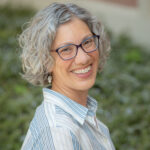
“Even if you create the best possible environment for teachers to learn, teaching is an incredibly complex set of skills and habits of mind to develop,” said Lauren Applebaum, who was one of the first three graduates of The William Davidson School of Jewish Education’s Executive Doctoral Program. Nine years after completing her doctorate, she is still passionate about the same question: how do teachers learn? Answering that perennial question calls on Applebaum as both a practitioner and researcher.
Applebaum is the director of DeLeT programs at Hebrew Union College-Jewish Institute of Religion in Los Angeles and was recently named interim director of the School of Education there. DeLeT recruits and trains future Jewish day school educators. Along with her colleague and noted Israel educator Sivan Zakkai, she also leads “Learning and Teaching About What Matters,” a national study of 4th and 5th graders in both supplemental and Jewish day school. The study explores how contemporary children make sense of these extraordinary times and how their educators make sense of what it means to teach in them.
A career in Jewish education was not what Applebaum envisioned after graduating from Williams College and starting her first job in education reform in Boston Public Schools. At Williams, which did not have a formal Hillel at the time, students did everything themselves to live Jewishly, and Applebaum got highly invested in a type of “scrappy, DIY” Jewish life. After graduation, when she learned about Kesher, an alternative model to Jewish afterschool programming in the Boston suburbs, it spoke to her, and she took a job there as an educator and even worked as the bookkeeper to earn a bit more money.
“Kesher was an amazing, radical experiment in audacious Jewish education,” Applebaum recalled. “They took professional learning for teachers as seriously as they did for kids.” The staff arrived at Kesher at 1:00 p.m., considerably earlier than the children, in order to allow time for teachers to connect and plan together. “At Kesher they were incredibly ambitious and not bound by institutional definitions of Jewish education,” she said. “That’s what hooked me.” Many of Applebaum’s colleagues at Kesher have gone on to illustrious careers in Jewish education. “It was a kind of laboratory where many leading educators got their start,” she said.
While teaching at Kesher, Applebaum participated in the Mandel Teacher Educator Institute (MTEI), a two-year long “train the trainers” program dedicated to a sustained approach to professional development for Jewish educators. She also completed an EdM at Harvard. Dedicated to the deep relationship between practice and research, Applebaum felt it was important to pursue advanced work in education at the same time as she was working in education, and she secured special permission from Harvard to complete the EdM part-time.
“A lot of the research I am doing now goes back to the basement of Kesher, where teachers together worked to improve their practice,” Applebaum said. “I loved working with kids, but my real talent was working with teachers.” Applebaum has deep empathy and admiration for teachers who expose themselves regularly to the challenges of the classroom and engage in their own complex learning process. “Teaching in an ever-evolving puzzle, and you never have one ‘aha’ moment that means you are done learning the craft.”
Life brought Applebaum to Los Angeles for what she expected would be a year or two, and she took a consulting position providing internal professional development for teachers at Valley Beth Shalom alongside teaching pedagogy and supervising fieldwork for students at what was then called the University of Judaism (now American Jewish University). Over time, she became associate dean of the education program there.
The draw of research alongside practice has continued to fuel Applebaum’s career, and she decided to pursue her doctorate in the Executive Doctoral Program at Davidson in order to gain the skills needed for rigorous research. “I never wanted a purely academic career, but I really wanted serious academic training, and I was fortunate to have the flexibility to be able to balance my professional responsibilities at that time.”
Applebaum was in the second cohort of the executive EdD. She entered the program with a firm idea of her dissertation research question—how adult teachers learn—and along with the immersive time she spent learning with her cohort at JTS, she was able to take some courses towards her degree in person at AJU and online through Teachers College. Applebaum started the EdD program when pregnant with her son and defended her dissertation in 2015 just after his fourth birthday party.
Reflecting on her own learning in the program, Applebaum was inspired by the different perspectives she gained from her “smart, capable cohort,” and recalled learning to practice ethnographic notetaking at Starbucks under the guidance of Meredith Katz. In her dissertation research, Jeffrey Kress provided deep support as her advisor and connected her to outside reader and advisor Miriam Raider Roth of the University of Cincinnati who specializes in action research and educator learning.
Applebaum titled her dissertation “When You Change Me You Change What I Do: Challenges and Possibilities in Transformative Learning for Teachers.” Her research focused on teachers engaged in Israel education, which even before October 7 was “as complicated as it gets,” she said. For Applebaum, her research method and approach is designed to connect more to the teachers themselves than the subject matter or content they are teaching. In this way, her ongoing research has relevance across educational settings and content areas.
“I can’t do what they’re doing,” Applebaum said about the teachers she studies, such as early childhood or Israel educators. “My part is to help them.” Applebaum called it “the privilege of her career to accompany teachers in their work.”
“Putting the voices of teachers at the center of the conversation is a powerful way to strengthen Jewish education,” said Applebaum. “When we listen to the learners—even the adult learners—we can figure out what we really need.”
Throughout her career, whether training emerging teachers in DeLeT or publishing articles on how preschoolers understand Israel, Applebaum embraces the relationship between research and practice. “Research makes practice better, and practice should make research better,” she said.


